Forest fires are no longer isolated phenomena or typical of remote regions: they have become a global threat that puts human lives, ecosystems and entire cities at risk.
By Jaime A. Moncada*
In January 2025, two huge wildfires, in Palisades and Eaton, in Los Angeles County, California, USA, affected large residential areas. These fires were driven by so-called Santa Ana winds, winds with seasonal fluctuations and katabatic characteristics that are typical of Southern California climate. These fires occurred in forests that were in extremely dry conditions and were fanned by hurricane-force wind gusts of more than 100 km/h. The fires moved voraciously over residential neighborhoods, built more than a century ago, embedded in these forests. The result was 29 deaths, the evacuation of 200,000 people, the destruction of more than 18,000 structures and the burning of approximately 230 km².
You may ask: how is it possible that this can happen in one of the most affluent places in the world? Or why, with the immense resources that a city like Los Angeles has, could these fires not be controlled quickly? Or why some houses survived the fire, while most of the structures around them were burned? I will then try to clarify these questions in this article.
Climate change
Southern California's fires are by no means isolated. The climate change that is happening globally has affected communities around the world. In Latin America, perhaps the most important forest fire in recent times occurred in Bolivia in 2010, when 25,000 different fires burned 15,000 km². Recently, major wildfires have occurred in Argentina, Brazil, Colombia, and Chile. Perhaps the most shocking fire worldwide occurred between 2019 and 2020 in Australia, where 34 people died and another 445 later died from inhalation, burning 343,000 km².
Wildfire researchers have concluded that climate change has increased the risk of wildfires by making weather conditions warmer, drier and more susceptible to a heat source. This includes longer fire seasons, more frequent and severe wildfires, and larger burned areas.
Extinction strategy
The expectation in most large wildfires is not to extinguish the fire, but to contain it. Although water is used to extinguish small and incipient fires, if the fire cannot be extinguished in the first hours, the strategy changes to seeking containment. Firefighters are working along the edges of the fire, seeking to reduce its spread and thus control the front of the fire. One of the first strategies is to build a fire line , that is, a break between the fuel (vegetation) and the source of ignition (the forest fire). This break is created by removing all vegetation down to mineral soil or rock, using digging tools, or with a "burn out" that removes the fuel before the wildfire can ignite it.
Extinguishing forest fires
When the forest fire is large, planes or helicopters that drop fire retardants are used to slow down the fire and inhibit combustion. It is important to understand that these chemicals are retardants, rather than fire suppression products. The most well-known retardant is called Phos-Check , an aqueous solution of ammonium phosphates and sulfates. This retardant reacts with and alters the decomposition of shrubs and grasslands, so that, when used in the recommended mix ratio, it does not allow fuels to emit flames or incandescent combustion. This retardant is manufactured as a powder or as a concentrated liquid, which is diluted with water before use, in a ratio of 1 to 8.4 (water retardant). This chemical is typically red in color, which helps aircraft crews identify the area where the retardant has already been applied. The color gradually fades to an earth tone when exposed to sunlight. In addition, the remaining retardant has fertilizing functions. Unfortunately, it has been found that this type of retardant can pollute rivers and lakes, affecting marine life.
In the attached photos you can see a Boeing 747, called in forest extinction jargon as the "Global Supertanker", as it is the largest aircraft used in forest firefighting. This aircraft can apply the retardant on the fire interface using a pressurized system that allows more than 70 tons of retardant to be unloaded in less than 10 seconds.
Wildfire Resistant Homes
Wildfire Resistant Homes – The topic of wildfires is of great personal interest. I have been living with my family for 15 years in a house that is located at the interface with a forest, as shown in the attached photo taken last winter. When we built this home, we made the decision to protect it internally with automatic sprinkler systems, in addition to the smoke alarms required by local regulations. But it was also of great concern to me, during its construction, the fact that the house was located at the urban interface with a forest.
But the builder explained to me that my house would comply with the current legislation in this regard. The building code in the U.S., the International Building Code (IBC), requires by reference the International Wildland-Urban Interface Code (IWUIC). The IWUIC establishes the severity of fire risk by assessing both the critical weather frequency of fire (FMCI) and the level of combustibility of the forest (NCB). FMCI is a set of weather conditions (usually a combination of low relative humidity and strong winds) whose effects on fire behavior make it difficult to control and threaten the safety of firefighters. The NCB refers to the type of vegetation, its density, accumulation of leaf litter, the amount of woody material felled and the size of the wood trunks in the forest.
For my house, for example, the FMCI is less than 1 day a year, because where I live the relative humidity is never less than 15% when there can be winds with a speed greater than 40 km/h. The NCB was determined to be that of a forest of abundant combustibility.
After other considerations that IWUIC has, my house must have a class 2 (IR2) type of ignition-resistant construction. The IR2 construction includes, among other requirements, that the roof must be rated B and constructed so that embers from a wildfire cannot accumulate between the eaves or protrusions of the roof. Also, the exterior walls must be 1 hour fire resistant or non-combustible construction. Additionally, the distance between the residence and the interface with the forest must be equal to or greater than 9.1 m. I should clarify that these requirements are specific to my residency.
Other Considerations
According to NFPA analyses, it is critically important to meet IWUIC requirements. California, for example, has required this code in new construction since 2008. Not only is it required there, but structures in high-risk areas are inspected by the local authority. However, this code is not retroactive, and it is important to understand that the vast majority of structures that caught fire in the Pasadena and Eaton fires were built before 1939.
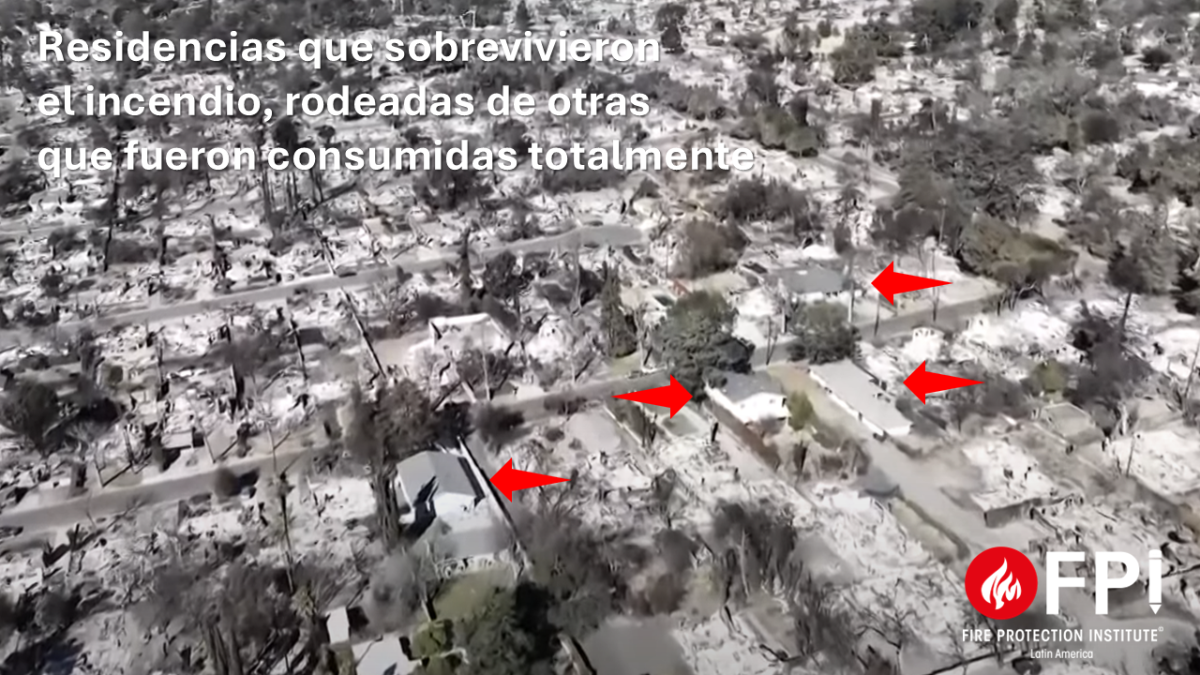
Wildfire analyses point to embers as the main way most homes ignite. It's not just the house at the interface with the forest that burns, but rather the embers, those burning pieces of wood and/or vegetation, that can travel through the air more than a kilometer away through the wind, and can cause spot fires and set fire to other homes at considerable distances from the wildfire. In the attached photo you can see how, in the Eaton fire, several newly built houses survived, while residences built before 2008 were destroyed by the fire.
Municipal water networks: In the Southern California fires, questions were raised as to why firefighters couldn't get water from street hydrants. The reality is that the municipal water network, no matter what city we are talking about, is not designed to fight fires in hundreds of structures simultaneously for days. At some point, the network is going to run out of water.
NFPA 1, for example, requires municipal networks in residential neighborhoods, where homes do not exceed a built-up area of 465 m², to have a fire water flow of 1000 gpm (3785 lpm) for 60 minutes. This standard does not assume simultaneous fires. It is obvious that, in a forest fire of large magnitude, the municipal network would be insufficient.