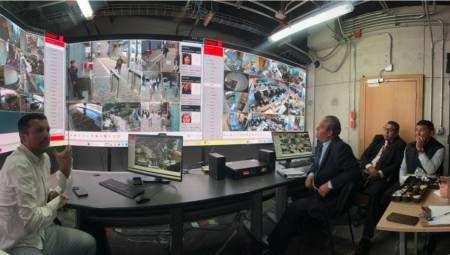
Video surveillance is evolving thanks to advances in artificial intelligence and deep learning. The cameras not only capture images, but also examine information and react independently, increasing security in high-risk areas.
By Andrea Ochoa Restrepo
Video surveillance is no longer a passive observation system. With advances in artificial intelligence (AI), edge learning, and cloud connectivity, video security has become a strategic data pillar with the ability to prevent incidents, improve procedures, and respond in real time. This transformation has a significant effect on highly complex industrial areas, such as refineries, chemical plants or devices that handle sensitive materials, where every moment is crucial and every failure can trigger serious repercussions.
The progress of deep learning-based technologies has made it easier for cameras to not only observe; also analyze, understand, and react. Built-in intelligent algorithms allow these devices to make split-second decisions and trigger automatic actions without human intervention. "It's not just a camera that observes what happens and that someone will see one day; it becomes an active element that can prevent a possible accident or workplace incident," says Luis E. Bonilla, a specialist at Axis Communications, a pioneering company in intelligent video security solutions.
This technological progress transforms cameras into distributed sensors that drive more informed operating strategies. "Video surveillance becomes a permanent source of valuable information to optimize processes, reduce risks and make more informed decisions," says Néstor Murillo, global solutions engineer at Verkada.
Intelligence for classified areas
In categorized areas, where the environment is at risk due to the existence of gases, dusts, or explosive materials, artificial intelligence makes it possible for cameras to perform previously unimaginable functions. Accredited models such as Class 1 Division 1 or Class 2 Division 2 not only withstand extreme situations, but also include cognitive skills to understand what they perceive and act accordingly.
Its functions include the automatic identification of individuals in limited areas, the real-time verification of the correct use of personal protective equipment (PPE), the detection of smoke, flames or spills through computer vision and the issuance of sound alerts through built-in IP speakers. In an environment such as a petrochemical plant, a camera can detect an operator without a helmet or safety goggles and issue a voice message, as well as alert the supervisor. "I avoid an accident, a plant stoppage and, most importantly, I protect lives," Bonilla emphasizes.
Edge Processing and Cybersecurity
One of the most relevant developments is online live processing. By performing operations directly on the camera, latency and bandwidth consumption are reduced, and cybersecurity conditions are strengthened by handling metadata instead of raw video. Axis Communications has developed its own line of processors specializing in deep learning, which triples the analysis capacity compared to previous generations. "Today, 100% of Axis' new portfolio already incorporates artificial intelligence at the base. This allows us to customize each chamber according to the needs of the environment, whether to detect leaks, analyze thermal patterns or generate operational statistics," says Bonilla.
The strategic value of the cloud
At Verkada, video security is conceived as part of a comprehensive digital infrastructure. Using cloud-native platforms, the company has integrated cameras, environmental sensors, access controls, and alarm systems into a single operating environment. This allows you to manage security from anywhere, scale operations without the need for additional infrastructure, and reduce costs in the long run. "Many times what makes a system more expensive is not its initial price, but the hidden expenses derived from obsolete architectures," explains Murillo.
Hardware Innovation: Rugged Cameras and Visual Thermometry
In addition, innovation is evident in recent camera models intended for risk areas. Axis has recently launched Class 2 Division 2 certified cameras, which are more accessible and suitable for operation in secondary risk areas. They conform to ATEX regulations in Europe and certifications in the Americas, fusing cutting-edge optics with solid housings.
In addition, devices with visual thermometry skills are emerging, which make it possible to measure temperature in real time and detect thermal irregularities before breakdowns occur. Certified PTZ models and compact sticker cameras make it easy to meet a variety of needs with precision, from electrical panels to vital valves.
Intelligent audio and response automation
Audio is another essential element. Through IP speakers certified for explosive environments, the cameras have the ability to generate custom alerts independently. This is crucial in contexts where conditions change rapidly. If a system identifies that a worker is not wearing gloves in a critical area, it can trigger an audible alert without having to wait for human intervention. In these situations, response automation makes the distinction between a constant operation or an emergency situation.
Privacy, Ethics & Regulations
The implementation of artificial intelligence in video security also involves ethical considerations. Solutions such as Axis Live Privacy Shield allow the faces captured by cameras to be masked in real time, protecting the identity of workers. "The AI itself allows me to add a layer of privacy. It does not depend on the person who exports the video, but it is an automated process," says Bonilla.
These functions are key to complying with regulations such as the Habeas Data Law in Colombia, the General Data Protection Regulation (GDPR) in Europe, and other global regulations. The protection of privacy is not only a legal duty, but a strategic element of the organization's culture.
Storage and Analytics: Moving Beyond the Video Realm
The role of smart storage has changed dramatically. Platforms such as the Axis Camera Station or Verkada's cloud VMS manage both visual content and metadata, making it easier to automate tasks, create reports, and connect video security with more extensive corporate systems. "The recorder is no longer limited to being a video store, but is an intelligent component of the ecosystem," Bonilla argues.
Applied deep learning: efficiency and automation
Deep learning technology has proven essential to progress in automated video security. Its ability to handle large amounts of information through neural networks facilitates pattern identification, object categorization, face identification, and behavior detection without previously established rules, which reduces errors and boosts efficiency.
For example, Hikvision has integrated this technology into products such as AcuSense, which distinguishes people and vehicles from other moving elements, thus minimizing false alarms. In addition, it offers tools for facial identification and vehicle handling, useful in banks, shopping centers and industrial spaces.
Deep learning and machine learning: key differences
At the core of these technological solutions are two fundamental areas: machine learning and its more sophisticated subfield, deep learning. Despite being intimately linked, they show variations in their operation, degree of human intervention and field of use.As Montserrat Sacie, data scientist at BBVA AI Factory, explains, "deep learning (DL) is a subfield within machine learning (ML), whose architecture is based on more complex neural networks." Daniel González Medina, professor of the Master's Degree in Data Science and Big Data at IEBS, sums it up with a metaphor: AI is a big doll; within it is machine learning, and within this, deep learning, the most specialized of all.
Machine learning focuses on detecting patterns and making projections based on large volumes of data. Instead, deep learning has the ability to understand more complex meanings through artificial neural networks. MIT details: "Neural networks are made up of thousands or even millions of simple, tightly connected processing nodes."
Training and culture: pillars of change
Ultimately, the effective implementation of these solutions is based on correct training and cultural transformation in organizations. Axis and Verkada agree that technology is only one component of the process. "The real challenge lies in how companies adjust, how they incorporate them into their internal processes and how capable they are to take responsibility for their ethical and strategic application," concludes Murillo.In regulated areas, where safety, productivity and the protection of labour rights are intertwined, it is essential to establish links between engineers, operators, managers and suppliers.