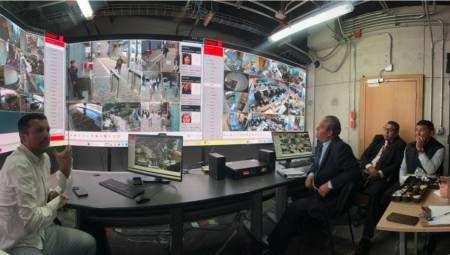

Mexico. At least 12 of the 16 mayor's offices in Mexico City have requested the Center for Command, Control, Computing, Communications and Citizen Contact (C5) to install more video surveillance cameras in their territories, as part of the security strengthening plan promoted by the capital's government.
The demarcations that have already submitted their proposals are Azcapotzalco, Benito Juárez, Coyoacán, Cuauhtémoc, Magdalena Contreras, Iztapalapa, Miguel Hidalgo, Milpa Alta, Tláhuac, Venustiano Carranza, Tlalpan and Cuajimalpa. Each one seeks to expand coverage in areas of high crime incidence or strengthen active sectors in their jurisdictions.
The general coordinator of the C5, Salvador Guerrero Chiprés, explained that the installation of the new devices will be intensified from June and July, once all the applications are received. "Although we are going to start tenuously in April, I believe that the strongest part is going to be June, July, to the extent that by then we hope to have all the proposals and suggestions, so that we can start," he said in an interview.
Currently, a comprehensive analysis is being carried out that includes not only the proposals of the mayors' offices, but also information from citizens through the Zócalo Ciudadano, as well as data from the Secretariat of Citizen Security (SSC) and the Attorney General's Office (FGJ).
Before placing new totems with cameras, the C5 plans to replace 6. 182 units that are about to complete their useful life. Guerrero Chiprés said that the objective is "to meet the goal of reaching a strengthening of around 50% of the current power by the middle of next year."
Currently, the capital's video surveillance system has 83,414 cameras, of which 99% are operational. With the plan announced by the head of government, Clara Brugada, the goal is to close her administration with 150,000 cameras in operation.
In addition to the crime incidence criterion, the deployment of new teams will also focus on areas with a high frequency of traffic accidents, public markets, schools and areas with high demand for emergency services, such as ambulances and firefighters.
Guerrero Chiprés stressed that "the video security of the national capital is seven times greater than any other entity. So the system is already very robust, but the instruction of the head of government is to continue with the strengthening."
Regarding the technology that the new cameras will incorporate, the official avoided giving details, as he pointed out that it is still in the analysis phase.
The C5 projects that, by June 2026 – the date of the start of the FIFA World Cup – Mexico City will have a system with 47% more capacity than the current one. "By June of next year we believe that we can exceed the number of chambers they have in London, which are administered by a government," concluded Guerrero Chiprés.
Mandatory video surveillance proposed in stadiums for the 2026 World Cup
A year before the start of the World Cup in Mexico, the United States and Canada, Deputy Marina Vitela Rodríguez, of the Morena party, presented a proposal to modify the General Law of Physical Culture and Sports. Its objective is to reinforce security measures for those who attend sporting events or shows in the country's stadiums.
The initiative states that the authorities of the three levels of government – federal, state and municipal – as well as the demarcations of Mexico City, must coordinate to implement, on a mandatory basis, wide-ranging video surveillance systems in all public spaces where sports events are held.
"The public has the right to enjoy the stadiums in conditions free of violence. In this sense, video surveillance is a key tool to protect attendees and guarantee order during mass events, by allowing the identification, arrest and punishment of those who engage in criminal behavior," the legislative document states.
The proposal contemplates that the cameras be placed in stands, accesses, service areas and parking lots of sports venues.
It is noted that between 25 thousand and 43 thousand people per event usually congregate in these spaces, although there are venues such as the Azteca Stadium that can accommodate more than 80 thousand attendees. Looking ahead to the 2026 World Cup, it is estimated that this stadium will receive more than 90 thousand people.
According to data from the Mexican Football Federation, in 2024 Liga MX registered an average attendance of 22,893 spectators per game, ranking as the sixth league with the highest influx of spectators worldwide.