Latin America. The Security Industry Association (SIA) published the 2025 Mexican Physical Security Market Assessment, which analyzes the evolution and economic impact of the sector in the country.
"SIA is pleased to present this report, which provides a strong and impactful perspective on Mexico's economic importance, security market growth and prospects for the next three years," said Don Erickson, CEO of SIA. 
Sustained growth and emerging opportunities
Among the study's most notable findings is Mexico's consolidation as Latin America's second-largest market behind only Brazil, with a nominal Gross Domestic Product (GDP) of US$1.89 trillion in 2024, according to data from S&P Global.
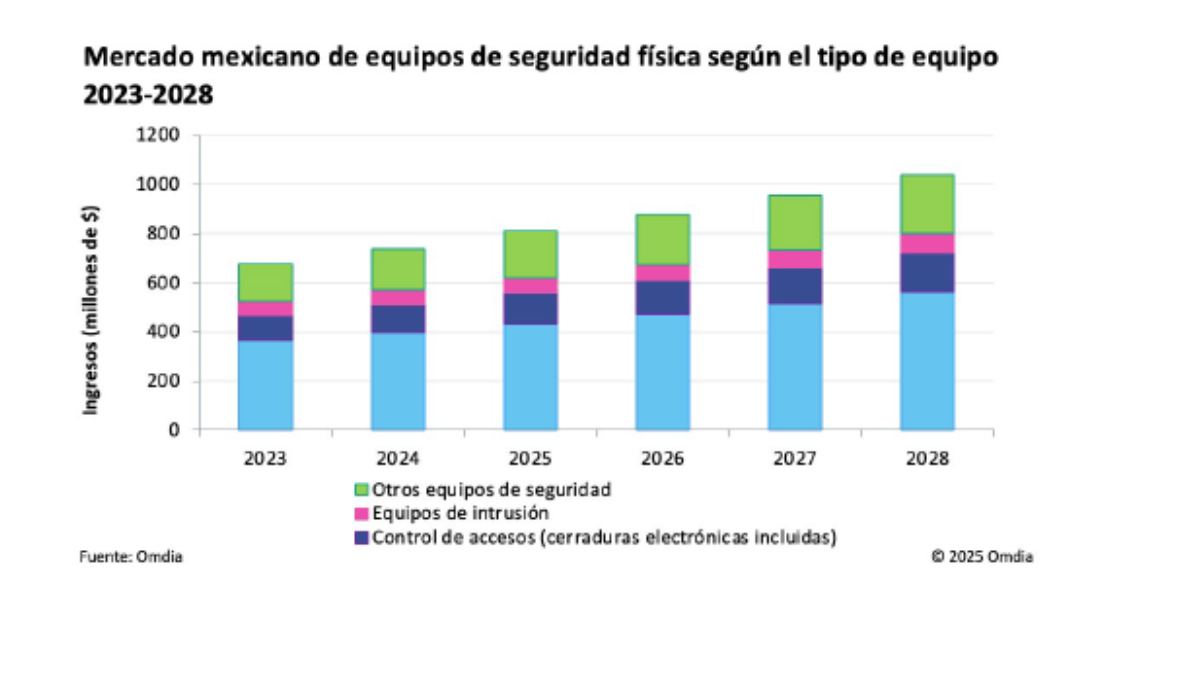
As for the specific physical security market, it is estimated that revenue from equipment sales reached $737 million in 2024, while related services generated $1.117 billion. Both categories have a compound annual growth (CAGR) of 9% and 9.3%, respectively, projected until 2028.
In addition to macroeconomic figures, the report delves into Mexico's strategic position within the continent. The country sits between the United States — its northern neighbor and the world's largest security market — and Latin American countries to the south. This location gives it a unique geopolitical advantage, particularly thanks to the growing trend of nearshoring, which has strengthened the manufacturing base in the northern states of the country.
This proximity has facilitated a greater participation of U.S. companies in the Mexican market, influencing the technical specifications of the products and safety standards, which tend to align with the expectations of the North American end user. However, the report stresses that the Mexican market maintains its own identity as a Latin American market, where personal relationships and trust play a decisive role in purchasing decisions.
"Relationships are often more important than price or product functionality, especially between integrators and end users. Many times, decisions are consolidated in social gatherings or lunches, a practice different from that of the U.S. market," the report states.
This cultural context highlights the importance of having local teams that understand the language, culture, and business dynamics, which is indispensable for any foreign supplier who wants to succeed in Mexico.
Technology and Adoption Challenges
Although Mexico is a robust market, it is not the most advanced in terms of technological adoption within Latin America. Countries such as Chile have an earlier integration of innovative solutions, partly due to government policies. For example, one of the interviewees for the study indicated that 40% of the cameras required in government projects in Brazil included video analytics, while in Mexico the percentage was only 10%.
However, the size of the Mexican market in sectors such as video surveillance, physical access control and intrusion equipment positions it as a space of great value for manufacturers and suppliers of security software and hardware.
Another regional point of contrast is the level of trade openness: while Brazil is more actively protecting its local industry, Mexico maintains a more open policy, which facilitates the entry of foreign companies and encourages broader competition.
"This report offers a comprehensive view of the market, clear data projections and robust regional analysis, identifying opportunities in both the public and private sectors," said Jason de Souza, Genetec's Managing Director for Latin America and the Caribbean and Chair of SIA's International Relations Committee.
"With this study, SIA reaffirms its commitment to the Mexican market, providing essential information so that companies in the sector can prosper and contribute to the security of our country," added Mauricio Swain, Chief Revenue Officer of KABAT Group and Vice Chairman of the same committee.