
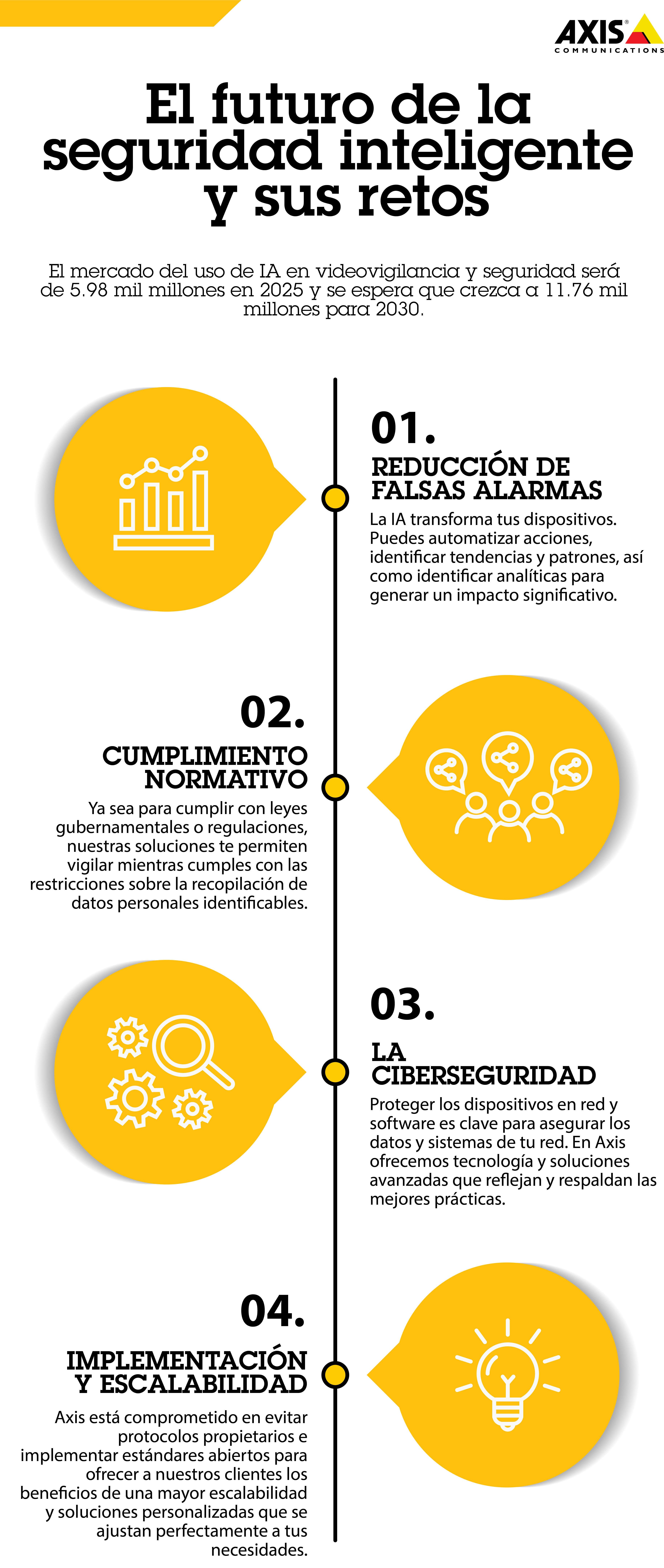
International. Video surveillance has evolved significantly with the integration of artificial intelligence, becoming a proactive and predictive tool in the field of security. According to the study "Analysis of AI in Video Surveillance Market Size and Share: Growth Trends and Forecasts (2025-2030)," the AI in video surveillance market size is estimated to be USD 5.98 billion in 2025 and is expected to reach USD 11.76 billion by 2030.
By Denith Garcia
The combination of AI and security devices enables advanced analysis of different scenarios in real-time, reducing false alarms and improving the detection of relevant events. However, the implementation of these technologies faces various challenges, from privacy and cybersecurity to scalability and cost.
 Reduced false alarms
One of the main challenges of AI video surveillance is the reduction of false alarms. Traditional security systems generated multiple unnecessary alerts due to environmental factors such as the movement of plants, animals or adverse weather conditions. AI has made it possible to improve the accuracy of analysis through the use of advanced facial recognition, behavioral analysis, and object classification algorithms. In addition, the incorporation of thermal cameras and radar sensors has optimised detection in environments with poor visibility or extreme weather conditions, increasing the effectiveness of security systems.
Compliance
Another major challenge is privacy and compliance. The ability of AI video surveillance systems to identify and track people has raised legal and ethical concerns. Regulations such as the General Data Protection Regulation (GDPR) in Europe and similar laws in other regions require companies to take measures to ensure data privacy. Implementing techniques such as image anonymity and data encryption is critical to balancing security with protecting individual rights. Likewise, the development of solutions that allow users to control access to their information is a growing trend in the industry.
Cybersecurity
Cybersecurity is another critical aspect of AI video surveillance. Network-connected systems can be vulnerable to cyberattacks, putting data integrity and facility security at risk. To mitigate these risks, it is essential to implement advanced security protocols, such as multi-factor authentication, end-to-end encryption, and regular software updates. In addition, the adoption of edge systems that process data on the device reduces exposure to external threats and improves response speed.
Deployment and scalability
Finally, the cost of implementation and scalability represent barriers for multiple end users. While AI video surveillance solutions have proven to be highly effective, their adoption remains limited due to a misperception of high acquisition and infrastructure costs. However, advances in hardware and software are allowing the development of more accessible and modular solutions, which can be progressively integrated according to the needs and budget of each organization. Optimizing return on investment (ROI) through systems that not only detect threats, but also generate automated responses, is key to investing in AI video surveillance.
Thus, the integration of artificial intelligence in video surveillance has revolutionized the security sector, offering more efficient and accurate solutions. However, it is critical to address challenges related to privacy, cybersecurity, false alarm reduction, and scalability to ensure responsible and effective use of this technology. As AI continues to evolve, video surveillance systems are expected to become increasingly intelligent, autonomous and accessible, consolidating themselves as a key tool for security in urban, industrial and commercial environments.
*Denith García, Inside Sales Manager for Latin America at Axis Communications.