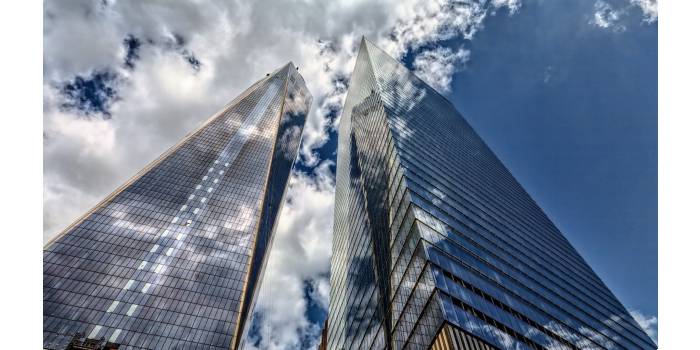
 The latest edition of NFPA 101 (2018 edition) requires that all stairs serving a high-rise building be designed "smokeproof."
By Jaime A. Moncada*
In Latin America, the main guide for defining the criteria for human safety and fire protection in buildings is NFPA 101, the Human Safety Code. This standard had never required the protection of building stairs with pressurization systems, with the exception of the staircase in the control tower at an airport. But the latest edition of NFPA 101 (2018 edition) requires that all stairs serving a high-rise building be designed "smokeproof."
The main reason for this change is that we are now designing the high-rise buildings so that their evacuation is partial, and the building is evacuated staggeredly. Initially the floor where the fire alarm is generated should be evacuated, then the floors above and below should be evacuated, and if the fire has not been controlled by the sprinkler system, the rest of the building would be evacuated.
Consequently, evacuation times in these types of buildings are often extended for quite some time and it becomes important that the enclosures of the evacuation stairs are adequately protected from smoke to ensure the safety of the occupants on the floors that are above the fire, throughout the evacuation process.
We must remember that smoke is inherent in all fires. In turn, it is extremely risky for the occupants of the building, due to its toxicity, and is harmful to the building itself. The smoke can be so dense that it can obscure internal visibility, making it difficult for firefighters to work and the evacuation process.
It is also important to emphasize that the concepts of smoke movement in buildings follow scientific criteria, and in increasing cases, design methodologies based on efficiency (Performance-Based Design) are used, which require the participation of a qualified and experienced fire protection engineer, using specialized computer programs.
What is a smokeproof ladder?
As mentioned above, NFPA 101 requires the ladder to be designed "smokeproof," which is primarily obtained in three ways:
1. Through natural ventilation, such as smoke protection provided by the external stairs. If smoke from the corridor penetrates the staircase, this smoke is quickly dissipated because the staircase is built on the façade of the building, open to the outside.
2. By mechanical ventilation, which requires the construction of a ventilated vestibule between the corridor of the building and the staircase. The lobby is ventilated with a change of air per minute, among other design criteria, preventing the possible smoke that is in the corridor of the building, migrate to the stairwell.
3. With a mechanical ladder pressurization system, which is purposely the most common method, and which will be explained in more detail below.
Design of the ladder pressurization system
For this purpose the design is carried out using a specialized multizonal computer program for the analysis of air flows that is much more accurate than the algebraic formulas, used for a long time by mechanical engineers, which are archaic and have exposed many problems during the commissioning of this type of systems. In this sense, in Latin America simple design methods are still used for the pressurization of stairs that are based on the speed of air through an open door, instead of the recognized methodology in fire protection engineering that is based on pressure differences.
The design should not only ensure that a minimum differential pressure between the ladder and the corridor is met, but also that this differential pressure is not so high, that a normal person cannot open the door from the corridor. The fire protection engineer has three main concerns during the design of pressurized stairwells, which are:
1. The variable pressure differences that occur over the height of the ladder well, called the Stack Effect.
2. The large pressure fluctuations caused by the opening and closing of doors, on different levels of the building.
3. The most suitable location of both fans and air supply inlets.
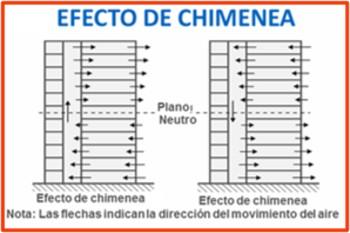
Figure 1. Direction of air movement within the building by the Chimney Effect (Photo courtesy of the Fire Protection Institute)
Intuitively, it might seem that the pressure differences from the stairwell into the building would be roughly the same over the entire height of the staircase. Unfortunately, this is not the case. In a building without vertical leaks through floors or axes other than the stairwell, the pressure profile would be linear. But in reality the buildings have other open axes (elevators, pipe shafts and electrical installations, garbage chutes, etc.) and also have floors that are not airtight. Additionally, the height of the staircase, the temperature difference between the building and the exterior, and the speed of the outside wind and its direction, also affect the calculation of the pressurization system. That is, the design of this system is much more complex than originally thought.
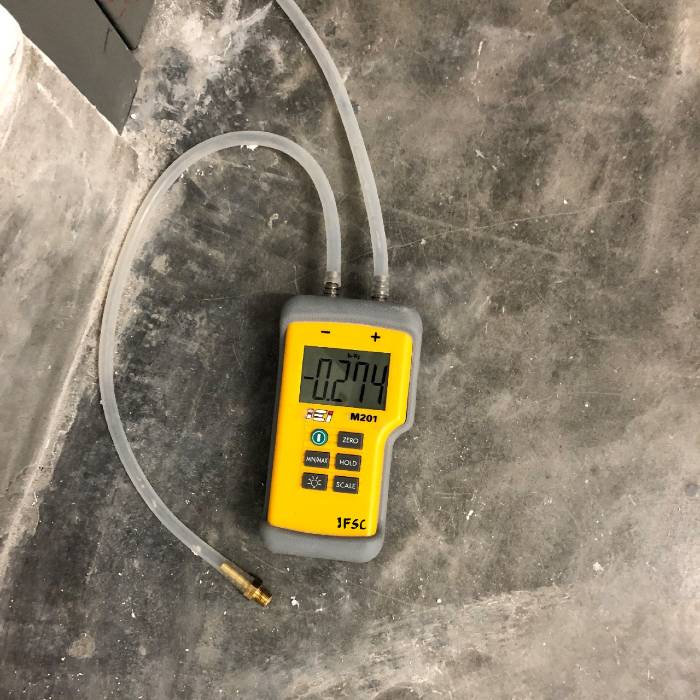
Photo 1. Pressurization test equipment, showing the pressure difference between the corridor and the ladder (Photo Courtesy of IFSC).
In my experience, all these problems come to light very late, when the acceptance tests are performed, where the pressure difference between the corridor and the door is measured, in Newtons per square meter, and the force is measured, in Newtons, necessary to open the door. In many cases, during acceptance testing the criteria established by the NFPA are not met, and modifications to the pressurization system are necessary, which are not only costly but delay the opening of the project.
* Jaime A. Moncada, PE is a director of International Fire Safety Consulting (IFSC), a fire protection engineering consulting firm based in Washington, DC. with offices in Latin America. He is a fire protection engineer graduated from the University of Maryland, co-editor of the NFPA Fire Protection Handbook, and directs the professional development programs of the Society of Fire Protection Engineers (SFPE) in Latin America. Moncada's email address is [email protected].