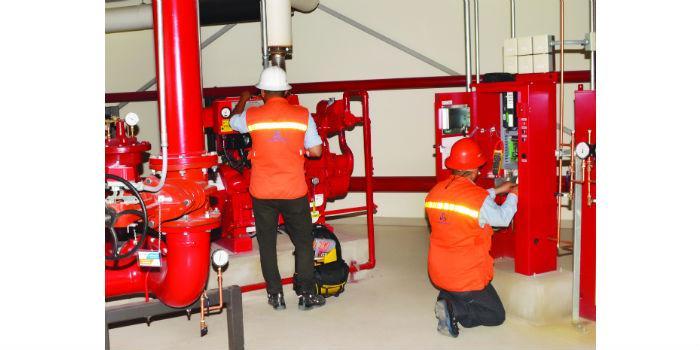
 One of the most rewarding tasks that I perform as a consultant in fire protection engineering is the analysis of water networks for fire protection of large facilities.
By Jaime A. Moncada, PE*
At first glance it does not seem very complicated, but the importance of the fire network in a refinery, petrochemical facility, or a mine is very important and without it none of the water-based fire protection systems would work properly. Fire water networks deteriorate over time and cost millions of dollars to replace. Oil refineries have the largest networks, so I would like to take these types of facilities as an example of how an existing fire water network is evaluated.
Most of the refineries operating throughout Latin America were put into service at the beginning of the second half of the last century. Its design bases, from the point of view of fire protection, were obviously in accordance with the technology of the time. It was an 8- to 12-inch (200 to 300 mm) diameter network with hydrants and monitors connected to various water pumps and a tank with two or four hours of capacity.
At that time the hydraulic design of water networks was very uncommon, especially when the nets were closed in rings. As the refinery grew, the network was extended following the original parameters, that is, extending the network by means of pipes of the same diameter, and installing hydrants and monitors through the installation. Very rarely hydraulic calculations were made, and when they were carried out, it was assumed that the existing pipe had the same characteristics, internally speaking, as a new pipe.
Something very common in the region is the use of the fire network in cleaning and maintenance of the plant, due to its availability and relative high pressure. This results in the decrease in the life of the network, by introducing oxygen every time the network is used and creating tartar on the inner walls of the pipe. Consequently, the network deteriorates, as its internal diameter decreases, to the point where it is decided to replace it.
Most of these networks have several kilometers of pipe and their replacement would have costs of the order of several million dollars. Because they are projects of such magnitude, it is the large engineering and construction companies that bid and eventually win the award of these projects.
As a general rule, these firms do not have fire protection engineers in their staff plant and without them, they face this type of project in the best way. In the worst case, they design the project as a replica of what is already installed, and in the best case, they design something similar to a municipal drinking water network. The possible result is cost overruns and ineffective protection.
We must bear in mind that no water network deteriorates standardizedly. There will always be areas of pipe that will deteriorate before others. Therefore, it is not advisable to change the entire network at the same time when some sections of the network begin to deteriorate, but rather to establish a readjustment programme in the short and medium term.
An analysis of the "C" factors, i.e. the factor of the internal corrugation of the pipe in the network (relative to the aforementioned tartar), and a study of the thicknesses of the pipe, will be able to give a real verdict of when a section of pipe would have to be replaced. In order to make this decision it is necessary to have accurate information about the operation curve of the fire pumps and perform dozens of water flow tests, making flows flow of the order of thousands of gallons of water per minute per test, in different quadrants of the network. Next, a hydraulic modeling process using certified "software" programs for fire protection must reproduce what was found in the tests, considering the different "C" factors that were established in the tests, until the most real approximation is found. This process is tedious and time-consuming, but its rigor and accuracy are critical if you are to establish the actual life of the fire network.
At the same time, the effectiveness of the existing network design during one of the many potential fires must be analyzed. This refers to the effectiveness of extinguishing and controlling a fire or explosion of the network. This involves comparing the flow rate and pressure of water available at the event site versus the flow requirement needed to control the incident.
For example, if a monitor is used on one side of a pressure tank to control a fire, the monitor must be able to release the water with enough pressure to reach the tank and with enough flow to obtain the density needed to control the fire. Several fire water monitor manufacturers provide distance versus pressure and flow versus pressure curves, which help correctly evaluate a network.
In an oil fire it is common to see that any monitor, hydrant or extinguishing system that is near the fire, is used by the fire brigade. This is often counterproductive, as water flows are used in excess of what is available, which causes a reduction in the pressure of the network, and consequently prevents water jets from reaching the base of the fire with sufficient flow.
As you might guess, the fire network analysis above can result in a fire attack plan for countless possible plant scenarios. These attack plans, which are called Fire Preplans, can only be drawn up if you have hydraulic information from the fire network.
One of the most complex scenarios of designing in a refinery occurs when the floating roof of a fuel storage tank is damaged. If for some reason, when the floating roof fails, the tank catches fire, existing extinguishing systems, usually foam chambers, are not enough to put out the fire. In these cases very large monitors (called super-monitors) are used that throw 4,000 to 8,000 gpm of foam at a great distance.
To be able to use this type of equipment, it is not only necessary that the fire network includes super-hydrants, where super-monitors can be connected, but also high-flow pumps. Currently, several refineries in the region are analyzing and reevaluating their fire network in order to mitigate this type of emergency.
*Jaime A. Moncada, PE is a director of International Fire Safety Consulting (IFSC), a fire protection engineering consulting firm based in Washington, DC. and with offices in Latin America. He is a fire protection engineer graduated from the University of Maryland, co-editor of the NFPA Fire Protection Manual, former vice president of the Society of Fire Protection Engineers (SFPE), who for 15 years directed NFPA's professional development programs in Latin America. Eng. Moncada's email is [email protected].