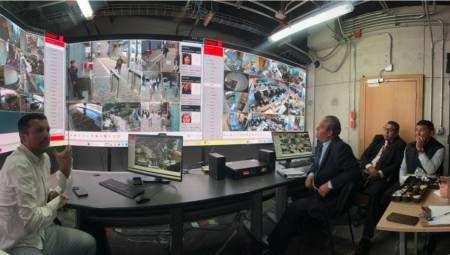
In a deeply connected world, but also traversed by visible and invisible threats, video surveillance has ceased to be a passive system and has become a framework for prevention, analysis and response.
By Andrea Ochoa Restrepo
It's no longer just about cameras hanging on a wall or monitors turned on in a control room: we're talking about smart grids that think, learn, and act in real time. Deep cameras powered by artificial intelligence, certified explosion control systems and state-of-the-art recorders such as NVRs and DVRs make up the heart of security today.
In these cities that are growing and transforming without pause, surveillance is no longer a control mechanism but an essential part of collective care. In the midst of the complexity of cities – with their dense flows, their diffuse borders and their multiple risks – having video security technologies allows us not only to observe, but also to interpret what is happening.
This is how decision-makers in the public and private spheres understand it: a well-placed camera can be the difference between a contained emergency and a tragedy foretold. An intelligent monitoring system allows you to anticipate movements, automate alerts, shorten response times and reduce the margin of human error. But beyond the operational, it allows something fundamental: to offer confidence.
It's no longer just about preventing theft or intrusion. It is about protecting lives, environments, strategic infrastructures. Of having eyes that don't blink. To build systems that think together with us. That process faces, identify license plates, count people, recognize anomalous patterns and do so with the precision of a machine and the logic of an algorithm that learns daily.
Installing a video surveillance system is no longer just a technical decision; It is a commitment to reduce losses, optimize resources, lower face-to-face security costs and, above all, build safer spaces to work, live or circulate.
Therefore, today the key is in integration: in how Deep cameras are connected to NVR/DVR recorders, in how the software that manages them is orchestrated, in how the system is designed from field knowledge. Sometimes an edge analysis with automatic alerts is needed. Others, contactless facial recognition. Or perhaps a bomb-proof thermal casing to withstand the rigors of a chemical plant.
Thus, the new paradigm of video surveillance is not only technical: it is territorial, social, sensitive. Because looking is not enough. What matters is how, for what and for what purpose it is looked.