Understanding the different factors that affect the development of urban environments is moving faster towards solving their safety challenges.
By ANNIE MARTÍNEZ ARDILA*
The term "smart cities" has become one of the most used expressions to talk about what, we believe, the cities we want to inhabit need. However, it is a concept as broad as it is ambiguous. The needs of each community vary according to the social, demographic, educational, economic, technological, environmental and mobility conditions that characterise the territories we inhabit.
Safe zones are an essential component of smart city design. In turn, technology is a fundamental pillar for the design of these, providing solutions that improve competitiveness, sustainability, public safety, quality of life and the well-being of citizens.
Today, almost 75% of the world's population lives in cities and towns. This percentage is expected to reach 80% by 2050. Cities and metropolitan areas are key economic agents; but they are also places where perceptions and realities of insecurity and low quality of life increase day after day.
However, the needs of our own cities vary from area to area, forcing us to recognize that the models we adopt are not necessarily the most appropriate. This leads us to reflect on how to ensure that our cities could have, in an organized way and according to their shortcomings, safe areas where their inhabitants not only have the perception of living and moving through safe spaces, but that this is a reality.
In this sense, a great concern arises: What path should we take for technology and advanced data analysis through AI to help us face the challenges of each of the territories? Perhaps, to arrive at this answer, we must ask ourselves what are the variables we should work on to get closer to safe areas and to achieve, one day, to really live in smart cities.
The first thing we consider valuable is to identify what the specific needs of the areas we inhabit are. For this we can find various models that can provide us with a base. For example, the lighthouse cities programme - endorsed by the European Union - provides concrete solutions for smart cities in environmental areas such as air quality, energy efficiency and electric mobility. This approach can bring us closer to those variables that we would have to analyze, or to the continuation of this program on smart and climate-neutral cities, which aims to achieve 100 climate-neutral cities by 2030.
However, for the reality of Latin American cities, in which we not only need to think about the environment but also about mobility, education, governance, population density, inclusion, economic development and – clearly – security, we must start by demystifying that only through surveillance cameras can we approach this concept.
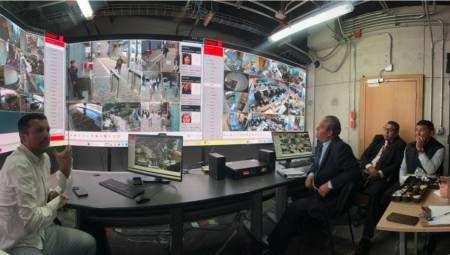
In the last period, in the city of Bogotá, Colombia, a concept has been implemented that goes beyond the use of technology to improve the perception of security. With this approach, a model has been developed that has managed to articulate the business community, the community, the public force, technology companies and human surveillance companies, by centralizing each of these actors through a single leadership. This allows not only to improve security conditions, but the sum of all these efforts seeks to promote, through safe areas, economic, tourist, gastronomic and cultural development that generates well-being for all its inhabitants.
This project has been carried out with the support of various actors and is a seed that grows to strengthen our city. It should be noted that, as leaders and citizens, it is necessary to transform the concept of 'security', ceasing to consider that it only depends on a public force, since in this new definition each of us plays a fundamental role. From our roles we can get closer to this archetype.
Talking about smart cities in Latin American territories may sound very ambitious. If we manage to move forward with safe areas that meet specific needs and that, together, achieve a feasible imaginary of the city, we will be able to get closer to that city model that we deserve so much. The articulation of all the aforementioned variables and the use of technological innovation are fundamental and will help cities and towns to improve their management. In addition, they will contribute to the achievement of priorities that benefit people.
Smart cities, through safe zones, can also benefit citizens and businesses by reducing their carbon footprint and transforming traditional processes and services, by determining safety as the basis for the development and well-being that our cities need.
 *Annie Martínez Ardila is general manager of Security Shops, a Colombian company with more than 20 years offering comprehensive electronic security solutions. Recognized by the Latin American Security Association (ALAS) for its advanced systems integration, Security Shops specializes in developing customized solutions that guarantee the comprehensive protection of business assets through cutting-edge technologies and a highly specialized team.