 International. From wearable devices and baby monitors to defibrillators and industrial robots, Internet of Things (IoT) devices are slowly taking over our lives in both personal and commercial environments. However, so are the cyber threats related to these devices.
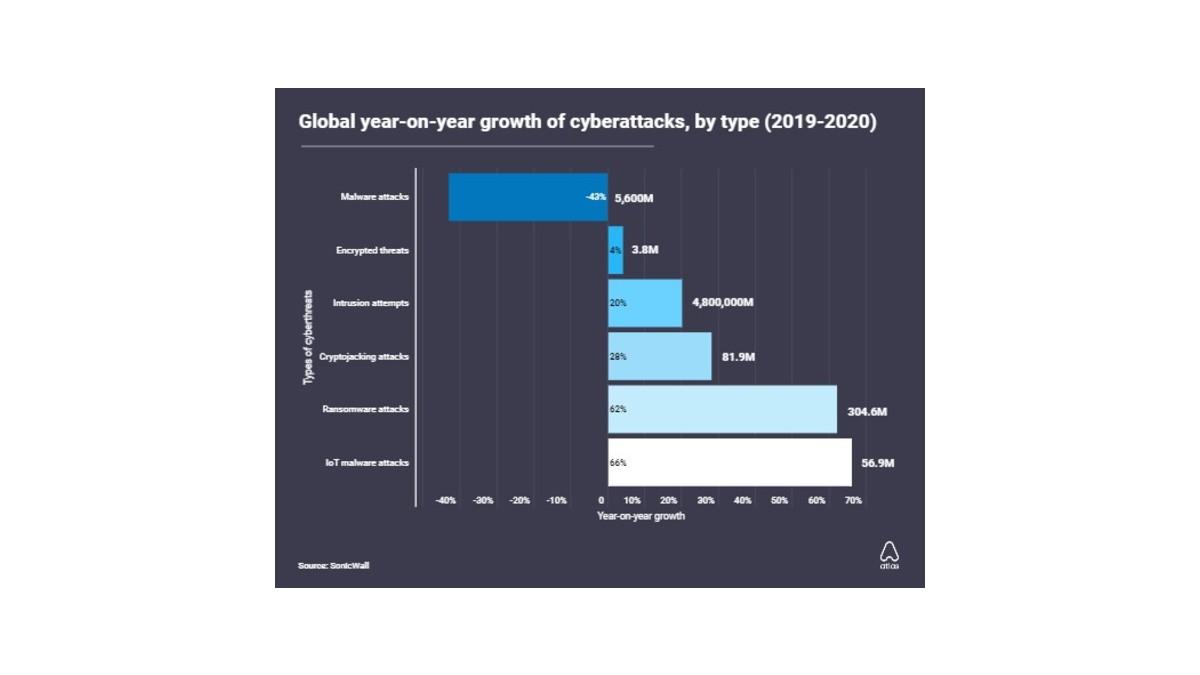
According to data presented by the Atlas VPN team, based on SonicWall's Global Cyberattack Trends report, in 2020, malware attacks on IoT devices increased by 66% compared to 2019. In one year, they went from 34.3 million cases to nearly 56.9 million.
The attacks peaked in October when they affected 10.8 million cases, more than in all of 2017. Of all industries, the education sector was the most affected. It experienced an average of 71 IoT malware attempts per month.
Most other types of cyberattacks also saw an increase last year. Ransomware increased by 62%, from 187.9 million cases in 2019 to 304.6 million in 2020.
Meanwhile, cryptojacking attacks grew 28% year-over-year, from 64.1 million cases in 2019 to 81.9 million last year. Cryptojacking occurs when criminals hack into personal or business computers to install software to mine cryptocurrencies.
The number of intrusion attempts increased by a fifth (20%) from 3.99 billion (3.99 trillion) to 4.8 billion (4.8 trillion) in 2020. Intrusion attempts are events when cybercriminals attempt to gain unauthorized access to a given system or resource.
At the same time, encrypted threats rose 4% to 3.8 million last year. Encrypted threats refer to cases where criminals take advantage of encryption protocols to hide their attacks. Encryption protocols, such as TLS or SSL, are typically used to create an encrypted tunnel to protect data over the Internet connection.
While other forms of cybercrime were booming, malware overall experienced a significant drop of 43%. It dropped from 9.9 billion (9.9 billion) attacks in 2019 to 5.6 billion (5.6 billion) in 2020.
North America experienced a 152% increase in IoT malware attacks
Last year saw an increase in IoT malware attacks in all regions of the world. However, some regions were more affected than others.
Of all regions, North America experienced the largest increase in IoT malware cases in 2020. In one year, IoT malware attacks increased by an alarming 152%.
Europe ranks second on the list. In 2020, malware attacks on IoT devices increased by 48% compared to the previous year.
Next up is Asia. Last year, the region saw an 18% increase in IoT malware cases year over year.
Finally, Africa, Australia, and South America saw the smallest increase in IoT malware cases: they increased by 17%.
The rise in IoT malware attacks is not entirely unforeseen. By 2020, it was estimated that IoT technology would be in 95% of electronics for new product designs. Naturally, as the number of IoT-enabled devices grows, so do cyber threats.
The shift to remote work was another factor behind the rise in IoT malware attacks last year. As workers began to access their company's systems through home networks that are often connected to multiple unsecured home devices, the latter became an attractive target for cybercriminals. Suddenly, they could use vulnerable IoT devices to access enterprise networks.
Tips for protecting your IoT devices
While some legislations related to IoT security regulation, such as the California Internet of Things Security Act, have already been enforced, for the time being, there is no global security standard for IoT devices. It means it's up to each company to decide how secure their devices should be.
In fact, according to Unit 42 research, 98% of all IoT traffic is unencrypted, while 57% of IoT devices are vulnerable to medium or high severity attacks.
However, we, as consumers, can take matters into our own hands to make our IoT and smart home devices more secure. Here are five tips to help you protect your IoT devices from external threats:
1. Secure your WiFi. There are many things you can do to make your WiFi network more secure. To get started, change the password and default name of your WiFi. The latter is often named after its manufacturer or the network you are using, making it possible for criminals to find or guess the default login credentials for your router. Also, be sure to use the strongest level of encryption possible.
2. Set up a guest network for IoT devices. Many routers support the ability to create a secondary WiFi network along with the main one. So, even if criminals manage to hack into one of your IoT devices, they can't access your family's computers and smartphones as they are connected to a separate network from that of your IoT devices.
3. Disable the features you don't need. Bluetooth, voice control, location tracking, remote access are just a few of the many features your smart devices can have. Be sure to disable any features you don't use as it will help reduce potential entry points for hackers.
4. Use strong and unique passwords. If some of your IoT devices require credentials to sign in, be sure to create strong, unique passwords that contain uppercase and lowercase letters, numbers, and symbols for each of them. This way, even if one of your IoT devices is hacked, criminals won't be able to access your other devices with the same login details.
5. Keep your software up to date. Always update the software to its latest version as soon as it is available. The latest software may contain security patches, making it difficult for hackers to take advantage of system vulnerabilities.
Source: Atlas VPN.