 Latin America. Public security is in intensive care in most countries, even the most developed ones.
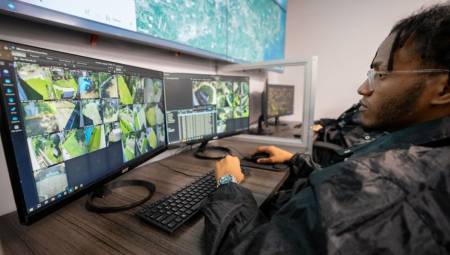
For a good number of years, regional rulers, in charge of municipalities, municipalities and other forms of local political division, invested in technology to improve public surveillance and thus give a better and more timely response to street incidents, but the results do not improve in relation to the economic effort made. Hundreds or thousands of cameras have been mounted in cities, of the most advanced technologies, but obviously it is impossible to cover 100% of the spaces, without dark areas for the "big brother" system.
What happens is simple to understand. We continue to think about safety, reactive and non-predictive schemes. Public security will only improve when it is approached preventively with "tech" criteria to generate prediction and on "collaborative" systems where all citizens contribute to the common good, in a technological system integrated among masses and with local government management, efficient and innovative.
That said, we can begin to think about stable operating schemes for these collaborative systems where an acceptable balance is achieved between, on the one hand, investment, which by the way is usually scarce, but the worse when scarce and poorly used and on the other hand the level of coverage required.
To graph this in an example that makes it clear what we are aiming for, a municipality of 50,000 people, with 40,000 of them of economically active age can count today on an image monitoring center with about 100 to 300 cameras. However, using a broader criterion and without investing much more than the investment, it could have 40,000 more cameras, strategically distributed next to a customizable panic button, if it were decided to provide an APP to each citizen to mount on their cell phones.
And not only this!! It would obtain a "big data" of the crime, with geopositioning of each reported event, photos, video and audio captured at the time of its occurrence, all invaluable evidence when it comes to investigating the cases against the criminals.
Lukewarmly, some local governments have initiated PPP delivery campaigns to cover cases of victims of gender-based violence, with cases prosecuted.
Congratulations. But there is much more to do, since long before the victim is attacked, there is an approach and relatives or neighbors who do not have the device today to alert as the exposed person has. Many arguments have also been added about that most of the time, autonomous equipment to report gender violence by panic button, are without batteries when they are required to be used, an issue that with cellular APPs mounted on the person's phone, do not occur. And a phone with a specific APP also allows video and audio to be sent, fundamental evidence that received in the monitoring center constitutes irrefutable proof of the aggression to stop and prosecute the aggressor. And we talk again about saving lives.
That is why SoftGuard presents its citizen prevention system with SmartPanics, a global APP that allows multiplying the individual protection of citizens at the time of an altercation, whether theft, fire, medical assistance, gender violence or to prevent them.
The alerts sent through the smartphone will be received at the Monitoring Center of the Municipality through the Internet or SMS to be attended by the operators immediately.
These events will be accompanied by the position of the device by the internal methods of the smartphone and in the SoftGuard Monitoring module it will be shown with a location map to the operator. The advanced video function will allow the user to send an image of the development of the emergency from the smartphone camera. In addition, the application allows you to send two-way audio through a call through the phone line and send an SMS with the event data to be attended in the monitoring center.
Each person will be able to count on the application after being downloaded from the Stores or Markets corresponding to each company without the need to pay or buy an anti-panic button.
Additionally, with SmartPanics they will also be able to report news such as: burned or damaged luminaires, waste on public roads, traffic accidents, strange or loitering presences, protests and riots, catastrophes and alerts of all kinds, so that the agencies in charge can provide follow-up.
Thus the municipality connects not only with the victims of gender violence, but with all citizens, thinking of a plan completely oriented to the "collaborative" role of security.
Thus, a taxi or Uber driver can be a valid auxiliary for the "connected" scheme of public safety, because while doing his job, which is driving, he can report any abnormal attitude to the local security center. What is the ratio of taxis to police patrols? 100 to 1 or more.
And what happens when we add the bus driver, train driver, all means of transport? We multiply the cameras and alert drives by 1,000 or by 10,000
Following this metric, imagine adding the managers of apartment buildings, the cleaning staff affected by outdoor and common areas and the private security personnel in those condominiums, who have a lot of time in front of their jobs and who observe their surroundings in alert and observation. A fact-reporting APP in its possession would once again multiply the scope of observation and criminal reporting.
What we are talking about is basically the local government placing itself at the forefront in the assembly of a collaborative security network of unimaginable dimensions and in response to the main problem posed by the citizen, insecurity. It is no longer necessary to explain to people that there are no magic solutions, that if this struggle is not initiated from a foundational change of axis, from a mix of technology distributed to each member of society, this has no other possibility than to worsen.