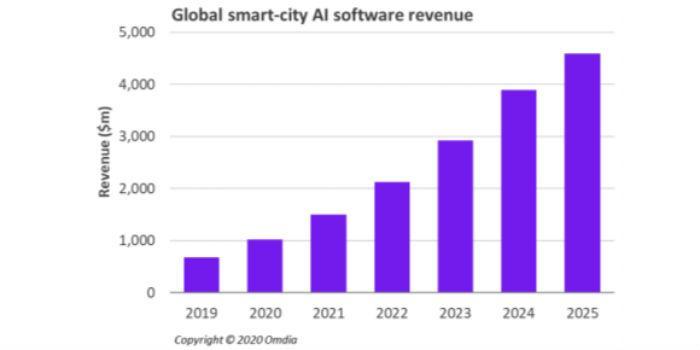
 International. The advent of Internet of Things (IoT)-based 4G and 5G connectivity is driving the online migration of smart city applications, helping to generate a more than sevenfold increase in revenue from smart city artificial intelligence (AI) software by 2025.
According to Omdia, the global market for artificial intelligence software for smart cities will increase to US$4.9 billion in 2025, up from US$673.8 million in 2019. Wireless data communications standards allow smart city applications to move into the online realm, where they can capitalize on the latest AI innovations. Ai's growing capabilities are enabling data and insights collected through IoT networks to be monitored, analyzed, and applied.
"From video surveillance to traffic control to street lighting, smart city use cases of all kinds are defined by the collection, management and use of data," said Keith Kirkpatrick, principal AI analyst at Omdia. "However, until recently, connecting disparate components and systems to work together has been a challenge due to the lack of connectivity solutions that are fast, cost-effective, low-latency, and ubiquitous in coverage. These challenges are now being overcome by leveraging advances in AI and connectivity."
The advent of 4G and 5G wireless data technologies is facilitating data collection and management, promoting the migration of artificial intelligence software from the smart city to the online countryside. AI allows data to be analyzed more deeply than ever before. The technology can identify patterns or anomalies within that data, which can then be employed for tasks that allow machines to mimic what humans might consider intelligence.
Using the power of AI, smart city systems can create municipal systems and services that not only operate more efficiently, but also provide significant benefits to workers and visitors. These benefits can come in many forms, including reduced crime, cleaner air, a more orderly traffic flow, and more efficient government services, as detailed in Omdia's latest AI research report, Artificial Intelligence Applications for Smart Cities.
Smart cities leverage AI for video surveillance
An example of how smart cities are leveraging AI is in the realm of video surveillance.
When hosting public events, some cities are starting to use video cameras that are combined with AI-based video analytics technology. The goal is for AI algorithms to scan the video and look for behavioral or situational anomalies that may indicate that a terrorist act or other outbreaks of violence may be about to occur.
However, cities are increasingly employing cloud-based AI systems that can search for images from most closed-circuit TV (CCTV) systems, allowing the platform and technology to be applied to existing camera infrastructure. In addition, video surveillance can be combined with AI-based object detection to perform tasks that include learning patterns in an area; detect faces, gender, heights and moods; license plate reading; and identify anomalies or potential threats, such as unattended packages.
As the use of surveillance cameras has exploded, AI-based video analytics now represent the only way to extract value in the form of information, patterns, and action from the vast amount of video data generated by smart cities.