
 International. The global DIY Autonomous Network Security Camera (DIY) market is projected to increase by 80 percent by 2024, a rapid pace of growth that is attracting new competitors and challenging the positions of current market leaders.
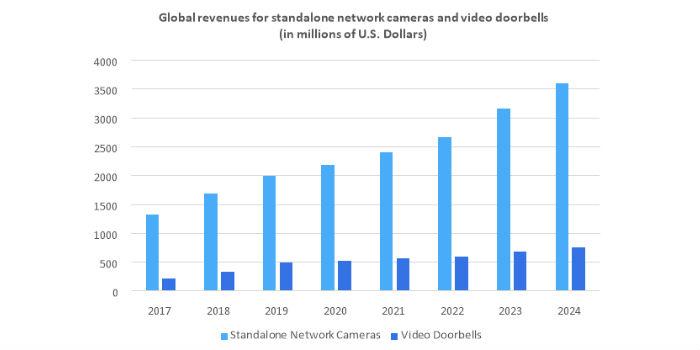
Global revenue from such cameras, which represent a mainstay of most smart home ecosystems, will soar to $3.6 billion in 2024, up from $2 billion in 2019, according to the Omdia Consumer & DIY Video Surveillance report. The related market for video doorbells is also experiencing rapid growth, with a global increase of US$750 million in 2024, up from US$492 million in 2019.
"Brands like Wyze, Xiaomi, Hikvision and Ring have quickly risen in rank to threaten Arlo and Nest, market-renowned in terms of unit shipments for independent network cameras," said Blake Kozak, principal analyst at Omdia. "Due to the competitive prices of the cameras, Arlo remained in the top spot as of 2019. However, the state of the company will be further tested as the competition intensifies in 2020."
Historically, Nest and Arlo have been major market players in independent network cameras. For example, in the United States in 2017, Arlo had a market share of 31 percent of global unit shipments, while Nest had a 10.2 percent share. However, as of 2019, Arlo's share fell to around 26 percent and Nest to 8.9 percent.
Contributing to the declining market share of Arlo and Nest is the growing number of brands offering products with similar technical specifications to top brands. However, these products come with free features that would otherwise incur a monthly fee from leading brands.
With new competitors undermining prices set by market leaders, the initial manufacturer's suggested retail price (MSRP) is also playing a major role in eroding the market shares of major players. This factor, combined with the significant increase in the total number of competitors, has put additional pressure on industry leaders such as Arlo and Nest.
Facial recognition stimulates brand recognition
In addition, brands like Swann, Lorex, and Night Owl are starting to offer advanced features like facial recognition, automatic tracking, and battery-powered cameras that are combined with network video recorders (NVRs). These features will add to the competitive pressure in the independent network camera market through 2020.
Product differentiators in 2020 are likely to include new features like enhanced color night vision, audio analytics, edge-based analytics, and storage-agnostic options, such as cloud, secure digital card (SD), or network-attached storage (NAS).
In addition, many more brands will join Apple's Secure Video, which will offer a secure and less expensive alternative for video storage compared to many options available today.
Not to be outdone, Nest is likely to return from its consumer camera pause later this year, as the brand hasn't released a new standalone security camera since 2017.
At the end of the day, 2020 will be another exciting year for the consumer video surveillance and DIY market.