 Colombia. Implementing initiatives to store energy to develop renewable energies and microgrids for the transport of energy is one of the ten commitments made by Schneider Electric, a global specialist in energy management and automation, at the Paris Climate Change Conference, COP21.
"We are living in a very exciting time in which new technologies will allow us to completely rethink the way we deal with energy in a much more sustainable and efficient way," said Jean-Pascal Tricoire, CEO of Schneider Electric at the close of COP21.
Reducing global warming means making the transition from fossil fuels to renewables, because fully mastering the potential of renewables also means looking for ways to store them. To date, electricity grids do not have the possibility for new energy sources to be integrated efficiently, such as solar or wind energy do not necessarily have a comparable consumption in a given time. The only solution to mitigate the risk of power outages was to use expensive and inefficient backup systems, such as fossil fuel-based generators, mainly diesel.
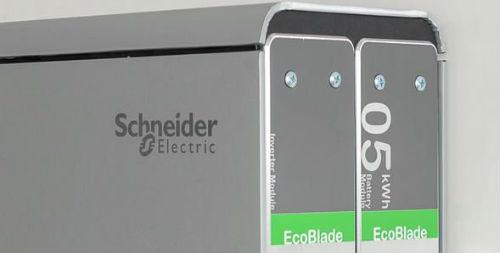
Only with an efficient and reliable form of storage can the challenge of providing energy reserves for the time when energy is not required be overcome. Built on the foundation of global leadership in energy management and secure electricity provision, Schneider Electric introduces EcoBlade, an energy system for residential, IT, industrial and commercial environments, as well as for the grid.
EcoBlade is a completely flexible energy storage system based on lithium-ion charged batteries. In turn, it consists of servers type "blade" (blade) of 30 inches of flat screen, with a weight less than 30 kilos. Each blade has a connected and intelligent module for the battery and is ready to use independently. In a home equipped with solar energy provided from solar panels, for example, people can use the energy generated by an EcoBlade for personal consumption or for resale on a microgrid.
Blades can also be used in cabinets connected to power grids, data centers, buildings or secondary power grids that have higher energy storage needs. At a higher level, blades can be integrated into containers to provide thousands of MWh and complementary energy management services for a complete energy distribution network.
The EcoBlade system can be implemented quickly and easily maintained. Each is integrated into a broad ecosystem of Schneider Electric solutions for electricity, which can be particularly trusted in the Struxureware software suite of integrated, cloud-based service modules. Struxuware collects and manages operational and environmental data, optimizing energy performance across the entire chain, from the generating source (such as solar panels or wind turbines) to deliver storage and cost-effective energy consumption.