International. With half of the world's population going to the polls this year, Sumsub, a global provider of full-cycle verification, detected an increase of more than 245% in deepfakes globally.
The results revealed show a multiple growth in certain countries where elections are held in 2024, such as the United States, India, Indonesia, Mexico and South Africa.
"By conducting millions of identity checks annually and avoiding thousands of deepfake attempts across all markets, we believe these trends are not unique to B2B/B2C markets. They are symptomatic of what is happening in the digital world in general. These revelations not only apply to businesses, but are also a key sign of the need to continue fighting misinformation, the spread of AI-generated scams, and online fraud that threatens society," said Vyacheslav Zholudev, co-founder and CTO of Sumsub.
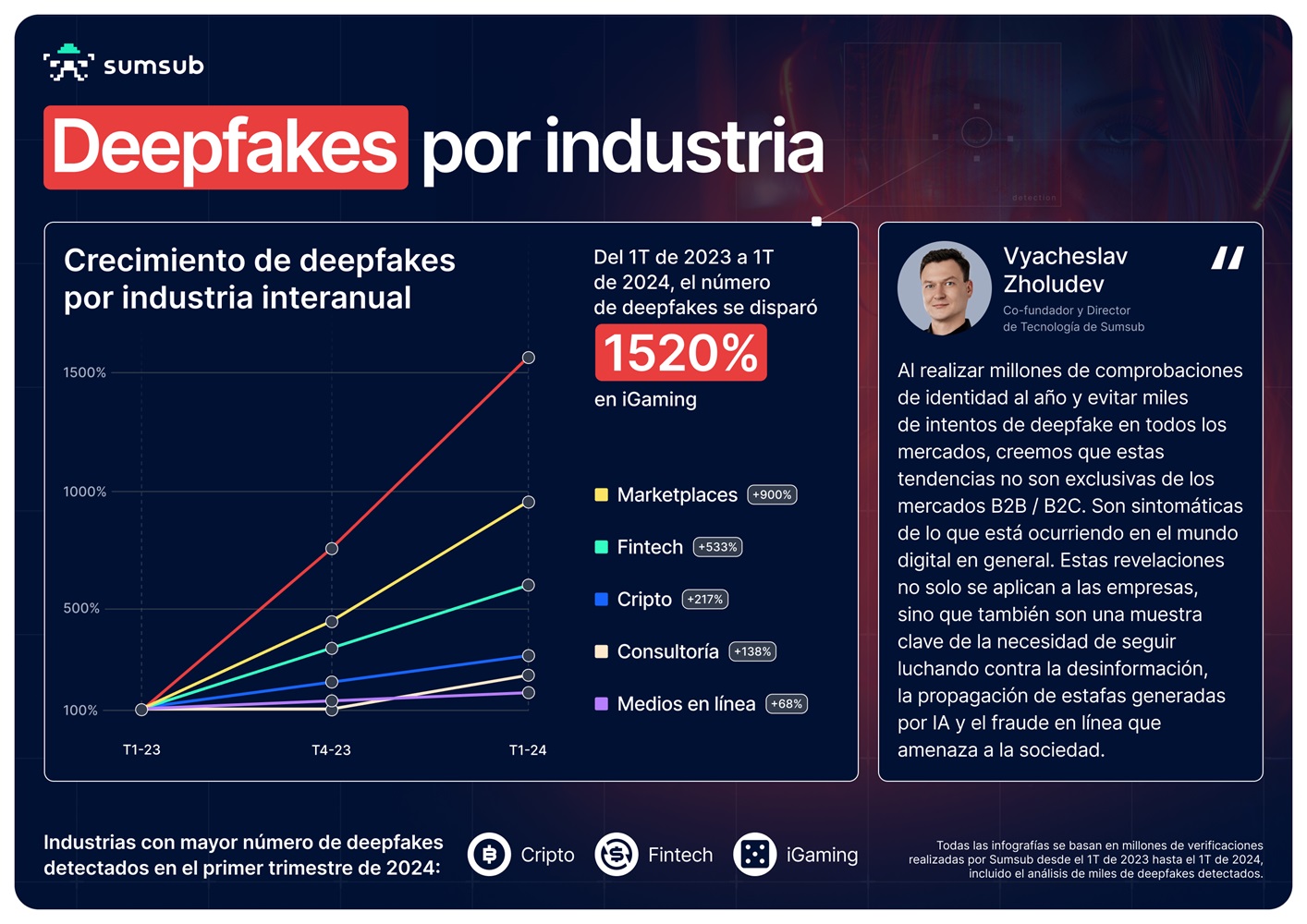
Sumsub's most outstanding data on identity verification and fraud, corresponding to the first quarter of 2024, shows that:
- The countries with the most deepfakes detected in the first quarter of 2024 are China, Spain, Germany, Ukraine, the United States, Vietnam and the United Kingdom.
- Brazil is among the 10 countries in the world with the highest number of deepfakes detected in the first quarter of 2024.
- There is a notable growth in deepfake incidents where elections are scheduled for 2024: El Salvador and Venezuela (200%), India (280%), the United States (303%), South Africa (500%), Mexico (500%), Moldova and Chile (900%), Indonesia (1550%) and South Korea (1625%). In the European Union (where elections for the European Parliament will be held in June), many countries experienced a year-on-year increase in deepfake cases, such as: Bulgaria (3000%), Portugal (1700%), Belgium (800%), Spain (191%), Germany (142%) and France (97%).
- Even in countries with no elections in 2024, deepfake scams are advancing at unprecedented rates year on year: this includes China (2800%), Turkey (1533%), Singapore (1100%), Hong Kong (1000%), Brazil (822%), Vietnam (541%), Colombia (433%), Ukraine (394%), Japan (243%), Ecuador (200%), Argentina (83%).
- Although AI fraud grew in most places, there were some countries with electoral processes in 2024, in which the number of deepfake incidents decreased; this includes the United Kingdom (-10%), Croatia (-33%), Ireland (-40%) and Lithuania (-44%).
- The growth of deepfake incidents can be observed in different sectors. Last quarter, the industries with the most deepfakes were crypto, fintech, as well as iGaming. If we look at the year-on-year comparison, the number of deepfake cases skyrocketed by 1520% in iGaming, 900% in marketplaces, 533% in fintech, 217% in cryptocurrencies, 138% in consulting and 68% in online media.
 "The number and quality of deepfakes are increasing and evolving daily around the world. Even with the most advanced technology, it's becoming increasingly difficult to differentiate between a deepfake and reality. The only way forward is to fight AI with AI. For businesses, the ultimate tool that keeps them protected is a multi-layered anti-fraud solution with different checks at different stages of the user journey. But content platforms and ordinary users remain vulnerable to deepfakes, especially in the run-up to the 2024 elections," says Pavel Goldman-Kalaydin, head of AI/ML at Sumsub.
He added that "media platforms need to stay vigilant and update their defenses to detect deepfakes and prevent AI-generated fraud. They must ensure that they do not inadvertently contribute to the spread of misinformation."
Sumsub also analyzed broader data on identity fraud collected in the first quarter of 2024 in Mexico and the Latin American region.
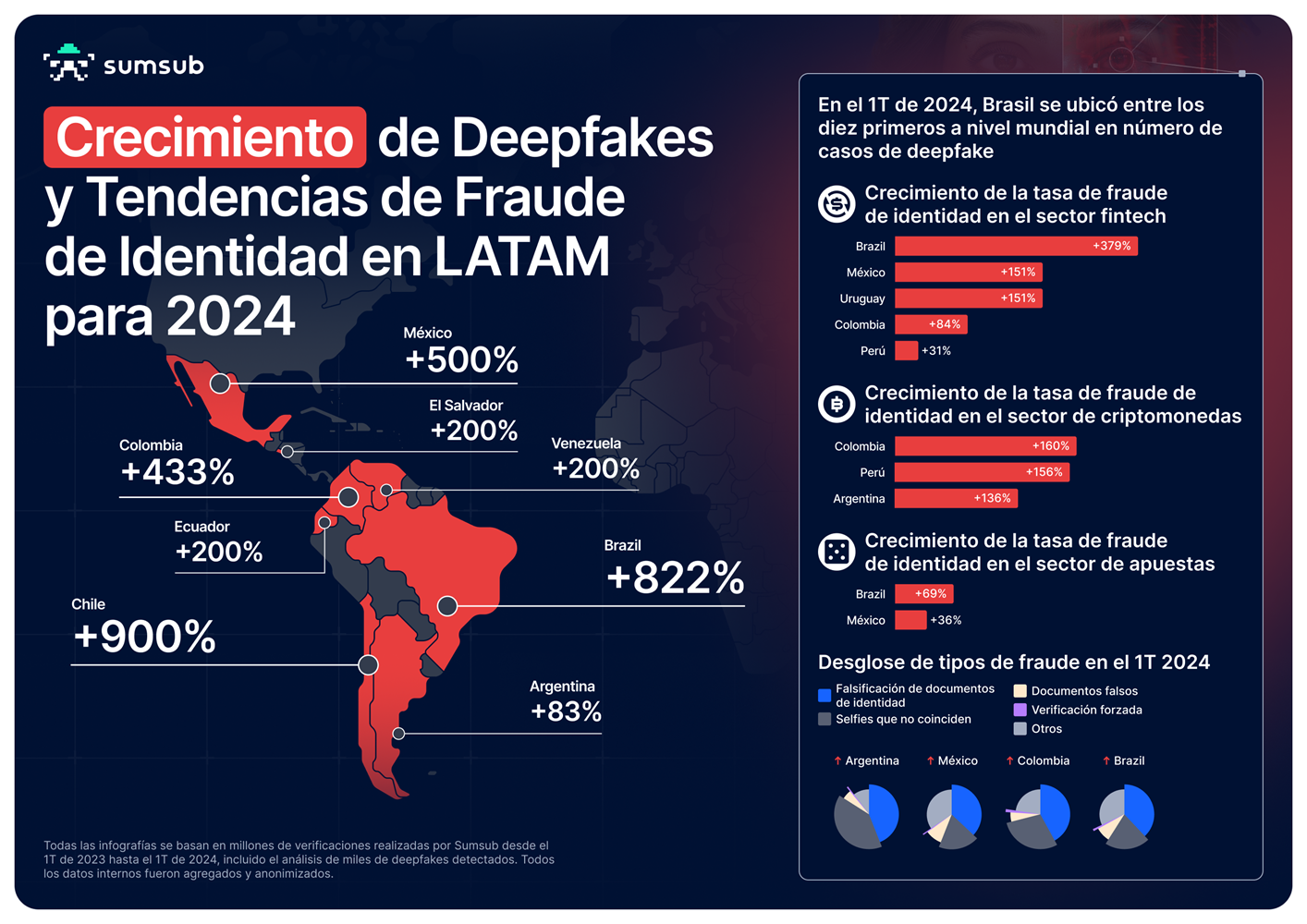
- The iGaming fraud rate (betting) increased from 2.2% in Q1'23 to 3% in Q1'24 (in comparison, the overall iGaming fraud rate, on average, was only 1.4%. So we can say that this fraud in Mexico is twice as high as the world average).
- Regarding the types of false documents, in general, the number of forged identity documents in Latin America was twice as high in Q1'24 as in Q1'23; (i.e. a 100% increase) the rate of fraud among residence permits grew by 44% year-on-year.
- The proportion of forced verification among all types of fraud in Mexico doubled year-on-year: from 0.3% of all frauds in Q1'23 to 0.6% in Q1'24.
Among all fraud cases detected in Mexico, the proportion of false proof of address documents (proof of residence) skyrocketed from 0.3% of all frauds in 1Q23 to 2.2% in 1Q24, which is the highest proportion in all of Latin America. - The rate of identity fraud in the Fintech sector grew 151% in Mexico and Uruguay, 379% in Brazil, 84% in Colombia, and 31% in Peru; in cryptocurrencies, fraud increased 136% in Argentina, 160% in Colombia, 156% in Peru; the rate of fraud in games of chance increased 69% in Brazil and 36% in Mexico.
To download the company's whitepapers for free, visit https://sumsub.com/guides-reports/.