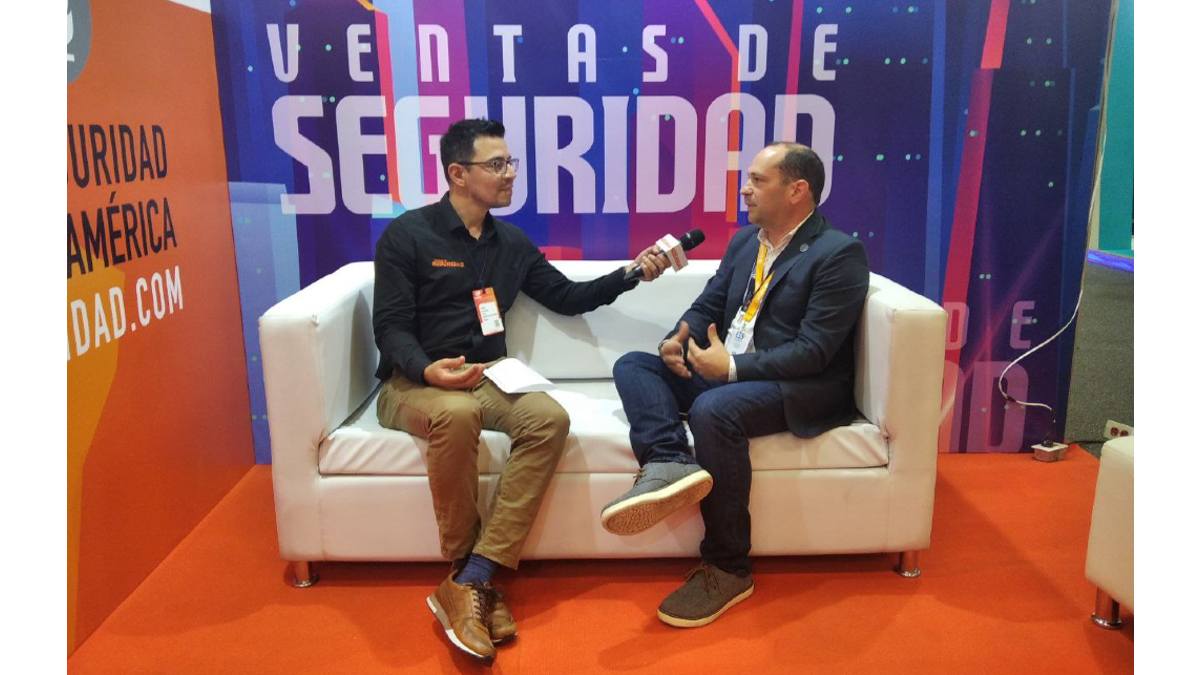
Colombia. Last August, in the context of ESS+ 2022, we had the opportunity to speak with Diego Madeo, who told us about Garnet Technology's plans in Colombia and the challenges overcome after the pandemic.
Diego Madeo, executive director at Garnet Technology and president of the Strategic Planning Committee of the Latin American Security Association ALAS, was representing Garnet at the ESS+ 2022 International Security Fair. In this event he explained that this year the brand delivered more solid proposals with new products, to strengthen business with distributors and monitoring companies in Colombia, something consistent with the company's strategy of opening more markets in Latin America.
Faced with the issue of technology and production problems, Diego said that it was due to the lack of microcomponents, prior to the pandemic. For him, what exacerbated the lack of components was the increase in demand, thanks to the wave of new products that use this technology. As for the security industry, its condition was due to the same thing, this boom in usability increased from an average of $ 4 dollars to $ 25 dollars the price of each semiconductor.
"Today the situation is a little calmer, measures have been taken in Asia and the United States, they have worked on creating new factories. But those factories are not ready yet, two years ago they started and it is estimated that by 2024 they will be starting to ship the semiconductors."
However, regarding the logistical problems also experienced in recent years, he indicated that it was a phenomenon that added to the production difficulties, precisely because in the pandemic he closed ports and borders, an issue that raised prices. A container went from 2 or 3 thousand dollars to almost 20 thousand and although the cost fell again, for the expert this was a challenge, which triggered the logistics to be cut, with dispatches in times of 5 to 6 months. He also pointed out that this was a situation in which as a company they had to make great efforts and absorb many of these cost overruns.
Within the interview he told us that, from his role as president of the Strategic Planning Committee of ALAS, he sees the need to make known, in a clear and complete way, the real value proposition that this association has for its members. And he emphasized what it means to have the summit of this association again in person.
Finally, he answered a question from our dynamic 'Security Challenges in Latin America', about how to prevent or help contain the lack of knowledge of citizens.
Diego suggested that it is something that should be done from the role that companies, institutions and associations around the security industry occupy, since technology has evolved a lot in the last five years, generating ignorance in end users. The expert was insistent that we must "push for the technology we develop to reach the decision-maker in a simpler way."