
International. A research led by the University of Granada and the Università di Pisa (Italy), published on the cover of the journal Nanoscale Horizons, studies a special type of particles, called excitons, that generated in the structures of certain electronic devices are able to increase their speed and responsiveness.
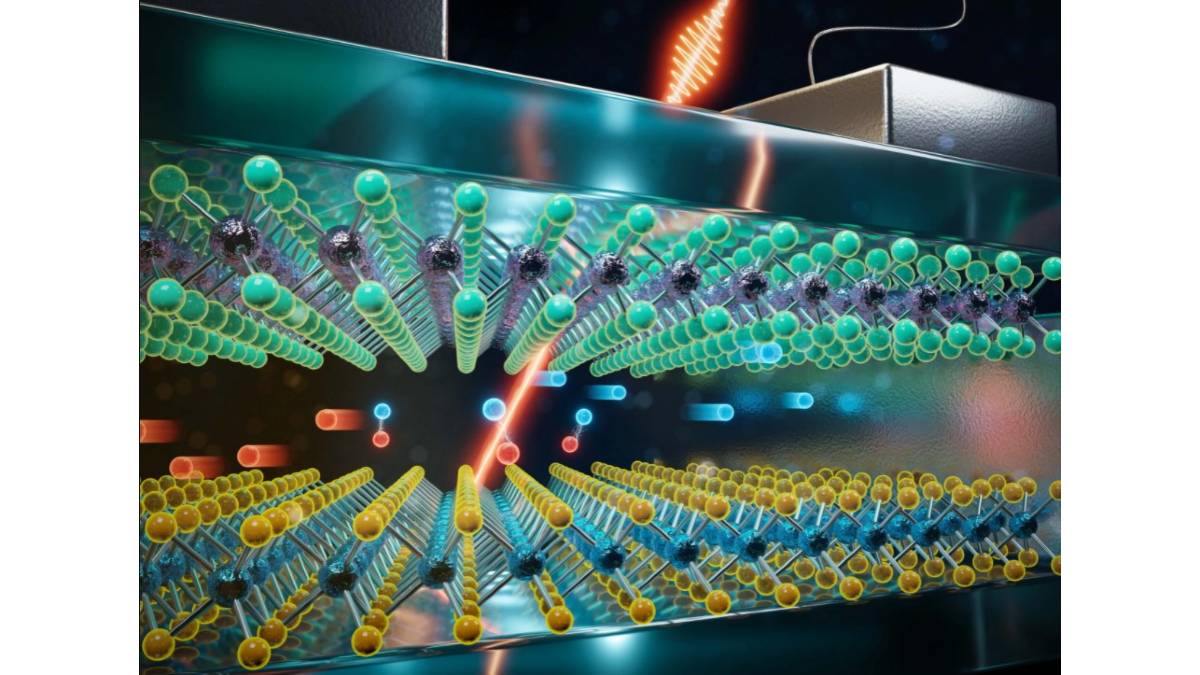
This study proposes to use excitons in structures based on a specific type of 2D materials, the dicalcogenides of transition metals or TMDC, to achieve fast photodetectors with great responsiveness, that is, with great amplitude of the electrical signals generated for a certain power of light received, which facilitates the detection and processing of these signals.
Photodetectors are an electronic device capable of converting light into electric current, very similar to a photovoltaic solar panel, but with a different application. The simultaneous achievement of a rapid response and sufficiently strong signals is the great challenge, and also the great objective, of research in photodetectors based on 2D materials, such as this one headed by the University of Granada.
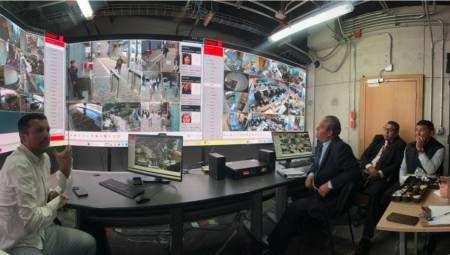
Such an advance in the speed and responsiveness of photodetectors would be essential to increase performance in different areas that use this type of device: surveillance systems, image processing, medical instrumentation, telecommunications through fiber optics, among others.
Professor Enrique González Marín, from the Department of Electronics and Computer Technology of the UGR, who participates in this research, explains that excitons are "quasiparticles formed by an electron and an electronic hole that, in the case of the TMDC heterostuctures that we propose, can be located in different sheets, one on top of the other. These interlayer excitons are easily separable by the application of a lateral electric field and allow to obtain electrical responses of greater amplitude in the photodetector", he specifies.
TMDC-based heterostructures are being investigated in numerous fields of electronics, from reconfigurable electronics, which aims to design devices with changeable electrical functionality, to neuromorphic electronics, which aim to mimic the very efficient (from an energy point of view) processing and memory architecture of the human brain.
2D materials and electronics
Two-dimensional materials are crystalline structures, that is, structures of atoms that repeat periodically in space. Unlike common crystalline materials, from which almost all the electronic devices we handle every day are made, in 2D materials the atoms are distributed only along very thin sheets, only one or several atoms thick.
These sheets have unique characteristics from the electronic point of view and have become the subject of intense research for optoelectronic applications and, in particular, in photodetectors. 2D materials can be stacked on top of each other, giving rise to the so-called "van der Waals" heterostructures, which are named after the type of forces that unite the sheets of the different materials.
These heterostructures are characterized by having enormously fast electrical responses (of the order of one millionth of a millionth of a second) when interacting with light, so they are very interesting in very time-sensitive optoelectronic applications, such as those used in artificial vision in neural networks.
In the particular field of optoelectronics, to which this work is circumscribed, heterostructures are being used to design, not only photodetectors, but new architectures of conventional devices known to all as solar cells, light-emitting diodes or lasers.
"But, probably, the most revolutionary applications of these heterostructures, and of two-dimensional materials in general, are in areas of physics that we have not yet transferred to the technological field, such as topological insulators, spintronics, Moiré patterns or valleytronics", explains Professor Enrique González Marín.
Machine vision
In the field of machine vision it is important that photodetectors are able to capture light and convert it into an electrical signal as quickly as possible. This is determined by the rate of photoresponse, and in the case of TMDC heterostructures, taking advantage of the formation of interlayer excitons, as predicted by the research, response times of one millionth of a millionth of a second could be achieved. In addition, it is important that machine vision systems have a low energy consumption, which implies that photodetectors must be able to work in photovoltaic mode and maintain a high sensitivity to light. TMDC-based heterostructures that exploit interlayer excitons can achieve these two requirements that are usually opposed.
* Bibliographic reference: Lopriore, Edoardo, Enrique G. Marin, and Gianluca Fiori. "An Ultrafast Photodetector Driven by Interlayer Exciton Dissociation in a van Der Waals Heterostructure". Nanoscale Horizons 7, #1 (December 20, 2021): 41-50. https://doi.org/10.1039/D1NH00396H.
Data Source Provider: University of Granada.