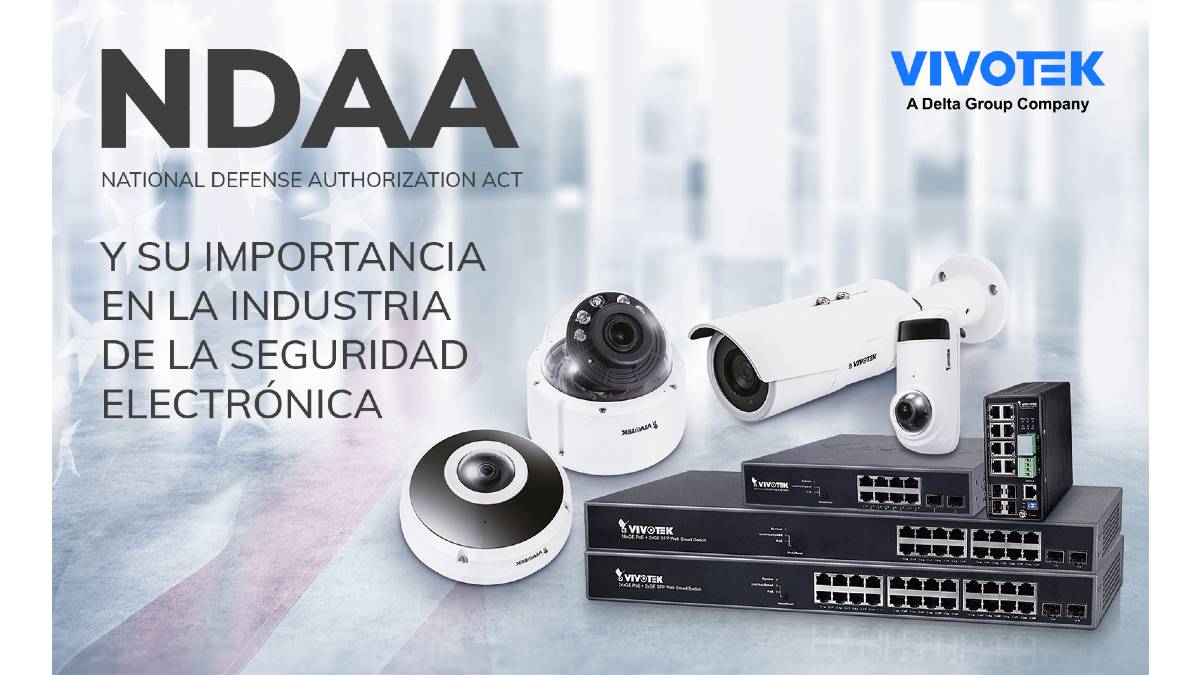
 International. What is the NDAA? The National Defense Authorization Act, for its acronym NDAA, is john S. McCain's National Defense Authorization Act. In the field of electronic security, Section 889 of this law prohibits federal agencies of the United States from using or acquiring telecommunications and video surveillance equipment from certain companies within the well-known Black List [1]. In other words, for video surveillance equipment to be installed on U.S. government property, it must comply with section 889 of the 2019 NDAA.
Why is it important?
Section 889 not only prevents federal agencies from installing cameras made by companies on the Black List, but also prohibits them from doing business with any organization that uses them. This entails a serious implication since, today, many companies are of a global scope, that is, they are international companies that in their day to day negotiate, work and are supplied by other international companies. Therefore, compliance with this law is critical for end users, consultants, integrators and manufacturers who want to conduct operations with customers operating internationally.
"Any tool that helps improve the security of systems is important to take into consideration; despite being a particular law for a country we have some clients who have a commercial relationship and direct investment of the same, so it is important to be able to comply with those requirements and offer a product that is within those regulations, "said Jorge Sánchez, Mexico BDM of VIVOTEK.
Why does Section 899 mention telecommunication and security system products?
While the devices manufactured by these companies were undoubtedly purchased to enhance public and private safety, the actual impact of their implementation has the potential to substantially compromise the security and operations of various nations and institutions. Research into these companies and their technology has revealed evidence of backdoors used for someone to access systems and spy on or perform malicious activities on them. Many of the companies listed in section 889 offer very attractive prices, however, the consequences can be very costly.
Why should integrators in Mexico and other countries in Latin America know about its importance?
The United States is the main trading partner of more than two-thirds of Latin American countries and is the source of more than $1 billion of investment in the region. The U.S. has free trade agreements with 12 countries in the region and accounts for 82% of total foreign trade. For Latin American companies doing business in the United States, this law has important implications.
Mexico, in particular, is in the top 15 worldwide of the countries that receive and attract foreign direct investment the most. The sectors that receive significant investments are industry, financial and insurance services, retail and wholesale trade and communications. End users of this type of industry and services require, for the most part, highly reliable equipment and good quality service. Therefore, it is important that integrators working with this type of end users know the risks and implications of using cameras manufactured by companies that are part of an exclusive list.
In addition, some of these companies have been implicated in human rights violations and abuses and many multinational and domestic companies have codes of conduct that do not allow companies in their supply chain to be involved in human rights violations.
On the benefits that users obtain by having a product that complies with the NDAA, Jorge explained that "Benefits focused on cybersecurity are obtained, being devices on the network can be vulnerable by some attack by hackers or malware with the intention of entering the camera and / or the network with which we can have a major attack not only on the security system. They also make sure to have certified equipment, manufactured and assembled both in the hardware and software part with best practices, to prevent cyberattacks from being successful. This added to a good practice focused on cybersecurity allows us to be less likely to suffer an incident."
What does VIVOTEK offer on the subject of the NDAA?
We are committed since the implementation of Section 889 in August 2019 to providing NDAA compliant products. Therefore, we have a wide range of network video cameras and recorders (NVRs) that do not use critical components prohibited by the NDAA. These products will be included in VIVOTEK's GSA contracts and are recommended for U.S. government applications that are subject to the NDAA.
With its international headquarters and manufacturing facilities in Taiwan, VIVOTEK offers reliable, competitively priced and NDAA compliant solutions. In addition, VIVOTEK is the first IP surveillance manufacturer to provide anti-intrusion software within network cameras and NVRs. Powered by renowned cybersecurity solutions company Trend Micro, VIVOTEK IP devices can now detect and block brute-force login attack or any abnormal activity inside.
* For more information on the NDAA or to see the full list of NDAA compliant products visit: https://www.vivotek.com/es/ndaa
[1] https://thecgp.org/policy-involvement/what-federal-contractors-need-to-know-about-section-889