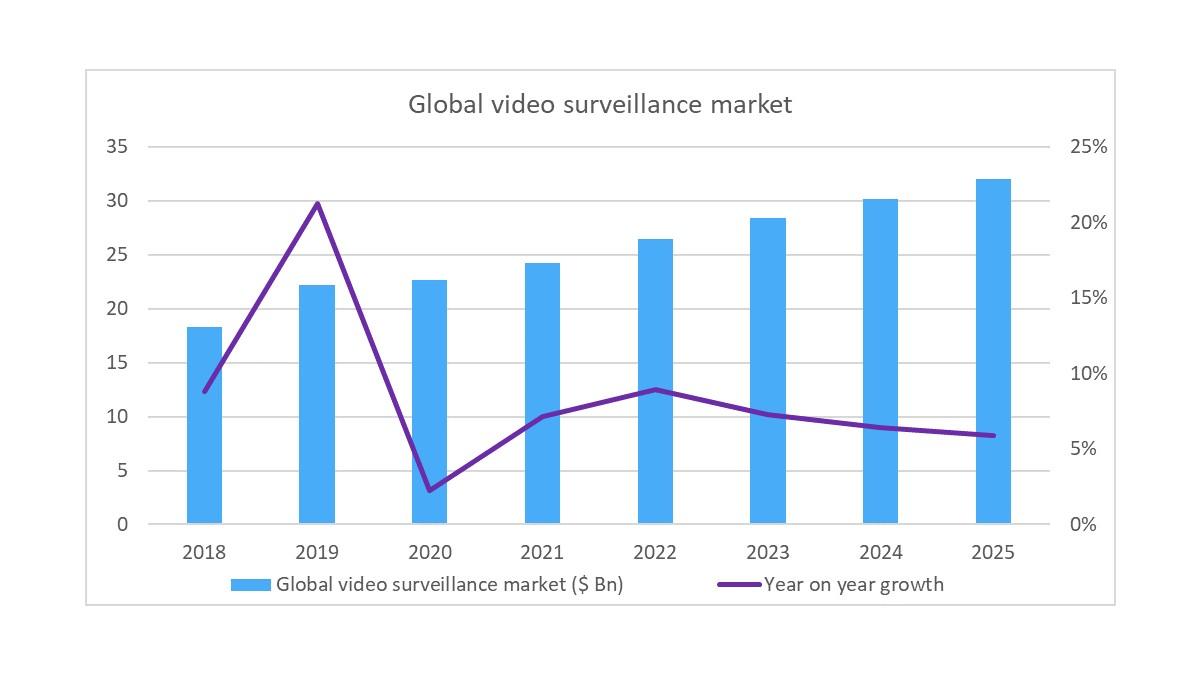
 International. According to Omdia's latest video surveillance and analytical intelligence database, the revenue of the global video surveillance market is projected to reach $24 billion by the end of 2021.
This marks a rapid recovery for the video surveillance market, as demand that was suppressed in 2020 will return and revenues will be bolstered by projects that were postponed in 2020 due to Covid restrictions being given the green light in 2021. Omdia forecasts that total video surveillance market revenue will grow to US$31.9 billion by 2025 with a total CAGR of 7.1% between 2020-2025.
Thermal solutions for body temperature: growth promoters and inhibitors
The market size of thermal solutions for body temperature has grown rapidly to US$1.3 billion globally in 2020. Driven by Covid 19 precautions, this technology has been adopted by several regions, notably China, East Asia, India and the Middle East. However, without the growth of thermal body temperature solutions, the global video surveillance equipment market declined by 3.8% globally in 2020.
Despite being a driving growth factor in 2020, Omdia forecasts that the body temperature thermal solutions market will rapidly decline in 2021 to just US$137 million, a decrease of 89.8%, which will ultimately limit the overall growth of the video velance market.
Geopolitics, supply chain constraints, and AI developments increase average selling prices
Omdia expects average sales prices for video surveillance equipment to rise in the near term as geopolitical tension between the United States and China and supply chain constraints from the Covid-19 pandemic increase pressure from supplier margins.
In recent years, geopolitical tensions between the United States and China within the video surveillance industry have intensified. The initial NDAA and blacklisting of Hikvision, Dahua, and Huawei within the U.S. are being augmented by new FCC regulations.
Oliver Philippou, Research Manager – Physical Security at Omdia commented: "The geopolitically driven semiconductor deficit and the impact of Covid has affected all industries, and video surveillance is not an expectation." This gap between supply and demand is expected to last until mid-2022.
In the long term, Omdia expects there to be increased adoption of network camera products that use AI deep learning acceleration and inference at the endpoint. This will result in higher average prices of network cameras.
Chinese Impact on Global Market Revenue
The Chinese video surveillance market is estimated to have grown by 6.4% in 2020 compared to the global average of 2.2%. This growth is mainly attributed to the thermal solution of body temperature. It is estimated that the market excluding such a solution has decreased by 0.8%. As such, China now accounts for 50% of the global market revenue. However, a combination of COVID 19 and the termination of the Xue Liang program has led to a decline in government investment in video surveillance in China. Still, government investment will continue to grow, albeit at a slower pace.
Tommy Zhu, senior physical security analyst at Omdia commented: "One of the main factors driving the growth of the Chinese market in recent years was government investment. Although the year 2020 marks the completion of the Xue Liang program, the government will continue to improve the construction of Safe China during its fourteenth five-year plan. In addition, as China is deploying its trillion-dollar investment in building new infrastructure, the demand for video surveillance equipment is expected to continue to grow. In addition, China's ambition to accelerate the transformation to a digital economy will boost investment in both the public and private sectors."
Source: Omdia.