 International. Media around the world have published articles on the increasing use of video surveillance equipment in China. However, the use of video surveillance equipment in the United States has received less attention. But they don't take into account that the United States has almost the same proportion of security cameras for citizens as China, according to IHS Markit.
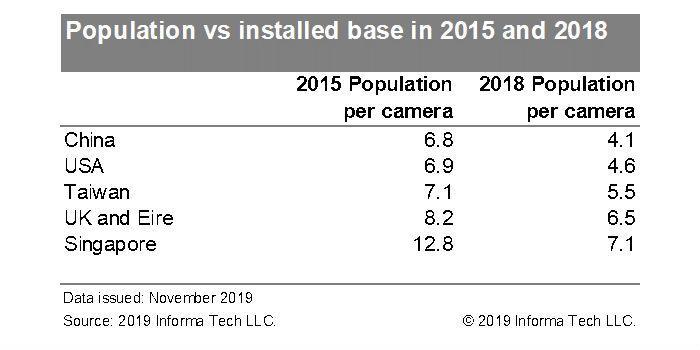
In 2018, China maintained its global leadership in surveillance camera penetration, with 1 camera installed for every 4.1 people in the country. However, the U.S. was very close, with a people-to-camera ratio of 4.6 to 1, according to the 2019 report.
"Over the past few years, surveillance market coverage has largely focused on China's massive deployments of cameras and artificial intelligence (AI) technology," said Oliver Philippou, research and analytics manager, video surveillance, at IHS Markit | Technology. "What has received much less attention is the high level of penetration of surveillance cameras in the United States. With the U.S. almost on par with China in terms of camera penetration, the future debate over mass surveillance is likely to affect the United States as much as China."
Taiwan ranked third in terms of penetration, with 5.5 citizens for each camera installed. The UK was fourth with a 6.5 to 1 ratio, while Singapore ranked fifth with 7.1 to 1.
Both China and the United States have achieved significant increases in facilities in recent years. China's installed base of surveillance cameras increased nearly 70 percent in recent years, rising to 349 million in 2018, up from 210 million in 2015. Meanwhile, the U.S. installed base rose sharply, to 70 million cameras in 2018, up from 47 million in 2015.
By 2021, China's installed base is expected to rise to 567 million cameras, while the U.S. base will rise to 85 million.
Driven by the government's Xue Liang program, the Chinese market receives significantly more funding from the government than any other region in the world with the aim of providing extensive video surveillance coverage within public areas. City surveillance was estimated to be the end-user market with the largest installed base in China in 2018. By comparison, the installed city surveillance base in China was proportionally 4.5 times larger than in the United States.
By contrast, the retail and commercial end-user markets were estimated to have the most cameras installed in the United States.
"It should also be noted that while the United States has a high penetration rate, this installed base has developed over many years, while the Chinese market has developed very rapidly over the past decade," Philippou said.