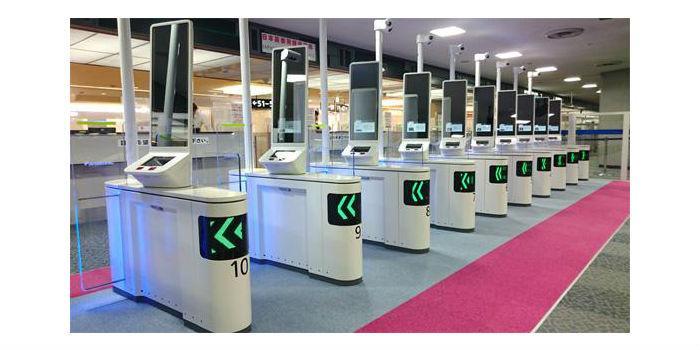
 International. A total of 66 additional automatic facial recognition gates will be supplied for use at an expanded number of airports in Japan and also for a recently expanded use in departure procedures for foreign travelers. The additional order will bring the total number of automatic doors to 203 units nationwide (123 units will be used for foreign nationals).
In October 2017, Panasonic's automatic facial recognition gates were first chosen by the Ministry of Justice's Immigration Services Agency, and since then 137 units have been put into operation at five major airports in Japan (Tokyo Haneda, Tokyo Narita, Nagoya Chubu Centrair, Osaka Kansai and Fukuoka). For the additional order, which will begin at Haneda Airport in Tokyo on July 24, 2019, another 66 units will begin operating at a total of seven airports, including Sapporo New Chitose (in mid-November) and Okinawa Naha Airport (in early July 2020).
With Japan's goal of reaching its goal of becoming a tourist nation and increasing the number of foreign visitors coming to Japan to 40 million a year by 2020 and 60 million by 2030, the Ministry of Justice has made several efforts with the role of immigration to streamline departure and return procedures for Japanese citizens and exit procedures for foreigners through the use of of automatic facial recognition gates in order to assign a greater number of immigration inspectors to examination procedures for foreigners, and to maintain the thoroughness of examinations while ensuring greater facilitation. As part of these efforts, effective October 18, 2017, three of Panasonic's facial recognition gate units were put into operation for the first time at tokyo's Haneda International Airport immigration checkpoint. By 2018, a total of 137 units were in operation at five major airports in Japan. The systems are contributing to fast but strict immigration procedures for travelers.
Without the need for a prior registration of biometric data, the system compares the photographic data of the traveler's face on the IC chip embedded in the passport with an image taken at the facial recognition door to verify identity. According to the Ministry of Justice, approximately 80% of all Japanese travelers use Panasonic's facial recognition doors.
Panasonic's facial recognition door has the following features: (1) intuitive usability thanks to the ergonomic design and sophisticated technology the company has developed for passport readers; (2) High-performance facial recognition engine with advanced technology that can handle variations that alter appearance, such as aging, makeup, facial expression, and image quality; and (3) Spatial design and general service design that allow for optimal arrangement in a limited space based on field trials.
In addition, to apply this system to departure procedures for foreign visitors, Panasonic has been improving the facial recognition engine through field trials in collaboration with the Ministry of Justice.