
 International. Conditions in the global semiconductor market have deteriorated rapidly since the beginning of the year, with enterprise information provider IHS Markit reducing its growth outlook for 2019 by more than 10 percentage points.
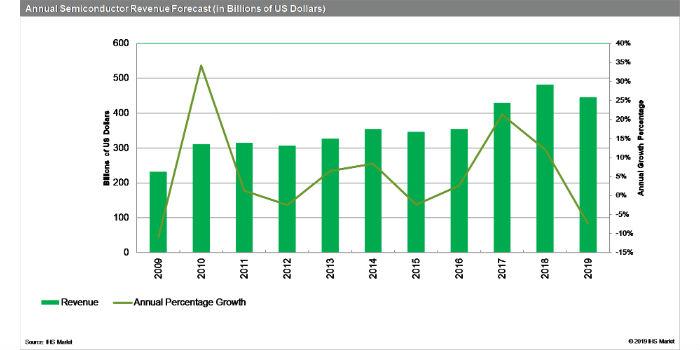
The global microchip industry will suffer a 7.4 percent drop in revenue this year, according to the latest figures from IHS Markit's application market forecast tool. Revenue will fall to $446.2 billion in 2019, down from $482.0 billion in 2018.
This represents a major shift in the market outlook compared to the previous forecast in December, which anticipated the market to expand by 2.9 percent this year. A 7.4 percent decline will mark the semiconductor industry's largest annual percentage decline since the Great Recession of 2009, when chip sales fell nearly 11 percent.
"After the chip industry achieved strong revenue expansion of 15 percent in 2018, many semiconductor suppliers in early 2019 remained optimistic that they could achieve moderate growth this year," said Myson Robles Bruce, research manager, semiconductor value chain, at IHS Markit. "However, the confidence of the chipmakers quickly turned into apprehension, as they witnessed the depth and ferocity of the current crisis. The latest data indicates that the semiconductor business is now headed for its worst year in a decade."
The tabs are below
The precipitous nature of the slowdown is due to increasingly soft demand, combined with a rapid increase in inventory levels in the first quarter. These events have impacted some semiconductor product segments more than others. DRAM, NAND flash, general purpose microprocessors (MPUs), 32-bit microcontrollers (MCUs), and application-specific analog integrated circuits (ASICs) were among the hardest hit products, all with double-digit revenue declines in the first quarter of 2019 compared to the first quarter of 2018.
Recent concerns about DRAM market conditions, a sharp drop in average selling prices, and weak demand served to lower DRAM revenue projections for 2019. In NAND flash memory, oversupply has been responsible for an aggressive erosion in prices.
Another segment set for a sharp decline this year is the logic application-specific standard product (ASSP), where demand is driven by the mobile phone business, a market it is struggling to generate due to near-universal saturation.
A silver silicone lining
The difficult conditions in the semiconductor market will continue through the second quarter. Sharp declines in the first half of the year have put the chip market on course for its worst revenue performance since 2009, however, IHS Markit Technology forecasts a recovery in semiconductor sales in the third quarter. This renaissance will be led by parts of NAND flash memory used in solid-state drives and high-end smartphones. MPUs employed in laptops and data center servers will also help drive the resumption of overall semiconductor sales growth.
Source: IHS Markit.