Colombia. The District Administration announced the creation of a project in agreement with the national government, for the provision of 250 cameras that would be installed in critical points of insecurity identified in the city, but the equipment has not yet been installed.
It was hoped that in the first half of 2015, it would be a fact that at least 100 security cameras would work in Cartagena, established in the first phase of that project coordinated by the National Fund for Security and Coexistence (Fonsecon) of the Ministry of the Interior. However, the first half of the year is about to end and the cameras are not yet installed.
To find out about the progress of this project, José Ricaurte, director of Distriseguridad, the entity that leads the development of the project, was consulted by local media. The official explained that this has suffered a series of delays caused by causes beyond the control of the District Administration and by the natural procedures involved in a large contractual process, emphasizing that the District delivered the necessary resources to the national Government months ago.
Ricaurte recalled that in 2013 the District had a "great flaw" in the issue of technology for surveillance systems.
"There were 50 wireless cameras that worked only until 2010, and there were another 80 fiber optic cameras, of which only about 20 worked. And while not all of them were in service, Telecom was being paid more than $60 million a month for the broadcast. Added to that, the monitoring center (in the Automatic Police Dispatch Center) was in total technological obsolescence," said José Ricaurte.
Given this panorama, the need for a new surveillance camera system in the city was born. The director of Distriseguridad says that in October 2013 the project was formulated before the Ministry of the Interior.
"With the Cosed (Crime Observation and Monitoring Center) maps of crime commission were crossed and it was concluded that at least 450 cameras were needed to cover critical points of the city. Due to the costs and the necessary procedures for that number of cameras, we opted for a middle ground and thus we came to formulate the project for 250 cameras, which would be given 100 in a first stage and the other 150 in the second, "explained the official.
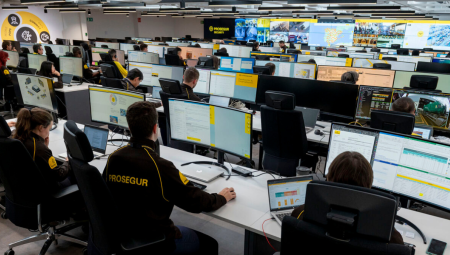
The total cost of the first stage of the project is $5 billion, of which the District had to contribute $1.25 billion and the rest was assumed by the Ministry of the Interior. The investment guarantees, among other things, a fiber optic network that will belong to the District, video wall (mosaic of screens) for the monitoring center, storage of three months of video and ability to pass to tape what must be stored for five years, and two years of maintenance of the camera system.
Ricaurte assures that since August of last year the District delivered the $ 1,250 million that corresponded to it to execute the project, but it has not been able to start in shape.