
 Denmark. Several of the branches of the fast food giant McDonald's in this northern European country installed an IP video surveillance system to monitor not only the actions of individuals outside the organization, but also their own collaborators, in order to avoid mismanagement and have control over everything that happens in the facilities and around you.
It should be noted that according to the European Crime and Security Survey 2005, which measures the volume and nature of crime in Europe, Denmark is among the countries with the highest levels of crime, along with Ireland, the United Kingdom, Estonia and the Netherlands.
Based on the above, for McDonald's, as for other companies, it was and is of vital importance to protect its assets and its customers, a purpose that is being fulfilled thanks to the advances of the electronic security industry.
It is important to note that the old McDonald's system only offered security for theft and vandalism, but this new solution allows the integration of different aspects, since it works the security itself (surveillance, monitoring and control) and helps the organization to analyze and manage transactions, as in the electronic point of sale (EPOS), where the CheckView records all the operations of the cash register and combines them with the information of the Milestone XProtect Transact video database such as date, time and place; this makes it possible to quickly search for specific information and monitor administrative activities, which can also be monitored remotely over the network.
"The system is incredibly easy to manage, and I'm confident we'll get a quick return on our investment," said Casper Scheibye, McDonald's supervisor on the outskirts of Copenhagen, Valby and Hvidovre.
Another important feature of the CheckView is the ability to update with the latest technology available, in addition to having the integration of megapixel cameras that improve the quality of photos and allow surveillance of establishments.
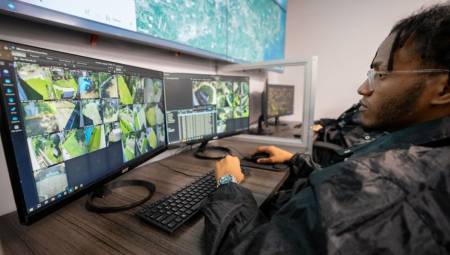
Video surveillance has proven to be an interesting option in the fight against crime and proof of this is what happened in California, last October, when the state police arrested a man who was confronting pedestrians and robbing them in downtown Redlands, a fact that was possible thanks to the security cameras installed there, which allowed the monitoring of the suspect from the Dispatch Center of the Police Department.
The security system not only prevented the man from carrying out his actions, but also demonstrated that cameras and their technical properties, such as zoom, support the work of the police force and make it possible to detect and stop ongoing crimes, as well as prevent other crimes.
Criminal actions like this, or much larger, happen every day around the world; some can be prevented, some cannot; however, in places where video surveillance systems exist, they help identify suspects to take action on the matter.