
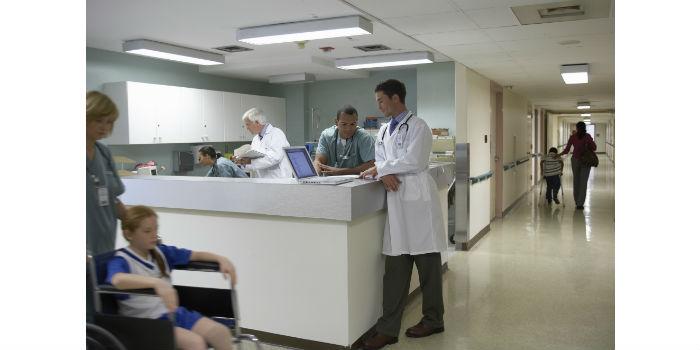
 One of the plans that Latin America is working on to advance its development is to improve its health systems. Not to mention a particular republic, issues of insufficient coverage or low quality customer service are quite common in most Latin countries.
by HID Global
To give an example of the weak points in health systems, the Central American Institute of Business Administration (Incae) conducted in December 2018 a survey applied to 1,281 health workers from 18 countries in Latin America. This academic exercise identified that problems such as the inability of the system, waiting lines and even fraud, are recurrent in the health systems of the region.
This is how the different actors within the health sector, both in the public and private sectors, face great challenges to develop sustainable systems that improve the quality, safety and coverage of hospitals.
Undoubtedly, innovation and updating are fundamental to achieve this goal, and several countries have already started with this mission from the point of view of investment. Chile, for example, announced that 57 new hospitals would be built in 2026, an initiative that is part of the commitment of the Investment Plan launched by the Government to modernize the public health network. Colombia also confirmed that nine new hospitals in Bogotá and Medellín would be ready by 2022. Along the same lines, the ministries of health of Ecuador and Peru have also expressed concrete actions to improve the infrastructures of their health networks.
However, to highlight these investments as they deserve, this wave of modernization would have to be accompanied by smart decisions, and solutions that actually help mitigate the problems described.
Secure identification for the construction of the modern hospital
One of the largest references worldwide in health systems is the United States. North America has a highly regulated system, which is vitalized thanks to the incorporation of technologies that help you improve your operating processes.
One such procedure is the secure identification of people, places and things. This practice has brought such good returns to American health systems that it is important to analyze how they work.
Although in a first reflection it is not dimensioned as it deserves, secure identification helps to counteract inconveniences in processes such as the flow of people, fraud, theft and the general security of medical centers.
Today's access control systems for example are very advanced. A particular software can be responsible for receiving user information during registration and automatically integrate it with the access control system to evaluate access permissions to different spaces, and even manage the issuance of a temporary card for visitors.
For several reasons, the use of traditional keys in hospitals is a thing of the past. There is now a wide variety of reader and coder alternatives that can be integrated with the clinic's different technologies. Currently, it is possible to incorporate access cards based on anti-cloning technologies, or even implement mobile access, creating identifications for employees and executives on their mobile devices with the same security and permission management features.
However, physical credentials are still of paramount importance in this process, as some regulations require physical identification for all patients and their families to see. This issue can be easily solved with the latest solutions in id card printing, which offer personalization and security functions that minimize counterfeiting and simplify the issuance process, making it possible to print a card in less than a minute, which translates into substantial savings in time and investment for health institutions.
There is also the issue of biometrics, which helps protect the identity of patients and reduce fraud in this type of institution. Biometric technology is particularly suitable in the area of registration and authentication of members of the health center, due to its inherent ability to prevent a user from taking someone else's card and gaining access to privileged resources.
Although it sounds strange, for many social benefit programs it is essential to check that the beneficiary is alive and present at the time of the transaction to avoid fraud. Multispectral imaging technology, for example, reads the unique fingerprint characteristics of both the surface and the next layer of finger skin, and performs enhanced live fingerprint detection in real time, comparing the optical characteristics of the material being presented against the known features of the living skin to determine whether the finger is real or fake.
Finally, there is another trend in which health systems can be favored with the use of secure identification technology: home care.
Systems leverage trusted identities to streamline patient home visits and eliminate billing fraud. There are solutions that combine NFC tags, mobile apps, cloud authentication services, and trusted web apps to simplify "proof of presence" by making it easier to document the time, location, and accurate delivery of prescribed care.
In short, all these practices standardize the management of identities to collect, process and analyze both the identity and other data of the users and strengthen the levels of security and operability of the sanatoriums.
Better patient flow management thanks to IoT
Almost all hospital care settings want to improve patient flow, crowded emergency rooms, complicated surgery schedules, cumbersome patient transfers between departments, ambulance diversions, long wait times for care, or worse, patients dropping out of treatment because of those wait times.
To mitigate these difficulties, it would be ideal to record data that shows what led a patient to this situation from the beginning, although this data is usually difficult to gather.
IT solutions have been introduced, but it remains a challenge to monitor the full cycle of a patient's journey along the flow of hospital care. While migration to electronic medical records solved the problem of compartmentalized data, systems still rely on manual entry of information; a process that is not normally carried out in real time.
Now, using scalable cloud solutions with sensors, hospitals can measure every area of their patient experience and automate outdated clinical processes using modern location services solutions. Applications deployed in an IoT (Internet of Things) cloud, which use Bluetooth Low Energy (BLE), provide real-time location data that powers solutions for major patient flow pain points.
With location services, which work with Bluetooth Low Energy (BLE) technology, hospitals can track the patient experience from admission to discharge. Patient waiting times at admissions, in exam rooms, pharmacies, or even commuting through aisles; all of this can be closely monitored. Thanks to these solutions, hospitals can measure the real level of their service times; in other words, the actual time patients participate in the flow of care.
This brings countless advantages. For example, the ability to automate alerts for doctors to examine patients who have been waiting longer than normal or to speed up admissions by allowing patients to register with their smartphones through mobile apps that detect their location.
Although this technology may not yet be widespread in Latin America, as mentioned above, in North America it is actively and successfully used, then it could be seen in our mission at any time.