Second part of this article where the following eleven errors indicated in the list of 22 for this class of infrastructures are highlighted.
by Eng. Germán Alexis Cortés H.*
Those of us who work in technology give excessive importance to electronic equipment, software; But we forget the cables, tubes, trays, supports, accessories and the spaces necessary for all this to operate satisfactorily. We forget maintenance and upgrade activities. We do not know rules, good practices and finally that is where the success of a system lies or numerous drawbacks that make a system unprofitable and demotivating.
In the first part of this article we highlight the first eleven errors of this list in which some were mentioned as the lack of planning, the non-definition of spaces, not correctly sizing pipes and ducts, misuse of standards, among others, which you can see in the last edition (26-5). In this second part we present the list with the eleven missing errors.
12. Not coordinating spaces with other designers
Of the most common problems in any installation in a new building is the one produced by "empty box syndrome". This is a deficiency at the design stage, when all designers assume that every unbuilt space is empty and really everything is available to them. Then the sensor, luminaire, grille, speaker, tray, tube or any other element is located exactly at the center point of each space. Obviously they are completely ignoring that spaces are shared among all. In the design stage they are accepted as such, but the crossing of ducts and exits becomes dramatic in the construction stage. The solution is relatively simple, but it is up to the Architecture team to lead.
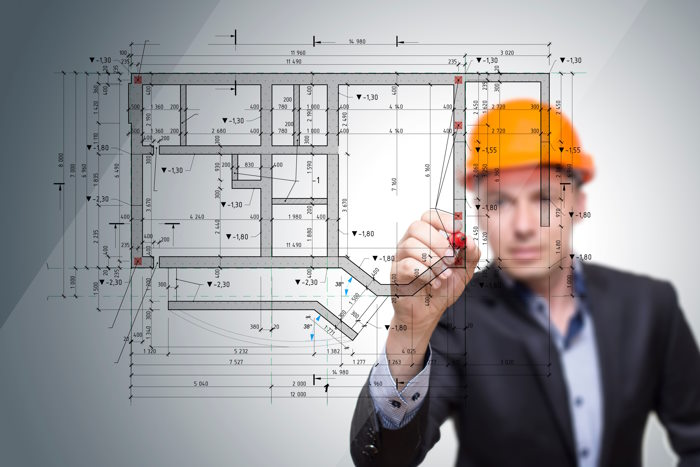
It consists of generating from the beginning of the engineering work a plan with a roof grid that serves to order the false sky zones that each engineering discipline can use. It is clarified that this grid does not necessarily imply that the false sky will really make reticulated and modular, it can be in drywall or similar continuous material without joints or in any other material that is not modular. What is intended is to indicate the minimum rules so that each designer knows exactly where to locate their infrastructure and outputs, trying not to cross or overcome the outputs of other disciplines.
In the same way, the architect of the project has from the beginning a cut in a corridor, where the wide and sufficient detail is obtained so that each designer knows vertically where he places his ducteries and exactly divides the three-dimensional space for each network or subsystem.
With these two aids from the architects, engineers have clarity on where to place our elements from the beginning of the design and avoid costs in work and rework.
13. Do not use the tools in BIM methodology
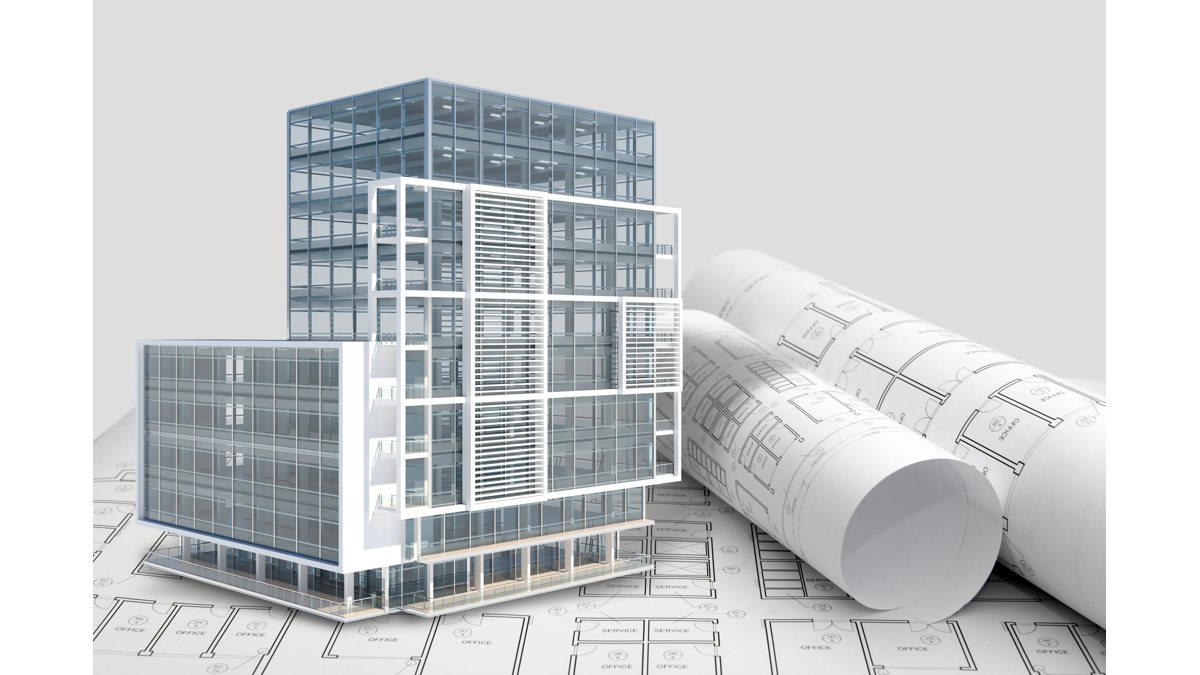
We are 22 years ago in the twenty-first century. Sometimes it seems that there are people who have not yet noticed. The BIM methodology is much more than a 3D blueprint. He has been at our service for several years and I know that there are many people who do not know what I am talking about.
When you make the plans in REVIT, Archicad or any other software with Building Information Modeling – BIM methodology, you can achieve a model closer to reality, correct duct crossings, better coordinate all engineering and architecture, improve installation details and have certainty about work quantities, budgets and installation times. So honestly, I think it's unforgivable that you don't use this.
14. Not coordinating details with other designers
For example, coordinate with the electrical engineer the number of power supply outlets, their capacity in Watts and the exact point where you want that electrical output. Almost always within the interconnection and general control rooms.
You must coordinate with the Air Conditioning Designer, the type of system that is required for equipment rooms, interconnection and main room. You must coordinate your fire detection system with the HVAC supply grids.
You must coordinate with the hydraulic designer the exact site of the flow sensors, valve sensors, and Sprinklers system test boxes and manual fire extinguishing.
And there are dozens of additional cases that must be coordinated accurately (in millimeters) to ensure that the tube, cable or output will serve what is required and will not have to be moved on site generating an extra cost.

15. Do not generate an orderly structure for pipelines
Communications have long used the same concepts, which you can find in TIA862, where communication connection spaces are used that come underground (Lower Room) or come aerial (Upper Room); Networks for dispersion and distribution that are joined in interconnection rooms, preserving verticality and sufficient quantity according to the area of each plant.
Security systems, communications, audio and video distribution or control of electromechanical equipment, must comply with all this in a standard way.
16. Not giving the necessary importance to interconnection rooms
They are the technical communications rooms that must be on each floor of a building and that form the core of the infrastructure necessary for the networks. Many times it is believed that they are cabinets embedded in the walls or that they are similar to electrical panels, but they really take up much more space and look more like the spaces of HVAC units than the electrical network.
The main mistakes are simply the non-existence of these rooms at the architectural level or placing them in places that do not provide the primary function, increasing costs by having to use fiber optics in excess or simply having to sacrifice some area designed to cede it to communications networks.
Another mistake is not having the minimum necessary area, not having the height where a cabinet of 42U or higher fits. The standards call for minimum areas for these rooms of 70 square feet, but really in most cases they are recommended from 100 square feet onwards. It depends on the amount of wiring and equipment that is concentrated in these sites. This implies a minimum amount of Rack Cabinets plus spaces for maintenance.
Easily in medium projects grow to 150 square feet and in large projects to more than 200 square feet. The area of these spaces is not much larger, but what does increase in large and large projects is the number of these technical rooms. The EIA/TIA568 standard means that a UTP cable of category 5 onwards is not used for paths greater than 300 linear feet, therefore, in many cases the area of the floors and plants causes several interconnection rooms to be used.
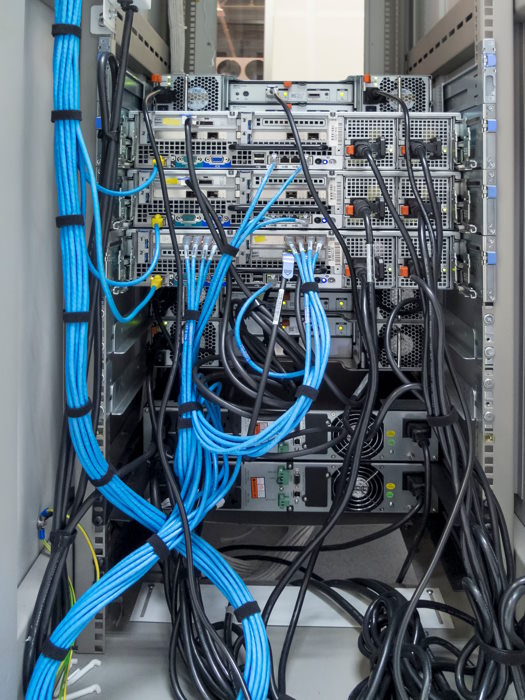 They must try to preserve the verticality between floors, that is, they must be located one above the other. Almost always interconnected with a free space that in some countries they call "buitrón de redes", which must be sealed by fire regulations at the end of the installations.
To finish these technical rooms must have the corresponding physical security (door, lock, fire walls) and electronics (fire detection and extinction, access control, intrusion alarm, video surveillance), plus the correct environmental conditions that determine special HVAC units, sometimes simple, but other times precision and the correct lighting for operation and maintenance.
17. Not thinking about security and redundancy
The redundancy that we so often try to eliminate to be efficient, in technology, means a safer and more reliable system; therefore, it is highly desirable. Many times we leave the stability and continuity in the operation in the hands of a single service provider or a single computer or a single software and when it fails, everything is lost. Therefore, we must always think about generating redundancies in equipment, communication routes, energy sources, servers, storage site among many others.
The mission-critical infrastructure does not escape this concept, therefore, ring, mesh or closed networks are used, in such a way that if communication is cut on one side to continue on another path, redundant control rooms, software with fail over, or mirror configuration are used. It depends on the importance of the system and the operation that exists in each site. Obviously the costs go up a little but it is well worth it to ensure continuity in the operation. UPSs or uninterruptible electrical power systems serve a similar function and others occupy important spaces outside cabinets in an interconnect room.
18. Together, but not scrambled
Mixing some subsystems with others is possible, but special care must be taken not to make scrambles that increase the risk and jeopardize the operation. As far as possible from the electrical part (at least 1 or 2 feet) that produces EMI/RFI type interference and disrupts electronic systems. As far as possible from the hydraulic part and if it is necessary to be close, hopefully be on top of the pipe to avoid leaks that damage the indoor cables.
Although the control center can concentrate the operation of all subsystems in a single console, it is recommended that the security, audio/video, maintenance, and control roles be separated into separate workstations.
Internal wired or wireless networks must be completely separate and autonomous for their use. That is, there must be a LAN for security, another for control, another for A/V distribution and above all that all these LANs are not the same corporate LAN of each site.
19. Forgetting the necessary networks
Sometimes there are forgetfulness of networks because they were not in the first phase of the project. Then the space is not left in trays, pipes and control cabinets either. It happens with the less important networks, such as ambient sound, IPTV, Digital Signage, nurses' call, parking control and guidance, irrigation control, among many others ... So when it comes to these other phases, it turns out that the infrastructure is already filled, there are no spaces in the interconnection rooms and innumerable problems arise that denote the basic error: lack of planning.
20. Forgetting to test the different subsystems
It is a failure attributable to the end user and owner of the systems or to the supervisor of the contract. Do not hire the commissioning service (exhaustive tests to each installed device), in scenarios of normality, alarm, emergency or failure, autonomously and integrated.
Therefore, no fine adjustments of the system are made, nor is the certificate of conformity obtained that guarantees that everything is tested and according to the actual designs and needs of the owner of the system. On many occasions by not requiring these tests, the systems are left poorly installed, poorly operated, poorly integrated, poorly automated and therefore the expectations that were placed at the beginning of the project decay and become disappointment, because the technology does not meet expectations.
21. Misuse of the WLAN system with WiFi
In this era the gigantic number of devices that can interconnect wirelessly is overwhelming, however, in mission-critical facilities it is not recommended that the primary system is a WLAN. But it is advisable that there is a redundant backup to the traditional wired system through WiFi. So the mistake is to go to extremes: all wireless or all wired. There must be a wired network that satisfies all the functions of the different subsystems in a stable, predictable and continuous manner. Based on this wired LAN, AP (Access Point) must be added to radiate a WiFi signal in all parts of the building as a backup and improving the comfort of users.
A common mistake today is to pretend that everything is done based on the WiFi network and not even a wired network is made for APs. Therefore, the building is often left with an inefficient and unstable WLAN. In mission-critical buildings this does not comply with the regulations.
22. Failure to comply with good installation practices
Without necessarily being in a mandatory standard or standard, good installation practices are recommendations of manufacturers and teachers of the guild so that everything works easier, cheaper, more controlled. The mistake is simply in ignoring them or not applying them.
For example: Do not leave record plans of how it is built, knowing that it is the most important record to improve updating and maintenance processes. Do not place passage boxes at least every 100 feet. Leave more than two curves in the pipe between passage boxes. Do not place the Data outputs at the appropriate height according to the furniture to be used.
Do not place sufficient Voice and Data outputs, depending on the equipment and needs of each person. Do not place inspection windows in closed false ceilings (there must be one to reach each device that is required and there must be a window at least every 5 meters over the path of cable trays). Do not follow general or specialized regulations in the type of space that is being worked.
If you notice, the vast majority of errors listed can be corrected by proper planning.
* Eng. Germán Alexis Cortés H.
[email protected] - [email protected]