 You hear it said ad nauseam that the video surveillance industry is rapidly migrating from analog video to IP video. Both system integrators and end users need options for migrating and installing IP video surveillance. They need more options to achieve migration and at the same time they need to stay on a realistic budget.
By Guy Apple*
For decades, millions of analog CCTV cameras have been connected to recording and control equipment via coaxial cable. In fact, about 80% of analog cameras were installed with coaxial cable spans, many of which exceed 100m.
Many installers and end users have been assured that the only way to implement an IP video surveillance network is to give up coaxial cable and start from scratch with Cat 5/6 structured cables and expensive IDF enclosures or medium-range Ethernet extenders, located at 100m intervals.
In addition, by provision of the fire prevention code, all old wiring must be removed.
A viable alternative
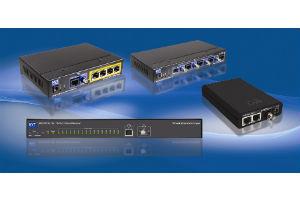
An alternative to this time-consuming and expensive scenario is to use existing cabling, whether it's coaxial cable, UTP, or other copper wire. NVT's TBus® transmission system allows installers to take advantage of the benefits of extended PoE power and remote data transmission, using existing cables. TBus (short for relay bus) technology allows installers to cope with the IP migration process, while reducing the time and labor associated with wiring and installing an IDF enclosure infrastructure.
Advantages of Ethernet with the TBus transmission system
The following are the main benefits:
1. It is compatible with almost any type of cable, allowing to reinstall the existing wiring.
2. It supports any connection topology (star, waterfall or ring).
3. It allows to cover long distances, up to five times those covered by Ethernet. This no longer requires IDF cabinets or PoE extenders, or local AC power. 4. Possibility to connect several IP cameras to a coaxial cable, which saves cable, time and resources.
5. Users can perform IP migration at their own pace and gradually.
6. Quick and easy installation.
7. Reuse of existing cable is an environmentally responsible practice.
8. Radical reduction of interruptions in the operations of the facilities.
Leveraging existing investment
The flexibility of the TBus solution allows for an economical, simple and hassle-free migration, thus avoiding the need for massive upgrades.
If it were necessary to install a completely new infrastructure, the project would be executed in one fell swoop, which would involve an expensive and massive renovation. Employing existing coaxial and UTP cabling allows the end user the luxury of migrating from analog cameras to IP cameras in the most convenient period of time.
Thanks to the reuse of existing cabling technology with TBus technology and reduced labor, it can cost only half of what an IP upgrade would be worth.
Connecting multiple IP cameras with one cable
Conventional IP products with coaxial cable currently available on the market come with a point-to-point system, which means that only one transceiver with local power in the camera and one transceiver with local power in the control room are available, or they work connected to a PoE port of an expensive PoE switch. These options are not efficient for systems with multiple cameras.
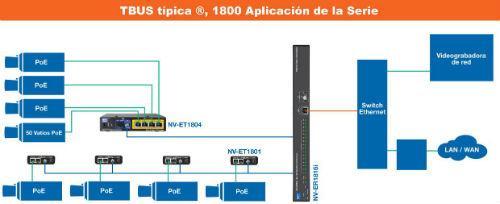
Thanks to a TBus distribution center, located in the control room, the potential of the system is maximized by supporting several remote transceivers and their cameras. The technology takes advantage of a stretch of cable that splits to provide transmission links to multiple cameras (see diagram). This translates into simple and inexpensive upgrades to IP cameras and minimal installation labor.
The distance problem with Ethernet
Conventional Ethernet signal repeaters must be installed every 100m. For the installer, this usually means placing IDF cabinets at unusual points in the installations, in order to create an ideal point for data repetition/power supply. Typically, this implies that a security enclosure must be installed that must have uninterruptible AC power installed. A camera located at 225m requires two repeaters.
These repeaters, added to their respective connections are a potential remote failure point that can become a major headache.
Thanks to the TBus with PoE, 56VDC are supplied in the control room and up to 50 watts are distributed to the TBus transceivers and their PoE cameras. It is not necessary to install repeaters and the problem of distance and power supply is solved without affecting the budget. Cameras can operate from the same UPS as the control room equipment.
Easy installation
The TBus system offers an easy-to-connect and transparent network that is very easy to use, reliable and allows seamless integration between existing cabling and the Ethernet backbone.
In order to provide maximum signal integrity and security, the TBus network offers 128-bit AES encryption through a one-button process called "Joining".
Without altering the activities of the facilities
Extending coverage over long distances using any cable and any topology allows for a gradual migration. This makes it easier for end-user operations to control the impact on work schedules. In the case of hospitals, for example, this minimizes disruption to services provided to patients. In its application to the gaming industry, this feature allows gaming tables and machines to operate within the framework of regulations issued by the supervisory authorities.
One more thing
The TBus solution doesn't just support IP cameras. It can also be used to provide Ethernet connection to all facilities for access control applications, wireless access point, IP phones, gate stations, security gates, or any other Ethernet transmission application. It is even possible to send CATV (cable television) signals.
Conclusion
The elegance of a TBus solution lies in the simplicity of its design and application. Installation is easy, data is robust and reliable, and everyone saves money. TBus technology allows more installers to cope with IP migration with a new set of financing and installation options.
*Guy Apple is Vice President of Marketing and Sales for Network Video Technologies (NVT). To contact you, please call +1 (650) 462-8100, ext. 210 or email: [email protected]