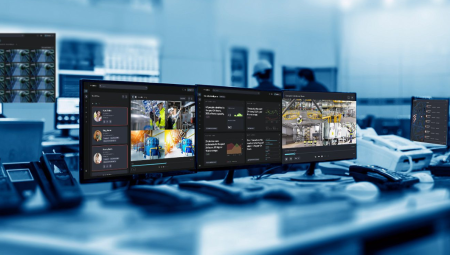
A corporate system can mean different things to different people. In this case we conceive a corporate system as one that maintains centralized control over an entire access control solution, while each headquarters independently controls their respective operations.
By Ricardo Pulido*
The robustness of such a system gives headquarters system administrators the ability to configure, manage, and monitor all locations from that location. It also allows them to simultaneously monitor alarms from multiple facilities from a workstation that is convenient for them.
Whether your organization is made up of a few locations located in different parts of a region or has many facilities around the world, a corporate solution adapts to the growth of your company.
The most important factor to consider when starting to plan your transition to a corporate access control solution is readiness. You should know what resources you have, who will be the main figures who will help you in this process and how to develop a solid plan to get the system up and running properly. When migrating to a corporate system there are a number of aspects of the process that are important and should be considered.
Define the "Operational Paradigm"
Organizations often experience stumbles because they do not define the operational paradigm. To put it in simpler terms, they don't deal with administrative processes, reporting and monitoring, or control experiences.
They have failed to have a panoramic view of the process. When moving to a corporate solution, a large number of functions, reports and processes will be added to your security solution and it is convenient to make sure that you invest the necessary time to redistribute the organization of this workflow.
The transition to a corporate system provides the opportunity to review and clean up databases, evaluate your old models, procedures, and your old technologies, and see where you can implement improvements or changes. The perfect time to define critical points is at the beginning of the process, not at the end. Often, this process provides the system owner with the opportunity to examine and debug their database, which, most likely, for years will have been managed by different people and groups.
The following are some of the questions that need to be asked: what existing reports can still be useful to you and what new ones will you require? What needs to be updated? Given the increasing number of alarm monitoring features, how will you incorporate them into your workflow and associate it with management measurement?
An equally important administrative process is to re-evaluate its nomenclature. Will your current nomenclature work across the corporate system? Or is it necessary to make modifications? Make sure you have a nomenclature that works for the entire corporate system, considering how it will affect different groups, including processes such as administration, reporting, monitoring, and integrations.
With a corporate system, you will now need to monitor several buildings, each of which has its own front door. How are you going to differentiate one door from another in your new nomenclature, taking into consideration the importance of having all this organized before starting the transition?
It is also essential to optimize the generation of reports before starting this type of project. Your organization currently has information about people, places, policies, and ideas in various locations. How much of this data will you keep? and How are they going to live together in the new unified system?
An important element is to adopt an advanced reporting solution designed to properly collect and organize your company's information. These tools will help you transform business intelligence into security intelligence through intuitive online interfaces, which allow you to examine information without printing or reviewing paper copies.
Set expectations
The second big step in making a successful transition is to define expectations in terms of performance and scalability.
Understanding the volume you are planning to process in your company allows you to properly define the overall architecture of the system. After all, all systems have their limits or lead to potentially unnecessary additional costs, so proper analysis of input activity, whether it's the door status monitor or the outbound traffic request, will be of use to you in this process.
Coordinate the different parties involved
In most cases, the transition to a corporate system will involve coordination between several parties (departments, headquarters and distributors). It is critical to communicate clearly with all the internal and external groups involved, including the main integrators, the IT department and others.
Integrators will be asked to install the various applications, ranging from solutions for the security and fire protection industry to CCTV solutions, for intrusion control and visitor management. Your IT team can take care of the transition to a virtual environment and monitor these needs during the process.
Another element that needs to be taken into account is the use of an additional maintenance team so that before the transition it carries out an audit of all its current systems, in order to determine inadequate inputs or outputs or any other errors in the system, such as possible problems in its database.
This audit can identify hidden information, not recorded in the journal, damaged equipment, credentials that may not have been transferred from one system to another, and other maintenance-related reports. Such an audit will bring to light errors in the current system that can be corrected before the transition.
When dealing with database migration, it is always advisable that the process be commissioned to the certified integrator and that he present a plan endorsed by the manufacturer or developer of the new systems, clearly indicating the scope and limitations of the process, if any.
Building a team
As we stated from the beginning of this article, the success of a transition lies in having a plan. And having a plan is basically about building a team. Decide who will be part of it, who will design the plan to migrate the data from your current access control systems to the corporate solution, and who will maintain the system and data once it is up and running.
Ideally, the team should be made up of people from human resources, security operations, IT and server management. Once the team is formed, define who will be responsible for each task.
This information must be clearly documented in a schedule, in which the expected results of each team member are also defined. Such results will include import and export requirements, reporting requirements, and data owners.
Doing this will allow you to determine any issues that may arise, which can be stored separately until you are identified and an imported solution is implemented to properly handle staff and credential updating.
Be prepared for the unknown
The last aspect you should consider is to be prepared for the unexpected. It's not easy, of course, but it's critical if the desired outcome is a successful transition. By fully understanding the system and everything around it, you are better prepared to deal with potential problems.
So stay on top of firewalls, virus protection, malware, backups, data sources, desktop management policies, update policies, and similar issues. On the economic side, be well educated about the annual costs of licensing, support services and upgrades.
They are often already covered in the first 12 months of operation, but are overlooked for the second year onwards. Be sure to hire this annual support service, it is the most cost-effective decision that will give peace of mind to your operation.
Pre-auditing all equipment will help you determine a part of this. So implement a plan and know ahead of time what details you want to include.
Transitioning to a corporate access control solution is a big step. With such complex requirements, there are many aspects that are essential to take into account. Be sure to prepare all steps of the process, know your resources and key personnel, and develop a solid plan. If you invest the necessary time and prepare properly, this can be a successful and smooth process.
* Ricardo Pulido is Regional Sales Manager for Northern Latin America and the Caribbean for Tyco Security Products. Industrial Engineer with 14 years of experience in consultative sales and business development.