

 We all know that a monitor is not required to see every camera we place, but then how many monitors do we need?
by Germán Alexis Cortés H.
Many of the attendees with whom I have the honor of sharing in the training courses of the Association (www.alas-la.org), answer me: "... that depends on the number of recorders ..." or "... you have to divide the number of cameras, by 16 ..." or a simple "... it depends ...". However, the right answer is not necessarily what you think.
The basics
Let's start from the basics ... the ideal would always be to see all the images, after all for that we are placing a camera, but when the number of cameras begins to be large, it becomes difficult to be aware of all. That's the problem that modern software largely solves, when doing video analytics.
But additionally we can not have many monitors because the costs of the CCTV system rise considerably, either by the price of the monitors, by the necessary space, by the furniture they require, by the amount of energy they consume, by the heat they generate ... but above all, by the number of humans that are required to see them.
Fortunately, the CCTV market has image concentrators that today make video recorders and matrices. It is then these devices that are called upon to receive all possible video signals and distribute them to the different monitors.
But the number of monitors should not depend on the hardware offered by these devices, but on a careful and analytical study of what is really required to see.
The vast majority of professionals in CCTV, neglect a little the issue of monitors, partly because we already get used to all the cameras installed, we must record them. So we believe that the goal of the video surveillance system is to record and not visualize. However, no one buys a CCTV system to see the accidents that have occurred; but to avoid them as far as possible.
And in order to prevent a situation, it is necessary that a human is watching the scene and taking the necessary actions with sufficient anticipation, which can even be a few seconds. It is at this time that the CCTV system becomes an integral part of a security system that combines the passive, electronic and active part efficiently.
The number of images an operator can observe depends on the type of monitor, its size, quantity, distance, the importance of the scene and the equipment that manages them. It is essential to give the operator the necessary tools so that he can do a good job on time.
Evaluating scenes
In any installation there are three types of scenes, which depends on the importance of what is happening there:
A. Camera images that we almost never see, because there is no need to be viewing continuously.
B. Images from cameras that should only be seen, when some special event happens.
C. Camera images that a human should always observe to prevent undesirable events.
The most critical situation occurs when situations of great importance occur simultaneously in different cameras. This can happen routinely at some times of the day or sporadically in an emergency situation. This analysis should be done at the design stage of the system, and should determine how many and which simultaneous images will need to be displayed at the most critical moment on a routine basis.
It is understood that in a special incident such as a fire, explosion, earthquake, among others, the vast majority of cameras would be important ... but as we have already seen it is not efficient, to be seeing all the cameras simultaneously. Although it is clarified that for that reason we must be recording permanently and in good quality the vast majority of scenes, even if no one is viewing them.
Now that we know how many images we should see simultaneously, in those moments of great importance within the daily routine in each site, then we look at the image management teams we have in the market.
For the images of the type A cameras, we do not need a special dedicated monitor. Let's see what happens to type B cameras. Some of those images should only be seen when a special situation occurs.
If we have recorders or matrices that have alarm inputs and we can place sensors that detect some of those special situations, then we can automate the visualization process (and recording), so that only when the sensors detect it shows us the pertinent images (notice that the event, can generate the need to see an image or several).
If our equipment has an adequate image change detection system, configurable for each channel, with the possibility of adjusting sensitivity and adaptable to schedules; then these systems largely complement the external sensors that can be located.
And if finally our system has a video analytics software, where we can define complex and special situations, which automatically alerts us; then we will have completely solved the problem for the visualization of the images of the type B cameras.
To see these images that the system automatically presents to us, we must separate at least 1 monitor. In large installations (more than 3 video recorders or more than 50 images), the statistical and probable analysis of how many simultaneous situations could routinely occur should be done. And in that case place more monitors dedicated especially to visualize the automatisms of our system.
Finally we have the type C images that we must always see. In this case, special care must be given to the main entrances and exits of the areas and / or scenes where there is a high risk (money, values, key production processes, important characters, among others).
Time of day counts
We must understand that these situations do not always become critical... rather they are routine; but it is precisely there that undesirable situations happen that could well be prevented. So, although during much of the day, you can see the scenes sequentially or in very small size ... it is in the critical hours where we must visualize large and absolutely clear images, which allow the operator to act quickly and accurately, relying on his work team.
When there are many images that must be seen simultaneously and we do not have automatisms that help us, it is recommended that the number of operators and obviously monitors be increased.
Human capacity
The human needs a high level of concentration to be able to detect abnormal situations in a scene and react in time. The higher your concentration level, the better results you get. Let's understand then that the lower the concentration you have, the risk associated with your work increases significantly.
In order for you to understand the situation, just remember why you like to go to the movies. Perhaps because of the effects, the lighting, the sound, the comfort and above all because you concentrate on the film and live it totally. Now think if you can clearly know what a character in the movie did, when he is working on the computer, his cell phone rings and he must attend to his daughter, all simultaneously ... right?
So in CCTV exactly the same thing happens. Very reputable entities such as ASIS, NIST, Scotland Yard and many manufacturers have diverse opinions on the number of images that an operator can control simultaneously. Some say that one (1) alone, others say that three (3), others that up to four (4), others say that it depends on the angle of view and distance, others that it depends on the scene and what you want to see of it ... however the most daring and only for certain applications of low control speaks of up to six (6) images per operator.
ASIS recommends that an operator be relieved of his job, in front of CCTV monitors, at least every two (2) – three (3) hours; although it is clear in indicating that within 20 minutes of his work management, the level of concentration has already dropped to 50%.
In experiments done by the British police, it was concluded that when an operator sees a single monitor, his concentration level in the first 5 minutes is 85%, with four images it drops to 74%, with six simultaneous images it drops to 58%, with nine images to 53% and with 16 images to 41%.
Studies tell us that an operator will be able to hold some minimum level of concentration up to 70 minutes if he is seeing a single image. Up to 30 minutes viewing four images and up to 20 minutes if you are viewing nine images. Even so, let's remember that the concentration level drops to less than 50%, after 20 minutes, regardless of the number of simultaneous images.
Therefore an operator who simultaneously sees 16 images will have only 41% of his capacity during the first five minutes of work and after 20 minutes his concentration level will be almost zero. Just imagine the level of concentration of that same operator, after six (6) – eight (8) legal hours of your shift. And after 12 hours? or 24 hours?
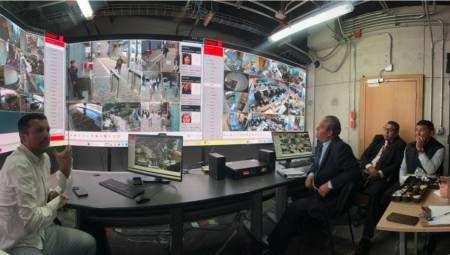
Believe me I have visited control centers, with more than 15 monitors, showing almost 200 cameras and pretending that the operator is aware of everything that happens in his 12-hour shift. I have also visited sites with more than 400 cameras, with half of the monitors and again everything in the hands of an operator, who sometimes has no technical or operational knowledge.
Don't fool the end user, the operators, the technicians and engineers, or yourself. It is asking for impossible and is leaving the very high investment that the end user makes, in unprofessional hands, in inefficient conditions, with inadequate tools and therefore the final result is mediocre or simply null. It calls into question the reputation of the entire guild and the business cycle is interrupted because that end user does not buy anything from you again.
In the next edition of SECURITY SALES we will continue with the second part of this theme, which will talk about the resolution of the monitors, their size and viewing distance, as well as practical examples, analysis and current trends in this matter.
* Germán Alexis Cortés H. is a Colombian Electronic Engineer, with a postgraduate degree in Engineering Management Systems. Consultant of the National Institute of Standards and Technology – NIST, in Electronic Security and Building Automation. CCP of ASIS, and CISSP of ISC2. He has over 20 years of experience in the electronic security industry. Renowned lecturer and university professor on high-tech issues at the Latino level. He has been a director of several companies in the sector and is currently a partner and directs Insetrón Ltda, an engineering and technical consulting company in electronic network projects for security, communications and automation. He has successfully participated in more than 150 projects at the Latino level.







¿El monitor en el cual se muestra la imagen de las cámaras de seguridad qué características debe tener? ¿Podría ser una televisión normal?
Sé que se debe tener en cuenta que debe estar encendido 24/7, sin embargo: ¿Cual podría cumplir con esto?
Hola, Nicolás. El Ing. Germán Cortés nos envía la siguiente respuesta:
El monitor no debería ser un Televisor normal, no solo por la vida útil sino porque no fue hecho para este tipo de aplicaciones. EL contraste, el brillo, la velocidad de cambio de un pixel a otro color menor a 3msg, la temperatura de los componentes, la resolución, el ajuste de color y la estabilidad de todo el sistema. Se debe buscar un MONITOR PARA CCTV o VIDEOVIGILANCIA. Normalmente son un poco más costosos, pero garantizan que toda la inversión realizada en las cámaras se lleve a una imagen confiable, estable y de buena claridad.
Sin embargo, la gran mayoría de personas usan como monitores de CCTV, los monitores de computador y en ese caso es peor aun, porque nunca fue hecho para mostrar video de forma permanente.
Saludos.