
 Recently, HDCCTV over coaxial cable has caught the attention of the industry. That is, the use of coaxial cable for the transmission of high-definition video using cameras and special recorders/controllers.
by Guy Apple*
It still seems somewhat distant, however hdcctv promoters bring some good points to the IP market. The fact is that customers need economical and installation options related to IP applications.
Approximately 80% of analog cameras were installed with coaxial cable. Imagine that there is a way to install IP and Megapixel cameras on that existing cable, even supplying PoE if necessary.
Here we will examine the reasons for using EoC (Ethernet by Coaxial) technology to offer an economically viable and easy installation solution.
Economy
End users are always concerned about cost. EoC technology leverages the legacy of coaxial cable, saving up to 25% of the cost of an UPGRADE to IP.
There is another cost that is often overlooked. In some states, leaving unused cable in place without being connected at both ends (or not properly labeled for future use) is not legal. This has to do with safety in loading fuel from fire and smoke. National Electrical Code Regulations 800.2 and 770.2 prohibit the abandonment of used cable. Removal and disposal/recycling of existing cable is expensive.
Plant Disruption
Disruption of plant operations can also be an economic consideration. In the case of a school, bank or casino, uptime means money. Leaving coaxial cable in place means increased camera replacements without disruption to normal operations.
Ethernet Extender/Repeater Distance
With Ethernet/PoE, repeaters must be installed every 100 meters. For the installer, this usually means supplying power in strange places throughout the facility in order to create an appropriate point of data repetition/power supply.
A camera at 225 meters requires two repeaters. These repeaters, their associated connectorization, and the typical need for constant power (UPS) add up to become a potential remote point of failure.
With EoC-based PoE, 48V power is supplied in the control room and distributed to EoC transceivers and IP cameras. There are no repeaters and the problem is solved without impacting the budget.
Many IP cameras can be powered through the existing 24VAC distribution system. However, PoE adds value, increases customer choice and can simplify the design. With EoC-based PoE, cameras can operate from the same UPS, as control room equipment.
Easy installation, no software configuration required
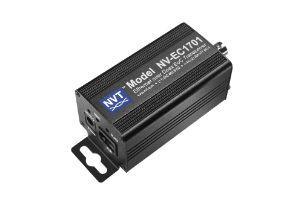
EoC provides a transparent plug and play network that is very easy to use, reliable, and provides seamless integration between the existing coaxial cable and the Ethernet backbone. EoC supports network protocols, such as UDP, TCP/IP, HTTP, etc. without any necessary configuration.
Maximizing the potential of EoC
The typical Ethernet over coaxial cable product on the market is peer-to-peer, which means a locally powered transceiver in the camera and a locally powered transceiver in the control room. This is fine for small systems, but it's not designed for systems that offer a large number of IP and Megapixel cameras.
A better solution is to have an EoC transceiver in the control room that supports up to four remote transceivers and their cameras. Video streaming and PoE are supported at distances well beyond the standard 100-meter Ethernet. This allows you to take advantage and flexibility of the system, camera upgrades and minimal manpower.
Summarizing
The goodness of an Ethernet Network over coaxial cable solution is the simplicity of its design and application. Installation is simple, data is robust and reliable, and everyone saves money.
EoC technology will allow more installers to approach an IP migration project with a new set of financial and installation options
*Guy Apple is the VP of Marketing & Sales for Network Video Technologies, NVT.