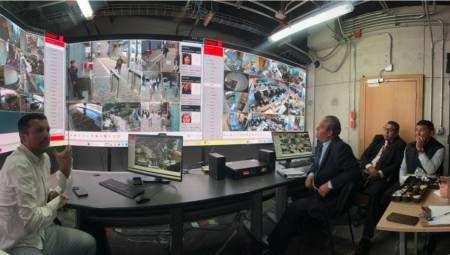
 As with other virtualized services, a hosted video surveillance platform allows users to access the power of the cost-effectiveness of cloud services by eliminating the need for on-site storage and maintenance.
by Matt Krebs*
This helps business owners reduce capital investment in physical security and add it to the total cost of ownership.
Fans of "Law and Order," "CSI" and other popular crime series have seen the video surveillance gimmicks – but have you stopped to compare Hollywood surveillance to what you see on the 11 a.m. news?
In the real world, even images of bank or convenience store robberies are usually replete with blurry green granules – terrible image quality for anyone looking for forensic evidence or using it for identification purposes.
How in a world where HDTV, Blu-ray and IMAX 3D dominate the territory of entertainment, how can a video surveillance camera be so poor? That's because surprisingly, 80% of security installations are still based on analog coaxial technology.
Physical security is one of the last industries to enter the digital age – especially in small shops, banks and gas stations, which dominate the base of the facility.
The reason? IP video-based surveillance systems – while providing superior image quality, flexibility and functionality – are often not a cost-effective analog alternative to an installation that needs only a few cameras to protect property.
But thanks to virtualization and the benefits of service management, those who require the benefits of video surveillance can migrate to the hosted video society.
The following are 5 reasons why cloud services are changing in the surveillance industry:
1. The hosted video is finally quite safe
The physical security industry is historically slow to adapt to change. When the work is to protect the lives and property of the surrounding community, it is incomprehensible to want to use what is familiar. However, IT and industry customers have paved a trajectory for relying on the cloud.
Today, we rely on personal finance, Social Security Numbers, and email data in the cloud, so security managers have been educated to rely on Internet-based services. Since an IP-based security appliance is essentially another node in the network, and must have the same passwords at multiple levels, SSL encryption, VPNs (Virtual Private Network) and firewalls protecting it.
In the top layer of the camera by itself, the hosted technology in physical security has been improved to protect the current video. Security provisions are instead of a camera connected in one go to a specific cloud hosting provider, it will communicate to a server only, unless it physically resumes and re-registers. Additionally, the same compliance regulations apply to video surveillance hosting providers, including SAS 70, RSA encrptation and ISO 27001 compliant.
The argument can be based on the fact that the storage of video data is more secure than in a DVR – that it is united over a solution based on analog security. With hosted video, there are no devices for physical recordings that can be stolen or video evidence that can be destroyed. Inverted form, inexpensive storage devices, called "networked storage," or "NAS," can be added to the system to protect against network failures.
2. Hosted Video is surprisingly easy to use and buy
A key to any electronic security deployment is easy installation, ongoing system operation and maintenance. Initially, installing an IP device (camera) is much easier than installing its analog counterpart: There is no coaxial cable to install, no BNC connectors to adjust and add, and no awkward power supplies to handle.
With an IP camera, the device is simply connected to any switch on the network – and the switch supports PoE, eliminating the need for an external power source.
In addition to the efficiencies of the installation, there are the ready-to-use methods that allow the IP camera to "call home" its host server with a single click, eliminating the need for installers to navigate firewalls, IP addresses and ports, making the installation process more dynamic.
The ongoing operation and support of the system is also easier than with its predecessor. Through a simple Web browser, users can connect to their cameras and systems to view live video, history and events, as well as manage these processes through mobile devices such as iPhone or iPad, a BlackBerry or an Android smartphone.
System maintenance and updates are manipulated behind the scenes through hosting provider. End users need to simply navigate through your Web portal and remember their username and password.
3. Hosted Video offers more benefits than other Systems
Cloud video hosting provides a simple, purchasable, scalable recording solution for video surveillance. A viable alternative is an SMB with a remote monitor, a license with multiple sites that need to be monitored simultaneously, or a large corporation looking to securely archive off-site to satisfy internal policies or points of compliance.
As in other virtualized services, the hosted video surveillance platform allows users to provoke boost the power and cost-effectiveness of cloud services by eliminating the need for site storage and maintenance. This helps business owners reduce capital investment in physical security technology by adding the total cost to ownership.
Although video data resides in the cloud, users can still access live and archived video through a portal wherever there is a device with an internet connection.
The cloud protects against theft or possible damage to site recordings. In addition, augmenting the system with a local NAS not only protects against critical video loss if the network goes down, but also allows recording in high resolution.
4. Hosted Video works for large and small businesses
Ideally, it considers systems that feature a smaller camera to be more suited to hosted video surveillance bandwidth, but there are applications for hosted video from family businesses to large retail businesses.
Large commercial operations seek to be more agile, more cost-effective ways to deploy discreet surveillance, occasionally surveillance is also interested in users of this technology. Hosted Video is ideal for them, because the connected camera can move from place to place easily, and automatically finds its path back to the host and reconnects.
In addition, companies currently managing surveillance systems have identified the need to move "critical video data" off-site to secure in a cloud-based locality because they cannot afford to lose this data.
ATMs, server rooms, and pharmacies are examples of areas that store critical video content that if lost, can be problematic for the business. Companies can isolate these cameras and simply host them off-site so the video is safe and not a risk in the long run, of video manipulation or DVR theft.
5. Video Hosted Video works and works with Analog Systems
Since analog remains a popular alternative among small business owners, many of the devices are being installed with a substantially useful lifecycle. So, even if end users are interested in migrating to IP-based surveillance to improve image quality, functionality, TCO, and scalability, they may be reluctant about their recent investments.
Fortunately, the solution lies in building a good migration strategy, analog signals can be easily profitable by converting to digital using video encoders (sometimes called "video servers"). These devices fix the existing analog device, converting the current from analog to IP and then connect to a switch to communicate over the network. When the analog camera eventually fails, it can easily be replaced by a fully IP unit, and the migration will be complete.
In this scenario, without existing hardware, cable or infrastructure, it needs to be abandoned to the extent of making the conversion and taking the next step in the evolution of video surveillance based on network video surveillance – this is another way in which the cloud is changing the face of the industry.
* Matt Krebs is in charge of business development for the video solutions received at Axis Communications, which provides network surveillance video solutions.