
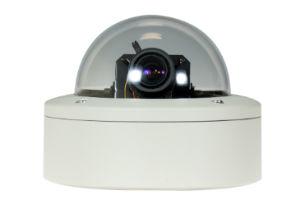
 Approximately 80% of all video systems used today are analog. However, many of these systems are clamoring for some of the benefits offered by high-resolution IP cameras.
by Adolph Salas*
The global HDCCTV (high-definition ccTV) interface standard originated from a group of standards, including SMPTE-292M, developed by the Society of Motion Picture and Television Engineers, to be applied in studios for television broadcasting. The HDCCTV works with the current coaxial cable, without an adapter.
For its installation it is not necessary to make configurations. It offers more than 2 megapixels of video without data compression. There is no compression of the information but it is completely digital, and offers images in 720p or 1080p and 30 frames per second. Contrary to what happens with standard megapixel and HD cameras, both recording and live viewing of places is immune to failures in the IP LAN network.
An important advantage for live monitoring, necessary, for example, in urban surveillance and casinos, is that the latency time is close to zero in the PTZ control (horizontal, vertical and zoom movement). Finally, although the cost per order per video channel is higher than that of analog CCT, it is much lower than that of megapixel IP cameras. In other words, HDCCTV provides analog systems with the high-resolution images they need, with the same ease and simplicity that characterizes the installation of these systems.
Use the same coaxial cable and install easily. Unlike IP camcorders, the HDCCTV is a point-to-point system that can use existing or category 5e or 6 coaxial cable, even fiber optics. This means that the video signal is sent directly from the camera to the recording device or digital video recorder without using packets, without compressing the information, without encoders and without the need to establish a network. Because of this, no extra training or creating an additional network is required for the system to work. There is no need to configure or program each device or take care of IP addresses.
Updates work automatically, without the need to configure them (plug and play). The installer simply needs to replace the current analog camera with an HDCCTV and uses the same coaxial cable. Just plug it in and it works. The camera can be connected to any compatible HDCCT recording device. It is not necessary to configure networks, there is no compression of the information, nor firewall, nor system incompatibility, there are no problems of congestion in the network, nor of disconnection of the service when installing and / or putting into operation the cameras.
One of the highest costs of any analog system conversion is the change of cabling infrastructure. HDCCTV technology offers organizations an easy and inexpensive way to upgrade an analog system to take advantage of some of the benefits of megapixel cameras.
Getting a better resolution is not a headache. Analog NTSC cameras can produce images of no more than 720x480 resolution, at a maximum resolution of 0.4 million pixels, and the signal degrades at a distance. HDCCTV cameras offer 720p and 1080p resolution at 30 full frames per second without latency or compression, producing images up to 1920x1080 pixels, six times the level of detail offered by NTSC. Consequently, the HDcctv can deliver higher quality forensic evidence at resolutions of approximately 2.1 megapixels in 1,080p and 1.3 megapixels in 720p.
Thus, these cameras offer much more detailed images than exclusively analog systems. The advantages at first glance consist of adequate facial recognition, license plate recognition and other video analysis solutions, in addition to high resolution and detailed incident verification.
No LAN failures. Because the HDCCTV's digital VCR is connected to a network, users can monitor all their cameras over the Internet. There is no need to worry about LAN congestion or bandwidth from the camera to the digital VCR.
Near-zero latency time. There is no latency time, which means that the video is transmitted smoothly and without fluctuations, jumps, or delays in the image. In other words, there is no delay between when commands are sent to a PTZ camera and when the camera responds. With this real-time PTZ dome control, minimal processing and minimal latency provide immediate joystick response.
This is especially important in remote applications, for example in an urban surveillance system. When these cameras are installed using fiber optics, rather than coaxial cable or UTP cabling, distances are measured in miles. Still, there is still no latency, something especially significant for an application like live monitoring, using a PTZ control.
Two clarifications about HDCCTV
As with all technologies, the benefits can be outweighed by some negative aspects that may arise in certain applications. As for HDcctv, such issues could include the following:
IP cameras win the resolution battle. With a maximum resolution of 2.1 megapixels, HDCCTV will continue to be defeated by the superior resolution of high-resolution IP video cameras in applications that need more than 2.1 megapixels. However, it is also necessary to remember that the most frequently used IP cameras today are those of 1.3 megapixels.
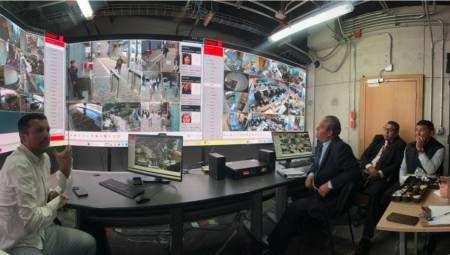
Most HDCCTV manufacturers do not produce a compatible switch, so switching video signal to the wall monitor is not possible. However, with Infinova's high-definition switching matrix, security operators can call and switch THE HD cameras to the desired monitor on the video wall and send the HD video to remote monitors in different parts of the building.
HDCCTV – The right solution for the right application – With so many technologies to choose from– analog, megapixel, HD.264 and HDCCTV – knowing both the benefits and disadvantages of HDCCTV will help integrators, users and other security professionals understand where HDCCTV can be most valuable to them.
*Adolph Salas is Infinova's Vice President of Sales for Latin America and the Caribbean.