 These kinds of activities deserve further implementation within fire safety processes. Let's know details of it.
By Jaime A. Moncada*
Wouldn't it be important for every project like a hotel, a hospital, or a power plant to have an integrated test showing that fire systems operate together and properly, and how they were originally designed?
Although this test sounds essential, the Integrated Test is rarely performed in the region and in my experience only a few entities in Latin America perform this type of test in their projects. Just to mention two examples, Marriott/Starwood hotels or U.S. government projects in Latin America require an Integrated Testing of human safety and fire protection systems prior to the opening of the building, and if this test does not work properly, the building simply does not open its doors until the Integrated Tests "pass."
Commissioning: The issue of the implementation of fire systems is an issue that, although it has always been important, only began to be regularized in fire safety since 2012, when NFPA issued its first document on Commissioning (Cx). This concept was standardized with the edition of NFPA 3, Recommended Practice for commissioning Fire Protection and Life Safety Systems1.
In a building, the Commissioning refers to the procedure under which it is verified that the fire safety systems meet the objectives of the user and the reference standards, in all their phases, from their conception, through their planning, design and construction / installation phases, until their commissioning, and that at the end of the project the fire safety systems are effective and functional.
In other words, Commissioning is a systematic process under which it is ensured, verified and documented that the requirements of human safety and fire protection are correctly executed during the conception, design, installation and start-up of the project. At the end of the Commissioning process, an Integrated Test of the fire systems is required.
However, the Commissioning of Fire Systems, as described in NFPA 3, to date has not had greater use in Latin America and when required in a project, this "Commissioning" refers mainly to the acceptance or commissioning tests of fire systems. In the United States, although the issue of Commissioning is much more advanced, this process is not mandatory and is required only by the user in certain very complex projects. However, integrated testing is mandatory and for that reason, since 2012, the NFPA took this topic out of NFPA 3 and created a new standard, NFPA 4, Standard for Integrated Testing of Fire Protection and Life Safety Systems.
Integrated Test: Integrated Testing refers to the testing of fire and life safety systems that confirms the operation, interaction, and coordination of the multiple independent subsystems, so that they perform their intended function. For example, in a high-rise hotel, activating the sprinkler system flow switch on a room floor should:
• Activate the audible alarm and the strobes, at least on the floor where the alarm was created.
• Send the elevators to the evacuation floor.
• Turn off the air conditioning system of the floor where the alarm was started.
• Start the pressurization system of the stairs.
• Initiate smoke extraction functions in the corridors of the floor where the alarm was created, among other functions.
• On the other hand, the main alarm panel and remote panels must receive an audible alarm and the panels must identify exactly the origin of the alarm, in simple Spanish.
• Possibly, the fire pump will also have operated, and the alarm panels must also identify this supervisory alarm.
That is, this simple test example must confirm the interaction and coordination between the alarm and detection system, the sprinkler system, the elevator system, the fire water pumping system and the building's air handling system. During the Integrated Test the contractors of each of these systems must be present.
Cause-Effect Matrix: How do you determine what should happen when an initiation element operates, or an element is disconnected, turned off, or closed? This is indicated in the cause-effect matrix of the project, also called the input-output matrix. This matrix reflects the sequence of operation based on system philosophy and fire protection standards. The cause-and-effect matrix is an integral part of integrated testing and is typically developed, in the design phase, by the project's fire protection engineer and is usually included in the alarm and detection drawings.
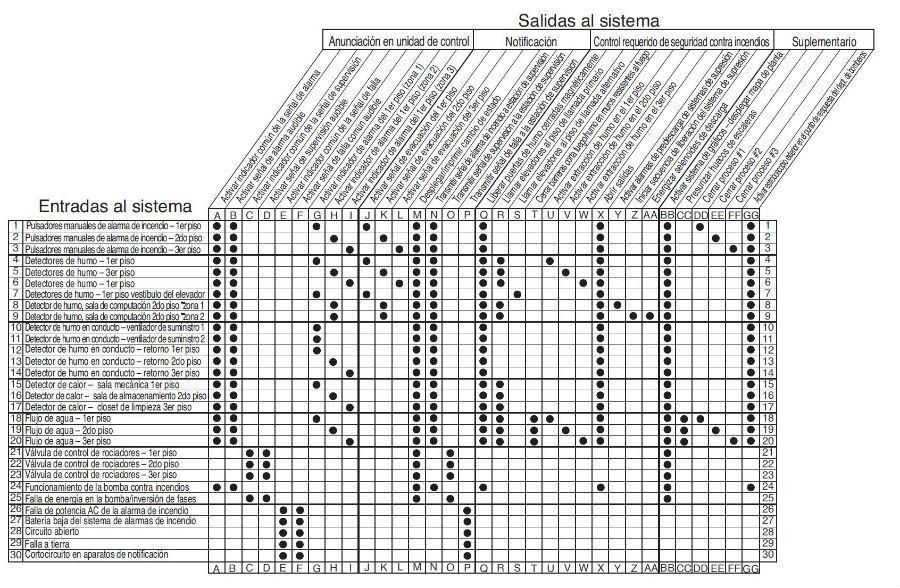
Figure 1. Typical Cause-Effect matrix showing the interrelationship between initiation elements (inputs or causes) and notification or action elements (Outputs or effects).
Integrated Test Agent (API): Integrated Testing of fire protection and life safety systems must be performed in the presence of the contractors of the various systems, who must operate the equipment, and in the presence of an Integrated Test Agent. This Agent is an entity identified by the owner of the building, which plans, coordinates, documents, implements and approves the Integrated Tests. The API is typically a fire protection engineering firm. Integrated Testing must be documented in test protocols that must indicate the results of the tests and where the API indicates that the building is suitable for operation or occupation.
Integrated Testing Frequencies: Integrated Testing must be performed on new projects, but also on existing projects where Integrated Testing was not originally performed. The NFPA gives a 5-year period for existing buildings to conduct this test, starting from the date NFPA 4 was adopted. Systems are also required to have a Periodic Integrated Test and their frequency depends on the importance of a building. For an important building such as an industry, high-rise building, hospital or airport, the Periodic Integrated Test should be between 3 to 5 years.
Footer 1: The NFPA 3 edition 2012 included in addition to the topic of commissioning, integrated testing of fire protection and life safety systems. As of 2015, this document is subdivided into NFPA 3, Recommended Practice for Commissioning of Fire Protection and Life Safety Systems and the new NFPA 4, Standard for the Integrated Testing of Fire Protection Systems and Life Safety Systems, extracting the chapters referring to Integrated Testing from the original NFPA 3. The last edition of these documents is from 2018.
* Jaime A. Moncada, PE is a director of International Fire Safety Consulting (IFSC), a fire protection engineering consulting firm based in Washington, DC. and with offices in Latin America. He is a fire protection engineer graduated from the University of Maryland, co-editor of the NFPA Fire Protection Manual, Vice President of the Society of Fire Protection Engineers (SFPE [email protected]).