 In this edition I will talk about detection pulses established by the Twin Pirs (Passive infrared), especially to consider their outdoor use.
by Basilio Ángel Holowczak*
A colleague indicated that he was always told to set 2 or 3 or more pulses on the pulse counter of a Pir, according to the pulses offered by the pulse counter of each particular Pir to avoid false alarms.
Considering that a counter of a Pir offers the choice of 1 and 3 pulses it is believed that when fixing 3 pulses 3 zones must be invaded with their 6 sensitive elements to create the alarm of the passive and thus avoid false alarms, this is true only in hot outdoor environments but if these are cold with only invading 1 single area with its 2 sensitive elements the 3 pulses are established.
Hot outdoor environments
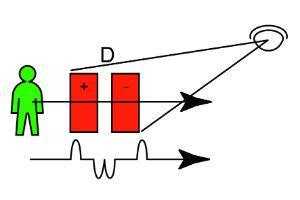
In hot outdoor environments (temperature close to that of the human body) if 3 zones are crossed (direction of movement of the positive to negative sensory element of each zone), the two sensitive elements of the first zone when crossed establish A negative pulse that exceeds the detection threshold, the second zone generates the same pulse as the first zone and the third zone the same.
That is, you will have the 3 negative pulses that exceed the detection threshold or 3 positive pulses if the direction of movement is from negative to positive elements and the detector will activate its alarm with 3 pulses fixed in the pulse counter, in this case false alarms are avoided but the detector will not be activated when the movement is towards the detector and not crossing its areas.
This must be done along a zone or eventually along a zone and then for a second, in this case they will be established: 1 single pulse if the movement occurred through or along 1 single zone (direct advance to the detector and not crossing zones) and 2 pulses if the movement or advance was first along 1 zone and then passed doing it doing so on a second area adjacent to it, being able to be 2 negative or positive pulses as a positive element of an area or a negative is first invaded respectively and in this case 3 PULSES WILL NOT BE ESTABLISHED and if the pulse counter is set to 3 pulses the detector will not go into alarm since only 1 zone (One pulse) or 2 zones (2 Pulses) and not 3 zones (3 Pulses) were invaded to alarm you).
Therefore, it is recommended for hot outdoor environments to set a pulse on the meter and lower the sensitivity to a level such that it detects only one person (Adjust the sensitivity in Summer), if the sensitivity adjustment is made in Winter increase by 20% the level found if in Summer temperatures higher than 30ºC are expected and leave fixed in a pulse to the meter for all seasons of the year to avoid detection in the face of external heat.
Obviously if it is left in 3 pulses it will be avoided in this case the false alarms in outdoor environments with high temperature but in that case it must be accepted that there will be detection if at least 3 zones are crossed and there will be no detection if only 1 or 2 zones of the Pir are crossed, thus committing the level of protection especially to be considered before external protection since indoors the movement in its Small environments will produce the crossing of 3 or many more areas of the detector (those that it offers).
Cold outdoor environments
In cold outdoor environments when advancing or moving only within a single area with its two sensitive elements there will be 3 pulses (2 positive and one negative that exceed the detection threshold if the direction of advance is from a positive element to a negative one or 2 negative pulses and a positive one against the opposite direction of a negative element to the positive) so fixing 3 pulses does not determine that there is that cross 3 zones with their 6 sensitive elements and then in this case it is not totally true that the 3 pulses avoid false alarms.
However, the 3 pulses can be used in cold environments and this is recommended for any interference that produces the generation of 1 erratic pulse in the detector. Note that in this case there is no risk of non-detection if the movement occurs ONLY ALONG A SINGLE AREA and not crossing several of them.
Special considerations
The following factors affect the detection range or sensitivity. Such factors increase with greater protection distances.
* Ambient temperature versus temperature of the object to be detected. The detection range can decrease when the object to be detected is of a temperature similar to the outside environment.
* The PIR detects better when the movements cross the detection zones, (mostly movements parallel to the detector). The detection sensitivity decreases for perpendicular or radial approach movements to the face or lens of the detector (movements along or within the detection zones).
* Mounting height: The lower the mounting height, the lower the detection range.
* Mount orientation: The deector must be installed perfectly vertical to ensure an adequate detection range (same height and protection distance throughout the coverage area).
* Slopes of the ground in front of the detector or within the coverage area: Positive or ascending slopes perpendicular to the vertical wall on which the detector is mounted will shorten the protection distance that is fixed, negative or descending slopes will lengthen the protection distance, this is also valid for slopes parallel to the wall on which the detector is mounted, in the lower area of the same the protection distance will be greater and in the high lower.
The following detection tests must be performed to achieve the desired adjustments at the installation sites in relation to their environmental conditions;
* Adjustable protection distance, the distance of the adjustment indicator is not final and should be used as a guide. Adjust the coverage so that the intruder crosses the detection zones
* Sensitivity adjustment through the sensitivity potentiometer to a level such that it allows ONLY the detection of a person. The coverage range can decrease up to 20% when the outside temperature is high, in this case the coverage range (protection distance) must be increased to compensate for the indicated decrease.
* When there is a vehicular path in front of the detection coverage such vehicles with their comparative temperature much higher than the human one (36.5ºC) can be detected at a greater distance than that set for the detector, readjust the coverage of the same for these cases.
*Basilio Ángel Holowczadel is an engineer in the Latin American & Caribbean Area of Takenaka engineering Co. Ltd. (Kyoto, Japan). If you wish you can contact him through the email [email protected] or the website www.takex.com.ar