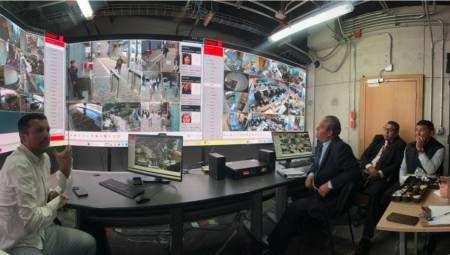
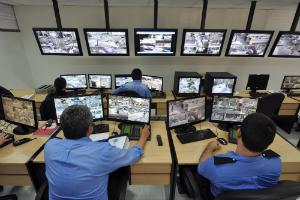
 Security plays a major role in crime prevention. Therefore, in the province of Mendoza, to accentuate police action, a modern Bosch video surveillance system was installed in order to prevent crimes and deter antisocial behavior in urban areas, semi-urban areas, vehicular accesses and interprovincial posts.
Bosch*
According to the Governor, "we decided to place a video security system because we believe that security plays a preponderant role in crime prevention, and with advanced technology the task of our police force is facilitated. We must understand that the security approach is a matter of integrating the various existing agencies and technologies."
In addition, Intelligent Video Analysis was implemented, thus allowing an operator to attend a large number of cameras at the same time, since they have a motion detection technology, which performs an intelligent analysis to alert about moving objects, abandoned objects, virtual line crossings, loitering in banking areas and performs forensic image searches from previously stored images.
In this way, it is possible to work in real time, promoting the well-being of citizens and acting quickly in criminal situations.
The video surveillance system implemented made it possible to optimize the human resources and means available to the province of Cuyana. In addition, in less than six months, 900 procedures were performed and 1,300 people were detained.
According to Carlos Aranda, Minister of Security of the Government of Mendoza, the application of technology helps fight crime. "It makes it possible to obtain immediate results and, through strategic and sustained planning over time, to combat crime in the long term. That is, it is a comprehensive and advantageous tool if used correctly."
Realization of the project
There is a CEO (Strategic Operations Center) who is in charge of the city of Mendoza and works as the main center of the province. Then, in each department there is an operations center where the images from the cameras of that department are visualized and recorded.
Due to the size of the project, it was planned in five stages.
The first stage of the video system was carried out in the city of Mendoza, in the road accesses and interprovincial posts. It included the video surveillance system, the civil works for the installation of 100 security cameras, between domes and fixed IP cameras from Bosch, a visualization center and the connectivity service for 36 months. This first stage took about a year, investing US$8.2 million.
The second phase, although it is in execution, by the end of the year 250 security cameras and six visualization centers will have been placed in the departments of Lavalle, Maipú, Las Heras, Guaymallén, Godoy Cruz and Luján. In addition, road checkpoints will be added. It is estimated that US$22.6 million will be invested.
The third phase is in the bidding process and has planned the activation of 100 cameras and three more visualization centers. The departments involved will be Alvear, Malargüe and San Rafael, where in turn the CEO SUR will be located.
The fourth stage would have 80 cameras and three visualization centers, in the departments of Tunuyán, San Carlos and Tupungato.
Finally, in the fifth and final stage, 100 cameras would be installed and four display centers would be put into operation; the departments involved would be Rivadavia, Junín, Santa Rosa and La Paz.
Technology
Keep in mind that the effort does not end in the technological part. Alejandro Pravata, advisor to the minister, in charge of the implementation and monitoring, together with Ángel Pitton, director of Informatics of the project, recall that one of the main barriers encountered by the system was the resistance that was generated from the side of the citizens.
"The challenge was to make them see that (through the devices) the same thing that a cash sees from the public road is observed and that the system foresees the masking of all those shots that can transgress private property."
To achieve the project, a technological infrastructure was acquired, which included the contracting of a high capacity and reliable data network linked to optical fiber of up to one Gigabit and which was in charge of the company Arlink.
In the integration, the Tetra communications system was used, so that the images captured are sent to the terminals of the personnel who are on the public road.
It should be remembered that, currently, the technological differential in terms of video surveillance is given, both nationally and internationally, since the introduction of the IP protocol, which allows a greater scope in the coverage of the solution. Thus, in the case of the province of Mendoza, the fiber optic network chosen allowed the monitoring of interprovincial posts with San Juan and San Luis.
Beyond the advice on which is the most appropriate technology for each need, a point no less goes through maintenance. "Generally, municipalities or security forces lack the tools, instruments and special means for preventive and/or corrective maintenance. Therefore, different types of service are offered ranging from cleaning the protective polycarbonate of the camera to the connectivity service, "summarizes Leandro Lagos, commercial manager of Arlink.