
 Video surveillance systems are becoming more common in cities; their use to assist in transit work makes them an increasingly important tool.
by Alejandra García Vélez
Security solutions allow you to automate processes and perform them with greater precision and quality. That is why it is not surprising that more and more cities seek to have technological support to optimize some vital procedures. Among them the control and surveillance of Transit.
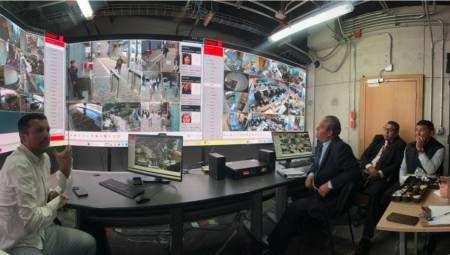
To address this issue, we spoke with Maria Eugenia Vélez Ramírez, director of the Traffic Control Center of the Ministry of Transportation and Transit of the city of Medellín. The official shared some details of the facilities that are being carried out in the Colombian city to support the work of the transit department.
First of all, he explained that the project aims to adapt 70 points for the location of photo-detection cameras; "Specialized cameras are being installed for the issue of electronic detection of violations. The main reason that motivates this type of system is the reduction of accidents and associated costs, derived from greater control of infractions," he said.
The photo-detection system is made up of cameras that capture the infractions automatically, read the license plate of the vehicle involved and make a record of the photos of the offending vehicle, the place, the date and time, as well as the type of infraction. The above serves as evidence to initiate a process before the control entity that in this case is the Secretary of Transport and Transit. "We are still in the implementation and testing phase. What was carried out in December was a pilot test that allowed to establish all the legal support that would be applied once the operation of the system began, "said Vélez.
"The Control Center in its first phase has had great achievements such as the reduction of response times to traffic incidents and better coordination in the use of resources, whether human or logistical, all this by centralizing in one place the information about what is happening on the roads. This fact allows decision-making to be much more accurate," the official added.
The Colombian capital, Bogotá, also has in operation an electronic detection system for offenders which will be composed of cameras with character recognition devices, to identify the license plate of the vehicle and register it in the system, in the same way, dome-type cameras were also installed with which traffic officers detect the infraction and register it.
The facility, which has been in operation since January of this year, has 67 surveillance cameras monitored by the police, which are located at different points and 12 cameras located on Carrera Séptima, one of the most important avenues in the city.
Precisely, the character recognition system cameras are essential in the photo fines systems, since they are the ones that allow to identify the license plate of the offending car and then compare it with a database that allows to identify the data of the owner of the vehicle to make the fine effective.
From the source
To learn more about the operation of this type of systems we have as a guest Eduardo Battisacchi from the Argentine company Domonet. This company has been establishing itself in the industry since 2007 developing technological products and services in the areas of security and home automation. These include the remote monitoring service for urban video surveillance and photo-fines for vehicle traffic control.
Currently, Domonet participates within the Traffic Control System of the City of Buenos Aires (in conjunction with other companies), specifically in the filming of photo-fines of traffic lights when the red light is violated or when vehicles stop at pedestrian crossings.
"Our system covers the entire process. From the provision of equipment, installation and maintenance, the process of downloading files, identification of photos and filming, its process and final elaboration so that the government (the only one with the power to do so) releases the act of infraction, "explained the guest.
In that sense, Battisachi also indicated that "it is very important to emphasize that the primary objective is the improvement of driving behaviors and their consequent benefit for the entire community (pedestrians and motorists). It is remarkable the decrease in traffic accidents that we have seen since the implementation of the system. Previously, if we analyzed the human losses, psychological and social and even economic consequences that citizens suffered, we should ask ourselves how we got to that situation."
And he added that given the level of effectiveness achieved, the city will continue to strengthen this type of facilities, and there is no doubt that more and more cities will adopt it. "Discount that from the excellent results observed, a series of steps will continue to be implemented in pursuit of this common interest with a greater integration of the systems, taking advantage of what technology can offer in this regard."
Installation
As for the technical aspect, the interviewee explains that the system is based on sensors that are connected to the controller of each traffic light. When the traffic light is red, the sensors detect any vehicle that violates the pedestrian path. There begins the sequence of photos and videos that allows the identification, without a doubt, of the transgressor.
"The video support allows to certify the infraction and is a very important guarantee for the driver, to demonstrate if any special situation required his conduct, for example the passage of an ambulance, and for the city government that avoids in this way the issuance of an unjustified fine," says Battisacchi. In addition, by legislation in the city of Buenos Aires, photography without the support of filming is not currently accepted as an infringement.
Finally, Battisacchi states that they have encountered similar needs in all the clients they have worked with on this issue. "Sometimes, and I say this as an ordinary citizen, we think that these systems have a tax or purely punitive interest. Nothing could be further from the truth. The collection for infringement does not affect our business in the slightest. The city government does not assume as payment for the service the participation in the collection situation. A fee was established for provision and maintenance regardless of the collection for infractions," he said.
"The primary objective of customers is to lower traffic accident rates. If, as I expressed before, we became aware of the negative effect produced by this situation, totally avoidable, if as citizens we complied with the simple rules of serious, reasonable and responsible coexistence we would have avoided incalculable tragedies, "concluded Battisacchi.