
 Large buildings need to have a series of requirements and systems so that fire protection and prevention is the most appropriate.
by Jaime A. Moncada*
In this magazine I have previously written about high-rise buildings, which are defined as those that have occupied areas more than 23 m (75 ft) high above the floor, or approximately seven stories. This height has been associated with the maximum height that a fire department can evacuate occupants through its facades. In today's Latin America, super-tall buildings are being rebuilt, which include buildings that have more than 100 to 150 meters. of atura, depending on who defines it.
The human safety and fire protection criteria for these types of buildings have been defined by the Society of Fire Protection Engineers (SFPE), who in cooperation with the International Code Council (ICC), the building code of the United States, established a Design Guide for Super Tall Buildings.
Currently, the tallest building in the region is the Gran Torre Santiago, also known as the Torre Gran Costanera, in Santiago de Chile, where I had the opportunity to work on the peer review of its human safety and fire protection strategy. This tower, designed by Cesar Pelli and developed by Cencosud, has a built area of 107,000 m2, 64 floors, plus 4 basements, and a height of 300 meters. It is not only the tallest tower in Latin America, but the tallest in the southern hemisphere.
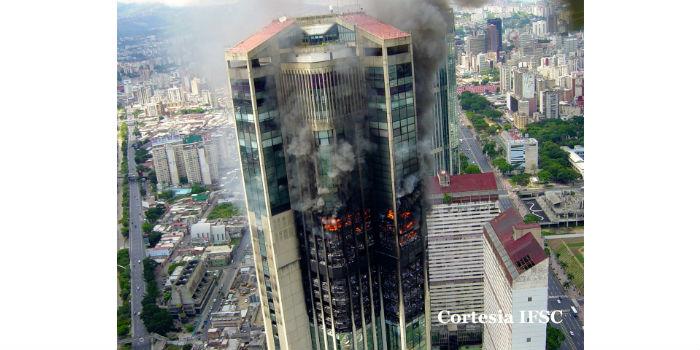
Before working on this tower, I worked at the Trump Ocean Club International Hotel and Tower in Panama City, which today is known as the JW Marriott Panama, which with its 70 floors and 293 meters. of height was, for two years, the highest before the tower in Santiago. I also had the opportunity to document, on behalf of the NFPA, the fire of the building that at the time was the tallest in South America, the East Tower of central Park, in Caracas. This building of 56 floors and 225 meters. of height, it caught fire on October 1st of 20041.
So, with a certain degree of experience, I can affirm that these types of buildings present unique problems from the point of view of human safety and fire protection. In my view, the most obvious challenges are the following:
• Movement of people in the building, including the difficulty of providing access for manual firefighting, limited means of egress, prolonged evacuation time, and the decision to fully or partially evacuate to the building
• Movement of combustion products, including the "stack effect", or the air draft that can be developed inside the building. In this sense, the air shot in a fire of a skyscraper has the possibility of spreading smoke vertically through the unprotected openings of the building, by stairs and elevator shafts. Additionally, ladder pressurization systems can, if not well designed, prevent the door from opening as the internal pressure of the ladder cannot be counteracted.
• The design of the automatic sprinkler system also presents significant technical challenges, due to static pressures, which can exceed 400 psi (28 bar). The definition of where to place fire pumps, whether they are all in one place, or at different levels of the building, or whether the fire water tank is installed in the basement or roof, are also complicated questions to solve.
As I have written in the past, human safety and fire protection requirements are defined by the use or occupancy of the building. However, the requirements of a super tall building can be independent of use. In fact, many of the skyscrapers where I have worked include shopping malls, offices, hotels, and residential apartments, within the same building. In many cases the top floor of the building is the floor with the highest occupancy density. Below, I summarize the most important fire safety systems:
- Fire Suppression Systems: All high-rise buildings, without exception, have to be protected with automatic sprinkler systems. This system is the most effective way to control a fire in a skyscraper.
NFPA also requires the installation of hose "connections" instead of "hose-equipped cabinets," which is called the Class I Water Column. The Class I System provides a column or upright, typically 6 inches (152 mm) in diameter, loaded with pressurized water, with connections for hoses 2-1/2 inches in diameter (64 mm), with a hose reduction of 1-1/2 inches (38 mm). It should be clear that NFPA does not require the installation of hose cabinets.
The effectiveness of manual fire extinguishers in incipient fires is more than documented, and these are of required use in all occupations that occupy high-rise buildings. Computing rooms in high-rise buildings should be protected with automatic sprinklers, typically pre-action systems. It is also possible that through a fire risk analysis, the user of the computer room decides to protect this room, in addition to the sprinklers, with a flood system with clean agents.
- Detection and Alarm Systems: All high-rise buildings require an alarm system that uses an alarm or voice emergency communication system. This involves the installation of manual pushbuttons and alarm horns throughout the building, but the installation of smoke detectors is not specifically required.
NFPA regulations are only requiring smoke detection in areas where someone can sleep (hotels, dormitories, hospitals, residences, etc.), in the elevator lobby, or in very sensitive occupations (such as a computer room or telecommunications room). Depending on the design of the air conditioning system, it is very likely that smoke detectors will be required in the air ducts (to prevent the air conditioning system from distributing smoke throughout the building).
The alarm through voice messages depends on the decision regarding the evacuation by floors against the total evacuation of the building. In a very tall building it is preferable to evacuate the floor where the fire occurs, the floor above and the floor below, and in order to achieve this procedure, the alarm system must have the possibility of sending a specific voice evacuation message to the areas to be evacuated, and an alert message to the areas that do not require immediate evacuation.
- Pressurization of stairs: Contrary to popular convention, deeply rooted in Latin American building codes, NFPA does not require the pressurization of stairs in any type of building, including high-rise buildings. However, stair pressurization can be used to reduce "construction type" requirements in high-rise buildings protected with automatic sprinklers.
- Fire Sectorization: An incipient area in fire safety, in our region, is the definition of the type of construction that a building must have, from the point of view of fire resistance. This is defined in the International Building Code (IBC), where the area per floor and the number of floors a building can have depending on its type of construction is limited. In addition, these limitations are eliminated or increased when the building is protected with automatic sprinklers.
Similarly, the finishes or interior coatings (defined through tests that measure their rate of flame propagation and amount of smoke developed) must be evaluated, which is also very difficult to obtain due to the lack of existing information about the interior finishes we use in our region (mats, hanging papers, suspended ceilings, plastic decorative elements). Finally, it is important to review the type of construction of the curtain walls. Recent fires in London and Dubai have called into question many of these exterior cladding and their impact on a fire.
- Evacuation: Evacuation is a complex issue and requires a specific study of the building through the NFPA 101 standard, Human Safety Code, which establishes the specific criteria for the design of evacuation routes (location, quantity, width, distance). NFPA requires high-rise buildings to be protected by an emergency lighting system in evacuation media and evacuation media signage. The emergency power system must be connected to the fire pump, the equipment in the command center, no less than an elevator serving all floors and smoke control systems, among others, and this must come into operation in less than 10 seconds after the loss of energy.
Skyscrapers require an Emergency Plan that establishes procedures for the notification of an emergency, the response of occupants and personnel to an emergency, evacuation procedures, adaptability of use of elevators, conduct of fire drills and the type and coverage of fire protection systems.
Elevators: Elevators in a high-rise building must comply with ASME A.17.1, Elevator and Escalator Safety Code. Because an elevator could stop on the floor of the fire or combustion products enter the elevator shaft, it is important that a re-call of the elevators is initiated after the operation of smoke detectors in the elevator lobbies or in the elevator engine room, so that they are out of service and operated only by firefighters.
Conclusions
In the modern world it would be unthinkable for a skyscraper to be designed and built without the involvement of a fire protection engineering firm, to draw up a Fire Safety Master Plan and review the building at its design stage. The protection of this type of buildings escapes what is required in Latin American building codes and that is why its analysis and review must fall on expert professionals in this field.
Footnote 1: http://www.nfpajla.org/archivos/edicion-impresa/bomberos-socorristas/690-infierno-en-la-torre
* Jaime A. Moncada, PE is a director of International Fire Safety Consulting (IFSC), a fire protection engineering consulting firm based in Washington, DC. and with offices in Latin America. He is a fire protection engineer graduated from the University of Maryland, co-editor of the NFPA Fire Protection Manual, Vice President of the Society of Fire Protection Engineers (SFPE [email protected]).