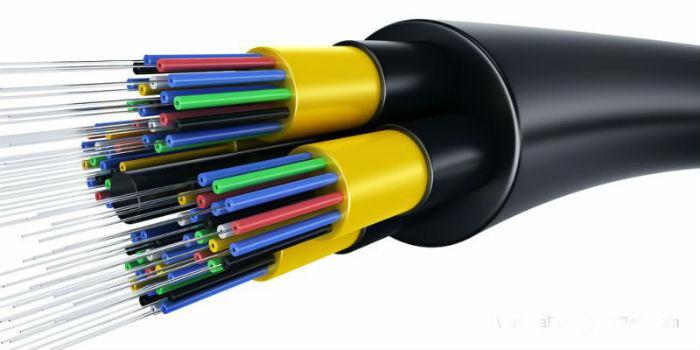
 Latin America. Fiber optics have become a solution to support the demand for higher bandwidth, but in the industry there are still many questions about its use, applications or regulations, among others.
"Although there are still many doubts about fiber, more than anything there are a good number of them about how to suspend it, whether or not it can be bent and how to do it and, of course, how it conforms to European or American regulations," said Carlos Morrison Fell, VP Enterprise Field Application Engineer – CALA at CommScope.
1. Can I fold the fiber around a narrow corner?
In the past, some questions were limited to knowing where and how to place the slack storage. Sometimes the answer was to devise reels in the top tray to maintain a large radius of curvature, in others patches were executed through different frames to keep the curves out and take all the necessary slack. However, now that fiber with reduced bend radius (RBR) is classified according to a particular standard, there are panels, frames, wall boxes, etc., that allow the clearance to be rolled directly into the unit.
Does this mean you won't have to worry about how to handle the coils? Does the curve-induced loss disappear? The answer is not quite a "no", but you have to understand a few things: there are still glass fiber optic curvature radius standards, for example, ITU-T G.657.A1 has a minimum curvature radius of 10 mm, G.657.A2/B2 at 7.5 mm and G.657.B3 of 5 mm.
"With these specific radii of curvature you need to maintain clean systems with the appropriate RBR. There may still be a loss of flexion, but maybe not in the same way as the past," added Carlos Morrison Fell. "Historically you could track fiber to physically see the curve, but with today's fiber, bending loss could indicate improper settling of a connector or routing problem in a splice tray."
RBR fiber is a big step in fiber technology that will expand to all parts of the network, including the outside plant. Keep in mind that, with proper use and cable management, technicians must be able to eliminate bending loss across the entire network.
2. I've heard about 8-fiber connectivity, but I use 12-fiber MPO (multi-fiber insertion). Should I change?
The short answer is no. If managed correctly, a 12-fiber MPO infrastructure with more fibers per connector provides 50 percent more usable fibers per connector in the same space. This is valuable as evolving standards continue to use duplex fibers as connectivity options over at least 100Gbps.
The main reason for the introduction of 8-fiber MPO connectors was to provide parallel signal application support using eight of the 12 available fiber positions of the industry-standard MPO connector. This application usually occurs on a QSFP (Quad Small Form-Factor Pluggable) transceiver.
3. How long can I suspend self-sufficient fiber?
Most self-sufficient fiber optic cables can mechanically withstand the longer distance loads that are normally specified for each cable. However, span lengths are often limited by the tension placed on the fiber optic glass inside the cable, and even by the minimum clearance requirements provided by the National Electrical Safety Code (NESC).
"CommScope provides stretch lengths in three categories: NESC vehicular access, NESC pedestrian access, and infinity within each NESC cargo category (heavy, medium, and light). When a self-supporting fiber cable is embedded in a support filament, such as a 1/4" 6.6M EHS wire, the limitations of self-sufficiency no longer apply, as the load is placed on the cable and not on the cable," added Carlos Morrison Fell.
4. Will fiber optics be the best solution for connecting cellular network radios in the future?
The consensus in the industry is yes. Mobile network operators will opt for fiber as the preferred technology for backhaul and fronthaul to cellular network radios whenever possible, due to increasing bandwidth requirements.
The density of future cellular radios will drive network convergence between wired and wireless traffic, increasing the need for fiber networking solutions that focus on providing density, accessibility, and flexibility to support multiple applications needed for the future.
"Another important factor is to reduce energy consumption and optimize the use of space in the tower. Many operators are transitioning to the C-RAN architecture) and fiber is key to the transition. With C-RAN, baseband units (BMUs) move from the bottom of the tower to headquarters that can be located many miles away. C-RAN offers an effective way to increase network capacity, reliability, and flexibility while reducing operating costs. It is also a necessary step on the road to Cloud-RAN, where BBU functionality will be 'virtualised', allowing for great elasticity and scalability for future network requirements," added Morrison Fell.
5. How can the compliance of fibre optic cables with the new European RCP regulations for building applications be confirmed?
Introduced in 1989 by European regulators, the Construction Products Directive (CPD), later the Construction Products Regulation (CPR), was designed to ensure that materials and equipment comprising buildings such as offices and schools are safe from hazards such as fire and other hazards. With the new classification published in 2016 on how communications cable products react to fire, the European Commission requires that building materials such as fiber optics have a common technical language such as CPR 305/2011, for example.
All manufacturing facilities providing services on the European market must have been audited and approved by notified bodies; in addition, the construction industry should only work with suppliers who have carried out extensive tests with these bodies and can provide the appropriate performance declarations for their wiring products, organised in Euroclasses A to F.
"Each product shall be required to bear the appropriate CE label for the applicable European classification. The type of test is determined by the type of verification system used by the notified body. Euroclass Cca and B2ca use the strictest 'System 1+' verification, which requires continuous audits and audits of production facilities and product testing. System 3 includes Euroclass Dca and Eca, which are lower security classes," said Carlos Morrison Fell, VP Enterprise Field Application Engineer – CALA at CommScope. "Approximately 80% of Notified Bodies are accredited for System 1+ and can assign Euroclass Cca and above. It is important for organisations to ensure that they use the appropriate notified body which can be found on the European Commission's NANDO website."