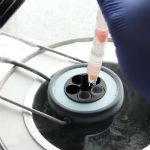
 International. HID Global announced the development of radio frequency identification (RFID) tags with state-of-the-art biotechnology, designed to meet a fundamental need of the cryopreservation industry.
The company has developed a state-of-the-art solution to be used at temperatures below zero, differentiating itself from other tools used in difficult conditions and at high temperatures. The exceptional label is already redefining cryogenic storage, enabling facilities to improve and simplify logistics, maximizing value for the medical and scientific communities.
Through a thorough process of research, testing and implementation, HID Global and Cryogatt Systems Ltd. jointly developed labels that could be used at extremely low temperatures in fertility clinics, research laboratories and other storage facilities.
HID Global's robust RFID technology withstands the rigor of storage at temperatures of -196°C (-321°F). In addition, Cryogatt and HID Global coordinated verification tests with the National Institute of Biological Standards and Controls (NIBSC). The result obtained was an "average time between failures" (MTBF) of more than two million hours and in the last two years there has been no record of a single failure.
"In close collaboration with Cryogatt and its customers, cryogatt and HID Global engineers were able to design the exceptional labels and readers needed for this innovative application," said Richard Aufreiter, Director of Product Management and Identification Technologies at HID Global. "It was a very stimulating challenge for us to work with the lower range of the temperature scale, where materials and electronic components often behave differently than they do at room temperature," he added.
Using a highly durable RFID tag designed for demanding environments, the companies worked together to develop an RFID tag system that involves embedding containers with HID Global Glass and Piccolino tags, using HID Vigo™ Direct Bonding technology.
This patented technology enables the creation of extremely compact and robust transponders with large memory capacity and safety features. Associated hardware includes patented Cryogatt readers operating at -196°C and Cryogatt software to accurately locate, record and monitor samples throughout the entire storage lifecycle.
The NIBSC implemented the new RFID solution and is now able to track, inventory and simplify long-term sample management. The solution allows you to incorporate the precise data into the right container, thus optimizing the storage space. The creation of selection lists is simplified, allowing samples to be grouped in a precise way when they are needed and recovery is done, on average, two to five times faster, while maintaining the safety of the samples.
In addition, access to detailed and accurate information has significantly improved the audit of the quality system.
"Tracking is accurate, in order to meet regulatory standards and save hours of searching," explained Kirsty Stevenson, Cold Storage Manager in the Department of Pathology at Bristol Royal Infirmary University Hospital. Other benefits of the solution developed by HID Global and Cryogatt are improved accuracy, optimization of storage space, accurate audit trails, increased sample safety, and time and cost savings."
"Implementing a solution capable of withstanding a difficult and highly regulated cryogenic environment is critical to the success of laboratories, hospitals, fertility clinics and healthcare institutions around the world," said Geoff Morris, Director of Engineering at Cryogatt Systems LTD., who further stated that "the solution we developed with HID Global also allows the peace of mind of knowing that the data is accurate, a very important aspect for future audits of compliance with current regulations".