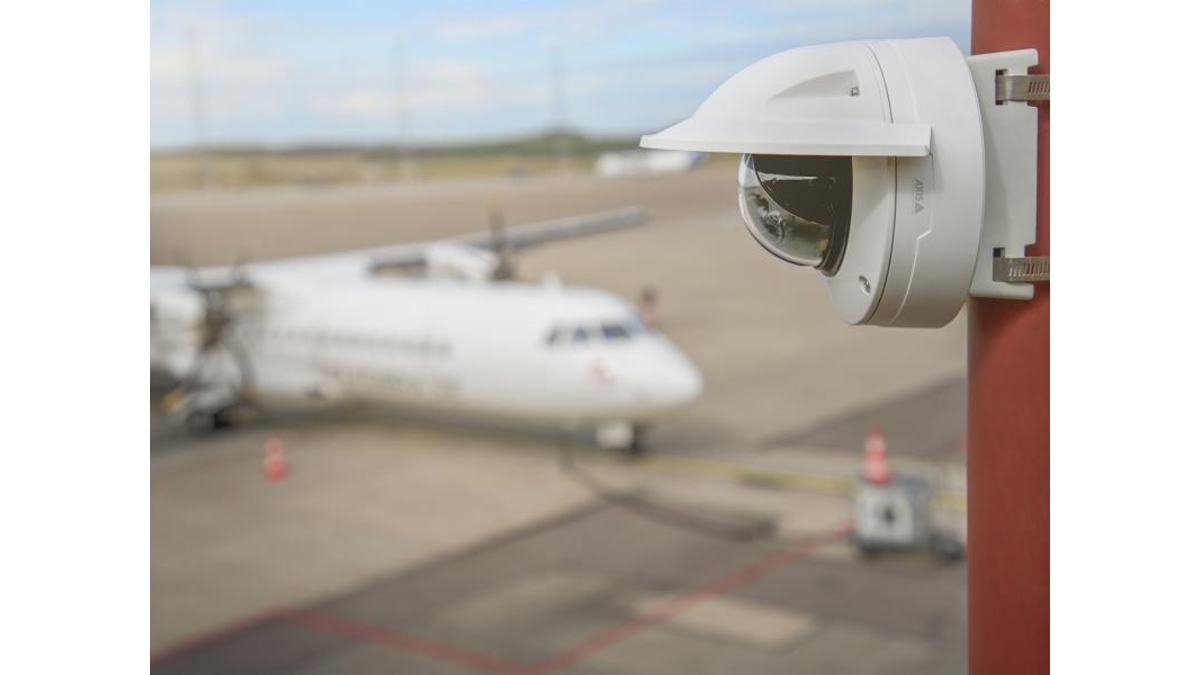
International. The airport industry faces complex challenges in terms of safety, efficiency and logistics management. In response to these demands, technology has played a crucial role.
Last year, the world's airports allocated almost US $ 6,800 million to acquire information technologies, since tools such as video surveillance allow them to execute their processes quickly, safely and with all the necessary protocols.
 This is explained by Manuel Zamudio, manager of Industrial Associations for North Latin America and the Caribbean of Axis Communications: "video surveillance is more than assuming costs due to the update and maintenance that such a system requires. Forward-thinking airports have realized that it is a platform for growth because in addition to their innate surveillance function, cameras can drive efficiency, profitability and can also help improve the customer experience."
Perimeter protection, thermal technology and range of vision
Airports are critical infrastructures that require robust perimeter protection to safeguard passengers, staff and assets. In this sense, there are already innovative solutions that offer unprecedented levels of security. An example of this is the combination of advanced cameras and sensors in perimeter protection technologies that help count people or traffic to improve the passenger experience and alleviate congestion.
On the other hand, the use of thermal technology and with greater range of vision, has improved the ability to detect intrusions and potential threats in real time without the need for light or in adverse lighting conditions, such as darkness or fog.
Lightfinder and meteorology in logistics
The integration of Lightfinder technology allows you to capture sharp, color images, even in low light conditions. Along with weather data, Lightfinder has proven to be a very useful asset.
"For example, at Tom Jobim International Airport, the most important in Rio de Janeiro, Lightfinder technology allows color images, even in areas with very low light conditions such as the airport sidewalk and the container area of the cargo terminal, which is one of the busiest in the country," Zamudio explains.
Additionally, the combination of Lightfinder and real-time weather data allows airport operators to make better decisions in the event of adverse weather conditions, such as storms or dense fog.
Real-time weather monitoring can also aid in the planning and execution of critical operations, such as fueling, cargo handling, and flight coordination, thereby optimizing efficiency and reducing potential logistical setbacks.
Deep and Machine Learning and Artificial Intelligence
Both technologies have improved analysis capability and data processing, which has increased accuracy in identifying threats and abnormal behavior, because if the camera sees it, AI algorithms can analyze it.
By using AI algorithms trained on large data sets, video surveillance systems can automatically detect suspicious events and objects, such as abandoned packages or unusual passenger behavior.
The integration of AI into video surveillance systems also enables the optimization of operational processes, such as passenger flow management to improve efficiency and the traveler experience.
In this regard, Manuel Zamudio comments that "Sharjah airport was equipped with an IP-based Axis Communications system, which facilitates monitoring multiple sources at once and monitoring the entire place. This is why the airport can use its resources more effectively and has greater control over video and who can access it. The systems have enhanced security, increased operational efficiency and supporting scalability as the airport continues to grow, as by 2027 it will accommodate more than 25 million passengers."