International. Hillstone Networks announced the delivery of version 3.0 of its Application Delivery Controller (ADC), which, along with its Web Application Firewall (WAF), promises "comprehensive, enterprise-class security" for web servers, applications and APIs.
As the use of applications on the web continues to advance rapidly, threats also proliferate, which is why cybersecurity arrives as a relevant topic in this 2023. According to Gartner, 84% of security breaches occur in applications, while 86% of web applications are vulnerable. In addition, according to the Ponemon Institute, the average cost of the customer data breach is $6.5 million.
In addition, as Hillstone Networks explained within the main vulnerabilities it is possible to find "loss of access control, cryptographic failures, faulty access configuration or errors in identification, forgery of requests between sites, remote code execution and injection attacks"
Hillstone Solution
Hillstone's portfolio in response to market needs includes its Web Application Firewalls (WAFs) and Application Delivery Controllers (ADCs).
Application Firewall
According to Hillstone, its W-Series Web Application Firewall (WAF) protects against network attacks and those targeting application layers, "providing protections against DDoS (Denial of Service), the top 10 OWASP threats, and bot attacks."
In addition, he stressed that this WAF validates APIs against the schema defined in OpenAPI, so it automatically generates positive security model policies to detect and defend against attacks and misuse.
He highlights this solution that "combines traditional rule-based detection with innovative semantic analysis." With this, the brand seeks to minimize false positives by creating a context-aware analysis engine. On the other hand, it "leverages machine learning technology to adjust security policies and block unknown threats and attacks."
In addition, records can be automatically aggregated across multiple dimensions, allowing administrators to easily identify suspicious anomalies or locate false positives, and then refine policies as needed.
The Web Application Firewall (WAF), hardened by the Application Delivery Controller (ADC) of the same brand, has a dual detection engine composed of rule matching and semantic analysis.
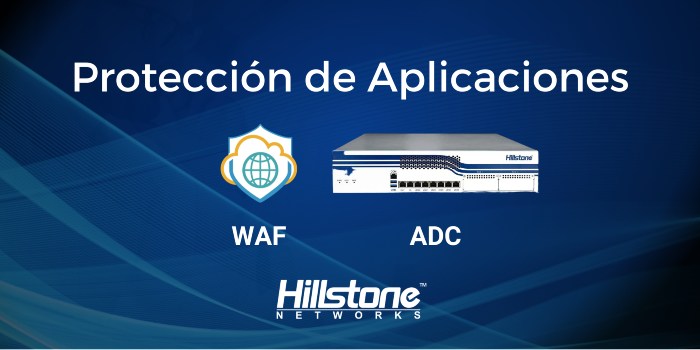
Application Controller
According to Hillstone Networks' application delivery solution (ADC application delivery controllers), on the hardware side, the "V3.0 introduced seven new models with a wide range of performance to serve business scales"; while on the software side "it has made a number of optimizations in terms of traffic transmission, download, distribution, etc., which makes the ADC better adapted to the complex and changing network environment".
However, compared to networks, "ADC software optimizes the most commonly used congestion algorithms to help manage different load sizes effectively (in the optimization test, the speed of data transmission from server to client is increased by 30%), so users can access applications and services more smoothly."
In addition, Hillstone Networks said that, due to the need for a more abundant address space, the transition from IPv4 to IPv6 has become a trend and, in that sense, "this solution is responsible for distributing traffic according to the routing algorithm or specified programming, to handle v6 traffic. In the ADC, the LLB for IPv6 is added, which paves the way for their broad application scenarios."
Overall, with these solutions Hillstone supports a full range of load balancing functions, including Link Load Balancing (LLB), Server Load Balancing (SLB) and Global Server Load Balancing (GSLB).
In addition, the AX Series supports health checks for applications, servers, bindings, world-class protection against network attacks, SSL offloading, application acceleration, data through cache, and more.
Finally, the brand ensures that its application delivery controllers "can greatly improve the availability and scalability of core applications and business platforms, and effectively improve the operational efficiency of enterprise data centers."