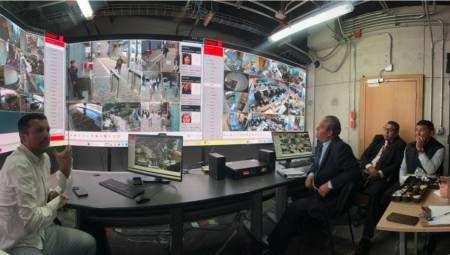
Colombia. The use of video surveillance and other technologies for the control and prevention of crime is a strategy that has proven to be useful and is used especially for urban security. Colombia is no exception to this global trend.
According to the Survey of Coexistence and Citizen Security, carried out by DANE, in 2021 44% of people felt unsafe in their city or municipality, a figure that, compared to the results of 2020, increased by 5.0 percentage points. When inquiring about the theft of residences, 1.7% of households reported this fact. In addition, of the people surveyed who own a vehicle, 4.3% indicated that they had suffered theft of all or part of it.
As for digital security incidents, 35.7% of people who were victims reported email or social media hacking; in second place was bank fraud by electronic means, with a percentage of victims of 22.0%. For its part, the Attorney General's Office reported in 2021 a 30% increase in cyberattacks, where Bogotá ranked first with 8,355 cases, followed by Medellín 1,664 and Cali with 1,569.
Undoubtedly, cybercrime became an agenda item for Colombia. The Top 100 Electronic Security Integrators Report 2022 indicates that in 2021 the abusive entry into computer systems increased by 26%, and 3,865 complaints were made for these facts.
Regulatory framework for safety in Colombia
Then, to respond to the country's security needs, the Colombian State proposed to articulate its institutions for the prevention and prosecution of crimes, which has implied in recent years the technological and strategic update. For example, the National Criminal Policy Plan for priority 2021 – 2025, which governs the actions of the police in Colombia, establishes the design of a technological platform for the integration of databases and analytics, which serves as inputs for decision-making.
In the same way, he indicated the importance of strengthening the Special Investigation Groups through technological tools and established a new model of surveillance and control "concentrating on the professionalization of the police surveillance service, knowledge management and the incorporation of new technologies, in complementarity with private surveillance."
However, the Framework of Coexistence and Citizen Security policy guide of the current administration, proposed to intensify the use and development of tools of innovation, science and technology with a focus on prevention for a healthy coexistence, protection of citizens and punishment of crime. This technology highlights surveillance cameras with facial recognition for criminal prosecution focused on critical points in cities, software for vehicle identification and license plate recognition, as well as drones for police procedures, surveillance of districts, municipalities and sidewalks.

Technological trends for security in Colombia
For Rubén Trujillo, Pre Sales Manager of Hikvision Colombia, there are 5 key points in technological trends for security that are being implemented in the country.
1. Biometric access control: there have been great advances from keys, PIN codes and identification cards. We are now in the age of biometrics. From fingerprint and palm recognition to facial and iris recognition; these bring advantages such as less counterfeiting, verification in seconds or fractions and more hygienic access, which is being favored as a result of the pandemic.
2. The Zero Trust approach to cybersecurity: With more security devices connected to the Internet, cybersecurity has become an immense challenge in the industry. Zero Trust is rooted in the philosophy of "never trust, always check". The concept has been accepted in the IT industry and is now moving towards physical security.
3. Green manufacturing initiatives and low emissions: Products with low energy consumption have become the preferred choices of customers whenever they are available, in turn the demand for solar-powered cameras is increasing. Although it will take time the movement towards reducing carbon and exploring green manufacturing for the security sector has begun.
4. Converged systems will break down data silos: public and private sector organizations are striving to get rid of obstructive "data silos." The trend in the security industry is to converge systems whenever possible, including video, access control, alarms, fire prevention, and emergency management. In addition, non-security systems such as HR, finance, inventory, and logistics systems are now also converging into unified management platforms for better collaboration and decision-making.
5. Sharp security images will be standard: High-performance image sensors, ISP technology and algorithms that allow cameras to maintain clarity and detail in any weather conditions and time of day are a trend that has been pleasantly received. In addition to the trend towards multiple lenses in one camera, two or more lenses provide panoramas and detailed views, cases that have already been tested in airports and stadiums.
Finally, for the expert of Hikvision Colombia "all these solutions will allow companies, educational institutions, commercial premises, residential units and airports, among others, to have a better security scheme and thus curb the rates of perception of insecurity that increase day by day in the country".