
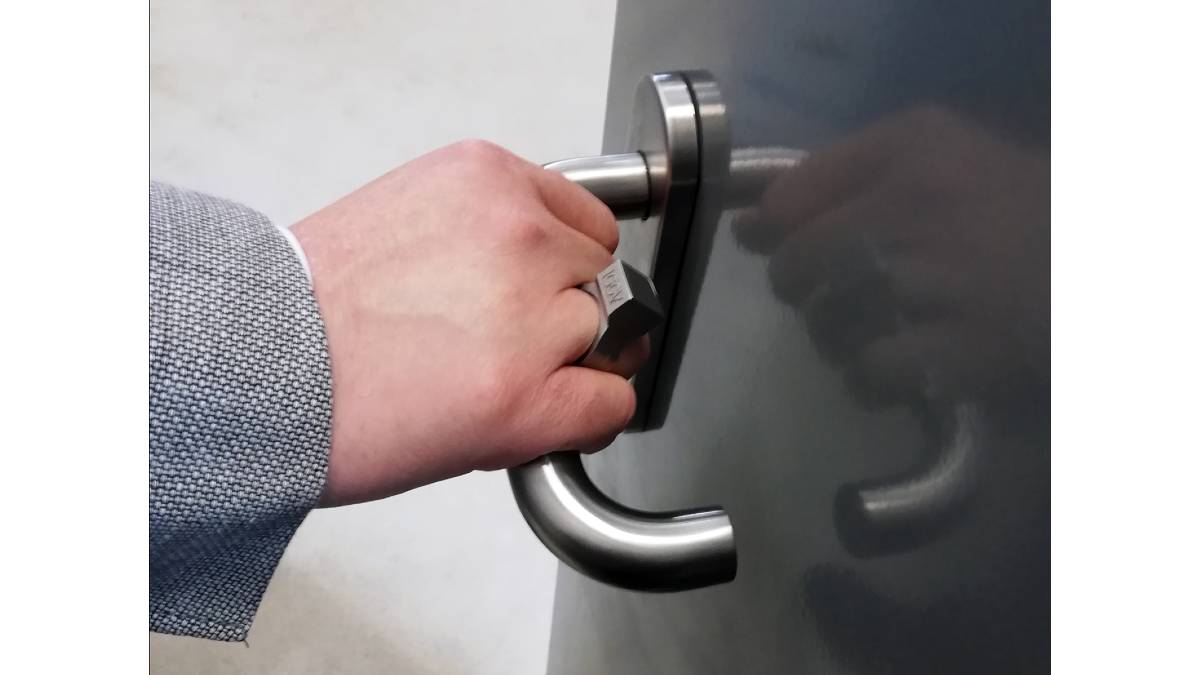
International. House key, wallet, health insurance card, hotel key card – a smart finger ring could replace all of this in the future. Produced by a 3D printing process, the ring has an integrated, tamper-proof, sealed and invisible RFID chip. Of course, the technology of integrating electronics during 3D printing can also be used for other applications. The multifunctional ring was developed by a research team from the Fraunhofer Institute for Processing, Composites and Foundry Technology IGCV.
Now, where is the key to my house? Could I have left her in the office? And when we want to take out our wallet at the supermarket checkout, we often find that it somehow made its way to the bottom of the shopping bag in all the hustle and bustle. A smart ring could soon put an end to such frantic searches: hidden inside the ring is an RFID tag that can pay at the checkout, open the smart front door, act as our health insurance card when you attend a medical appointment, or replace the key card at a hotel.
It might also be possible to save medical data such as our blood type or drug intolerances on this chip: in the event of an accident, the emergency doctor would have all the necessary information at hand. Fraunhofer IGCV researchers developed the smart ring as part of the MULTIMATERIAL Center Augsburg. The large-scale project, sponsored by the Bavarian Ministry of Economy, Regional Development and Energy, is divided into ten individual projects, including the KINEMATAM project, which came up with the idea and the smart part demonstrator model.
3D printing with automated electronics integration
However, more important than the ring itself is the manufacturing process and the ability to integrate electronic components while producing a component, even in places within the component that would otherwise be inaccessible. The inside of a ring, for example. We can refer to 3D printing in the broadest sense to describe a production process, but in technical jargon, it would be called "powder bed additive manufacturing."
The principle is as follows: a laser beam is guided onto a bed of fine metal powder. At the point where the 80-micrometer laser spot hits the dust, it melts and then solidifies to form a composite material; the rest of the metal, which is not exposed, retains its powder form. The ring is built layer by layer, leaving a cavity for electronics. Halfway through, the process stops: a robot system automatically takes an RFID component from a charger and places it in the hollow before the printing process continues. This precisely controllable production technology opens the door to a wealth of possibilities for fully individualized ring designs. And the chip is sealed by the ring, which makes it tamper-proof.
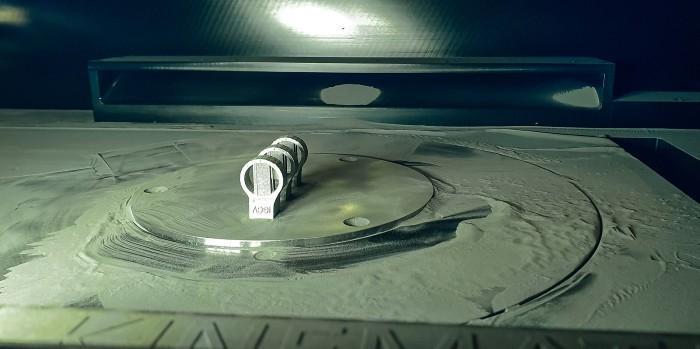
3D printing itself has been around for a long time. The main focal point of the development was the expansion of the laser beam fusion unit using the in-house developed automated process that places the electronics. "Converting hardware technology to allow electronic components to be integrated during the manufacturing process is unique," says Maximilian Binder, principal investigator and group director in Fraunhofer IGCV's additive manufacturing unit.
The second focus of the development was to answer this question: How can electromagnetic signals from the RFID chip be sent through the metal? Metal, you see, is normally an effective shield against signals. The research team carried out numerous simulations and experiments and found a suitable solution. "We use a frequency of 125 kilohertz : it has a shorter range, which is exactly what we want here, and the metal protects it less effectively," Binder explains. In addition, the label is placed in such a way that its signals have to penetrate only one millimeter of metal.
The design of the cavity and the way electronic components are embedded in it are also critical to propagating the signal, as walls can reflect or absorb signals. Another challenge was to protect sensitive electronics from RFID tags from the high temperatures, which exceed 1000 degrees Celsius, involved in the manufacturing process.
Numerous imaginable applications
The technology can be used wherever the conventional method of integrating electronics is difficult. The researchers are currently working, for example, on an application in the production technology sector: they are implementing sensors on sprockets, with the aim of sending, live during operation, information on the state of charge, temperatures in various positions and other important parameters for an evaluation unit wirelessly.
Is the initial damage to a tooth already occurring? The measured vibration will tell us. The integrated sensors receive the power they need through an RFID antenna printed on the outside; the sensors then operate passively, i.e. without a battery or other separate power supply. Consequently, the integrated sensors will be able, in the future, to realize a monitoring potential that otherwise would not have been possible due to the high rotational speed of the sprockets.
Data Source Provider: Fraunhofer Institute.