 International. Work began in earnest on 6G communications in 2020 with more than a billion dollars committed and a Chinese satellite sent to experience the possibilities. Finland, Korea and China are particularly active in researching the terahertz electronics that will be at the heart of 6G, but there is excellent work in India and elsewhere.
Finland and its partners are backing more than $350 million in new research grants from the European Union, so this is serious. Although little is decided, not even frequency, much can be said about the extremely ambitious goals and challenges of 6G. This article gives IDTechEx's assessment of 6G communications 2021-2041.
Much better than 5G
5G covers much more than the needs of mobile phones or even personal electronics in general. This will be even more true in the case of 6G, as thing-to-thing communication is arguably more important than human communication. There are more things than people in the world!
The future of everything?
At a minimum, the basic specifications will cover the needs of sensing, positioning, edge computing, high-definition imaging, and, yes, communication. To a human, 6G response time will seem instantaneous. For the first time, there will be no cell-to-cell transfer for mobile devices. No more suffering from the loss of service in the transfer from cell to cell.
Massive improvements
- To meet the ambitious 6G targets, the main focus is on six parameters:
- First coverage and ubiquity truly 3D. 10k meters up, in space, underwater.
- Data rate greater than 100 Gbps, X100 capacity.
- It adapts to peripheral devices without power, low power consumption and low cost.
- Always low latency/response speed <1ms.
- Reliability 99.99999%. Safe, private, secure, resilient.
- Massive connectivity 10 million devices / km2.
Jumping into the "terahertz gap"
The key parameters of 6G will be at least ten times better than those of 5G, largely because the frequency will be at least ten times higher. That means in the unallocated terahertz band from 275 GHz to 10 THz, also known as far infrared. This is the territory of the physics of the cowboys of the Wild West, where few components exist and the signals generated are weak so far. They call it the "Terahertz Gap."
For this reason, initial experiments are often carried out at the easiest end - 100-300GHz. The FCC has proposed formalizing this "experimenter's play zone" in some bands between 116 and 246GHz. Launching 6G can, like 5G, start at a relatively easy frequency (275GHz?) and then migrate to a challenging higher frequency (1THz) to get most of the benefits. (5G started at a few GHz and is migrating to tens of GHz.)
That maximum THz frequency is unlikely to be higher than 1THz because, right after that, the atmospheric attenuation of the beam increases to severe levels and the components also become extremely challenging.
By very close and very far
In fact, THz frequencies will be used locally and between satellites, with the rest being free space optical (FSO) in most cases because fiber optic laying will be too expensive or impractical. There may also be some C-band long-distance links in GHz.
Problems that are business opportunities
Problems that are opportunities include:
- Terahertz (THz) waves lie between microwaves and infrared in the frequency spectrum of light, but because of their low energy, scientists have not been able to harness their potential.
- Modem and front-end chip for higher frequencies. GaAs, GaN, InP, SiGe, silicon CMOS in fully depleted insulator (FD-SOI) are in dispute.
- Fronthaul/ backhaul: high-capacity connectivity and high-altitude solar drones in the air for 5 years only in the sun. China, Germany/France, the UK and the US already have in-flight experiments for weeks, not 5 years. Some will be unmanned airships, leader ThalesAlenia Stratobus of France/Italy rolls to follow the sun with its top solar fabric, which will launch in 2021. Also needed are the tens of thousands of low-Earth orbit LEO satellites that are being deployed by the Europeans and SpaceX in the U.S. None of these aircraft and satellites are dedicated exclusively to 6G, but they are essential for 6G.
- Heterogeneous hardware constraints on complex integration into a single platform
- Network edge device capability to reap the benefits
- Managing complex 3D network resources
- Spectrum and interference management
- Atmospheric absorption of THz
- THz beam management
- Security of the physical layer
- THz Modeling
- Cost control
A bridge far away?
There are arguments against all this 6G enthusiasm. Some say 5G is proving so expensive that it may never be fully implemented. They suggest that those who need more will get it from a higher frequency version of 5G without more standards needed. IDTechEx points out that 6G can't happen without something that doesn't exist and may never be affordable.
It is necessary because the THz beams are narrow, weak and do not surround the corners. Almost anything stops them, so you need smart surfaces even in your private home to provide access everywhere. There are many names for these smart surfaces. "Hypersurfaces", "IRS Intelligent Reflective Surfaces", "SPM Software Programmable Metasurfaces". They consist of active THz components and metamaterials in separately programmable "mosaic" arrays. They must redirect, amplify, collimate, polarize, and otherwise manipulate those THz beams.
More reviews
The world tends to solve its problems with less infrastructure. For example, no more telephone exchanges or parking meters. 6G goes against this because it needs a lot of infrastructure.
They say 6G will finally enable billions of things to cooperate with things, all directly connected to the Internet. This is the basic concept of the Internet of Things. Well maybe. They say 6G is the future of virtual and mixed reality, medical imaging, and robotic vehicles, but let's consider the latter. Tesla develops autonomous vehicles that work without mapping or connectivity. You don't need 6G for that.
Can we predict anything yet?
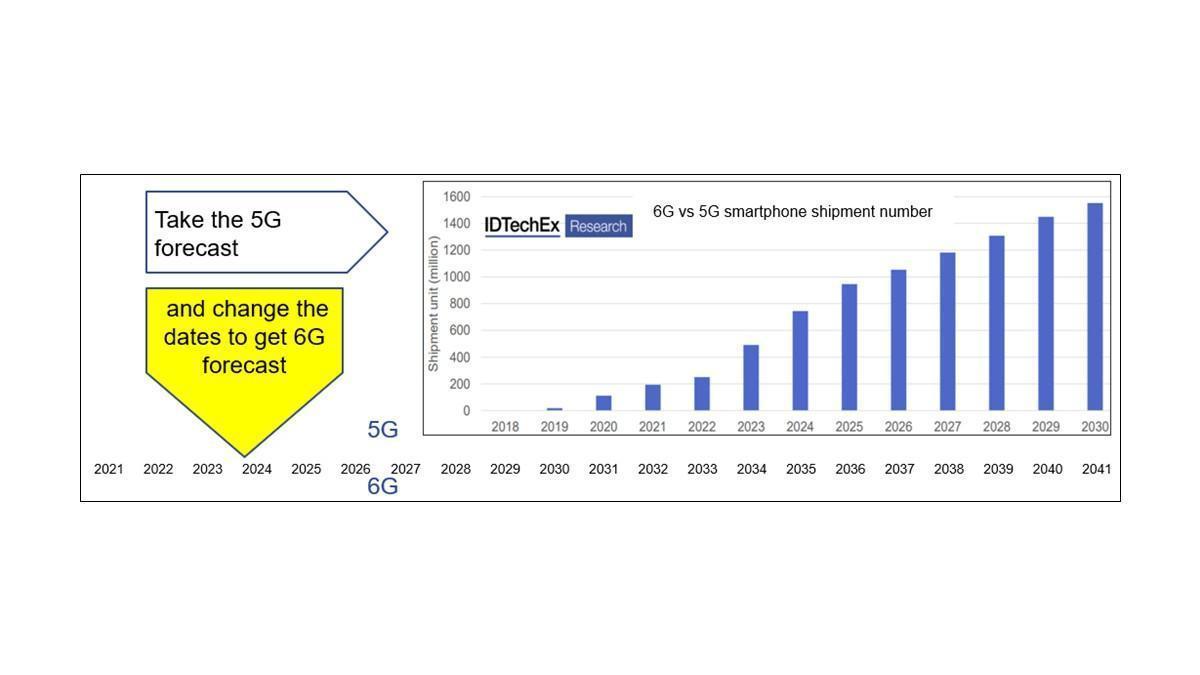
So how do we forecast at this early stage? IDTechEx suggests that, for mobile phones, take the IDTechEx 5G forecast and move the dates forward eleven years. The overlap of 5G and 6G functionality will be considerable, at least seven years.
Materials that will be generalized in 6G include graphene and metamaterials (supercapacitors, heat leveling, HEMT transistors, antennas, hypersurfaces) and many different 3-5 compounds (HEMT transistors, THz diodes, substrates, energy harvesting, solar aircraft).
Source: www.IDTechEx.com/Research