 International. Data breaches continue to dominate headlines around the world. Recent findings analyzed by Atlas VPN reveal that up to 45% of businesses suffered a data breach in the past 12 months.
The data is based on a survey conducted by Kaspersky and B2B International on September 30, 2020. The researchers interviewed 4,179 companies globally, with 50 and up to 4,999 employees. The companies surveyed belong to the following 5 industries: financial services, government, manufacturing, IT and telecommunications, retail and wholesale.
Atlas VPN delves into the specifics of the data breach, such as which sector saw data breaches most frequently and what the dangers of a data breach are in each sector.
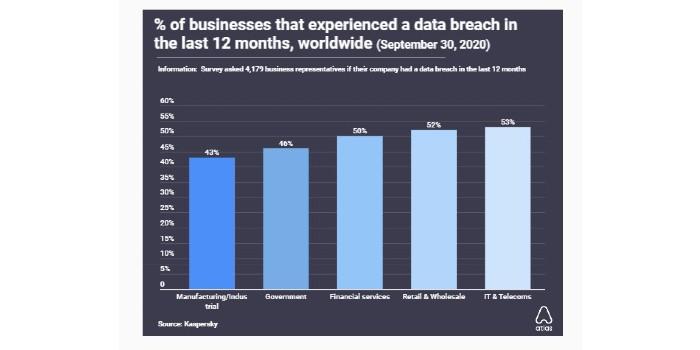
The analysis reveals that of the 4,179 companies, 45% lost data to hackers in the last 12 months. IT and telecom companies suffered breaches more frequently, and 53% of companies lost data. IT and telecommunications companies often have financial information about customers, in addition to other sensitive data, such as private conversations, social security numbers, and addresses.
Next up is the retail and wholesale industry, in which 52% of businesses experienced a data breach in the past year. These cybersecurity incidents in retail companies can damage the reputation of the brand, leading to the loss of numerous customers, especially those who are privacy conscious.
Third on the list is financial services, where exactly half of respondents claimed their company lost sensitive data to scammers. Breaches in the financial industry are a major concern as an inadvertent leak allows cybercriminals to empty victims' bank accounts.
Companies in the government sector are no exception to the rule, as 46% of them had a data breach in the last 12 months. Attacks targeting the government are often supported by foreign authorities, whose aim is to obtain political and military information.
Finally, manufacturing and industrial companies experienced data breaches less frequently, but still a significant amount, at 43%. The danger is mainly for the companies themselves, as competitors hire hackers to steal internal data that would destroy the competitive advantage that the victim company had.
Most common threats in general
Surprisingly, as many as 78% of companies surveyed reported some form of cyber threat to their systems last year. On average, one cyber incident caused $312,117 in damage.
In addition to data breaches, viruses and malware are the most common threats detected. More than 43% of businesses experienced viruses and malware on their internal network in the past 12 months.
There is a wide variety of viruses and malware created by hackers. However, the vast majority of them are created to make money illegally.
In addition, 39% of companies reported that "bring your own devices (BYOD)" devices had also been infected by malware. Some companies provide all the equipment needed for the job, while others require employees to bring their own computers and mobile devices.
Company-owned equipment usually has at least some security measures in place as soon as the employee gets the device. However, that's not the case with BYOD equipment. There is no guarantee that employees will update their computer software, leaving vulnerabilities that hackers can abuse.
The fourth most common cyber threat in businesses globally is cryptomalware and ransomware. Cryptomalware is a type of ransomware that encrypts a user's files and demands a ransom. Scammers can also steal the data, delete it from the company's database, and request a ransom (usually in Bitcoin) to recover the data.
Unfortunately, companies often choose to pay the ransom to avoid damaging their public reputation, so they further encourage these attacks.
DDoS attacks are one of the most well-known types of cyberattacks, affecting 34% of businesses globally in the last 12 months. DDoS is short for Distributed Denial of Service, and is an attack that is used to block a service or website, making it temporarily inaccessible to its users.
Although people suffer DDoS attacks, cybercriminals typically target services. They often attack services hosted on high-profile web servers, such as banks or credit card payment gateways. Revenge, blackmail and activism are the most common reasons behind the attacks carried out.