
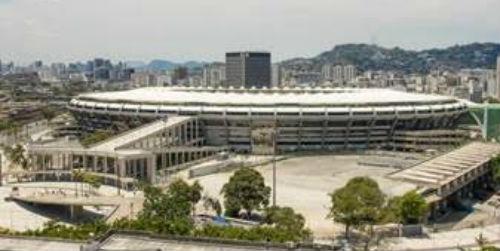
 Latin America. In August, thousands of people will travel to Brazil to be part of the most important sporting event of the year: the Rio 2016 Olympic Games. While the athletes will have the commitment to give their best and conquer the podium, the attendees will not want to miss a single detail of the match to be able to share their experience with people around the world.
To meet these expectations, stadiums will need to operate reliably before, during, and after each contest. The trick is to make this moment become an unforgettable experience for everyone.
Today, sports facilities have evolved taking advantage of technological advances and seeking the comfort of both athletes and attendees. Its infrastructure is based on the automation and interconnection of systems to offer the best quality and efficiency from start to finish.
After more than 70 years of experience in construction and modernization projects of sports venues around the world, Schneider Electric projects 10 characteristics that Olympic venues must have to be first-class scenarios:
1. Lighting: During the day, the central attraction of a stadium will be the playing field, the athletes and the scoreboard; at night, the lights required by a stadium must comply with demanding regulations. Athletes must be able to perform their maneuvers without having visual impairments or feeling shadows, so large sports venues will deploy advanced lighting technology to allow uninterrupted competitions day or night.
Other elements that impact on lighting are sports broadcasts, photos of spectators and journalists, so special lamps are required to illuminate a field with up to 2,000 lux of power. Meanwhile, inside hallways, corridors, restrooms, and even in parking lots, lights let people know where they are, shop, and evacuate the area at the end of the event.
2. Information: During the contests, viewers want to have all the details to analyze the chances of victory of their favorite. Journalists, for their part, want to offer information and characteristics of athletes. Today's stadiums require information to flow throughout the stadium and for everyone to know what's going on both inside and outside.
Television networks, speakers, giant screens and advanced camera systems, some at floor level and others floating above the stadium, are increasingly frequent demands that must be met to satisfy the spectator experience.
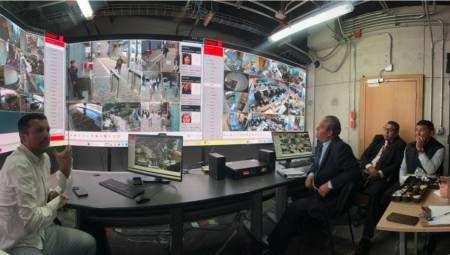
3. Security: Undoubtedly, if there are cameras to see the plays, there must also be closed circuit television systems that allow the recognition, control and prevention of suspicious activities. The use of video surveillance cameras becomes at this time a crucial factor that allows the prevention of all types of crimes.
4. Access: Access controls have also undergone a great evolution. Now, users can simply swipe their smartphones through a reader to identify themselves and walk into the stands without needing to print tickets or buy tickets. The use of interactive mobile applications allows to more reliably manage the access and recognition of buyers, the distribution and location in the stadium and the use of the comforts of the same in a more reliable and efficient way.
5. Circulation: Less is more, and if displacements are necessary in a stadium they must be short and effective. Supporting attendees so they know where the items they require are, such as restrooms, food courts, and even security and emergency services, is also part of the infrastructure a stadium requires. New technologies play an important role in offering these services in the shortest possible time.
6. Connectivity: Mobile communications have evolved and attendees of a sports show can both select their seat and pay for their entrance ticket online, or order their food and drinks from an app. They will still be able to share their photos, comments and videos in real time.
Stadiums, on the other hand, have an obligation to allow the public to share their experience and enjoy it. The challenge is to have a robust connectivity system that supports mobile networks, data networks of journalists and audiovisual media, as well as all computer and telecommunications technology so that the building's data networks can be managed without complications.
The demand is growing and the systems that come in a few years, based on the Internet of Things (IoC) and high automation, will require not only connecting phones, but also computerized garments, cars, drones, robots, among others, naturally.
7. Purchases: As we mentioned earlier, an infrastructure is required that supports connectivity but at the same time that transactions are recorded without complications to avoid long lines, congestions and crimes. The most innovative mobile applications even allow purchases to reach the right chair without missing a second of the action.
8. Visibility: Attendees are increasingly demanding and want to see dubious plays, important facts and obviously victories in real time and from various angles. Subsequently, they will want to share that experience with friends and family. The alternative will be to have the appropriate connectivity infrastructure for this purpose.
9. Air conditioning: Beyond lighting, there is a possibility that wind, sun or rain will damage the show. Something that the stadium infrastructure can do to prevent it is to use heating or cooling systems, depending on the case, to keep attendees comfortable without generating noise or hindering the view.
10. Comfort: Everything is summarized in this word. The stadium must add all the above factors so that the attendees live the best experience of being part of the moment and share it with the rest of the world.