
 International. Global shipments of in-display fingerprint (FoD) sensors expanded by nearly a factor of eight in 2019, as these devices increasingly replace conventional silicon-based capacitive chips in smartphones.
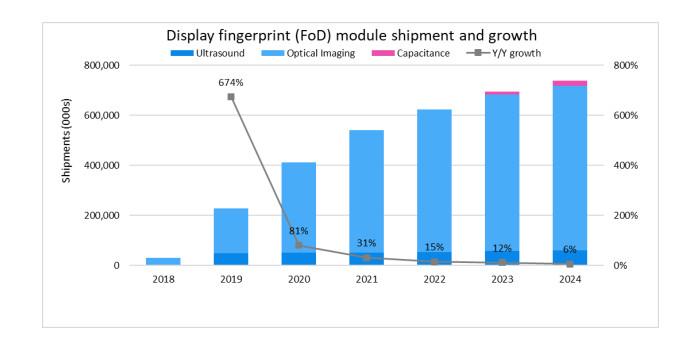
A total of 228.3 million FoD sensors were shipped in 2019, up 674 percent from 29.5 million in 2018, according to Omdia. Since FoD sensors have reached the sweet spot for pricing in the market, FoD shipments are expected to continue to increase at a tremendous pace in 2020, expanding to over 400 million units, as reported by the Omdia Display Fingerprint (FoD) Technology and Market Report – 2020.
"FoD sensors have become a critical biometric identification technology for smartphones," said Calvin Hsieh, director, touch and user interface at Omdia. "Today's smartphone screens are longer than ever, completely covering the front sides of phones and leaving no room to locate capacitive fingerprint sensor chips on the surface. FoD sensors avoid this problem because they are hidden under the screen, allowing them to avoid influencing the appearance of smartphones. This advantage is generating a massive growth in demand for FoD sensors."
In addition to Apple, most smartphone brands have adopted FoD as an advanced biometric identification technology to replace capacitive fingerprint chips. More than 70 smartphone models integrated FoD in 2019.
FoD can offer the same kind of fingerprint recognition user experience as capacitive chips, without requiring any learning. FoD's invisibility also gives smartphone manufacturers the freedom to offer a headset design without any notches. FoD technologies are mature and affordable, so the average selling price of an ASP fingerprint module can be as low as $3 to $4, which is more cost-effective than alternative 3D facial recognition technologies.
Major FoD technologies include optical image CMOS image sensor (CIS) and ultrasonic echo solutions. Samsung adopted Qualcomm's ultrasonic solution for the Galaxy S10, S20 and Note 10 series, but opted to use EgisTec's optical imaging CIS solution on the Galaxy A series.
Goodix is the leading provider of FoD solutions with a 50 percent market share. The company has benefited from sales to Chinese smartphone brands.
Optical imaging CIS solutions accounted for a shipping share of 79 percent of the FoD market, while ultrasonic focus occupied 21 percent of the market in 2019. Due to growing market demand and the entry of more vendors into the business, Omdia estimates that optical imaging CIS solutions will capture an 88 percent share of shipments in 2020. FoD solution providers also offer types of thinner microlenses FoD solutions, which can reduce the use of space to make room for greater battery capacity inside smartphones.