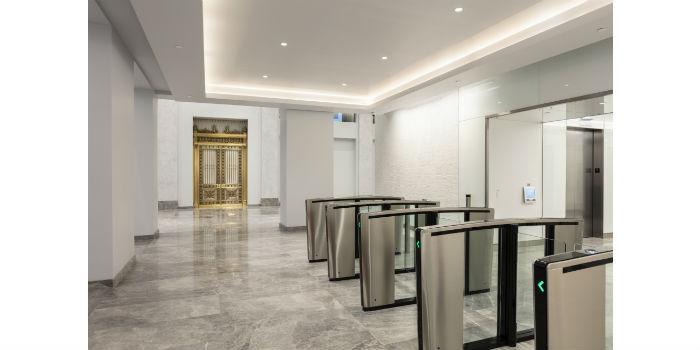
 United States. In the city of Boston there is a new town known as 33 Congress Street, located in the heart of the financial district, which combines the best of historic design with new construction.
33 Congress Street incorporates more than 400,000 square feet of offices and commercial space, transforming the historic neighborhood and positioning the area as a dynamic destination downtown.
The project was designed by Arrowstreet, an award-winning architecture and design firm, and was led by Jason King, AIA, LEED, AP, BD+C, Arrowstreet Senior Associate.
According to King, the 33 Congress Street building consisted of three different structures that were built at separate times: in 1904, 1906 and 1922, and then combined into a single space. While the space functioned as a single building, there were three separate elevator cores, bathroom sets, stairs, and more. Those entities needed to be reconfigured into one. The most striking feature of 33 Congress Street is a new, modern glass and steel structure, which contains six additional floors of office space that sit on top of the three original masonry buildings.
Another important goal of the project was to upgrade the main lobby to a modern design that would allow public access, increase safety for the building's employees, and respect various historical aspects.
"We needed a way to get people into the new main elevator lobby quickly because of the high volume of traffic we anticipated would take place after the redesign," King said. "We also wanted to create an entrance that would provide a better inflow from the sidewalk into the building."
The original building had an existing revolving door, but it was small and surrounded by stone. "It was dark and unattractive," King said. "We were creating an open and spacious space in the Class A lobby, and we wanted visitors to clearly see the ornate, coffered ceiling, and experience the grandiose and historic nature of the lobby upon entering."
The revolving door and the optical turnstiles
King implemented a Boon Edam Crystal TQ manual revolving door to guide visitors into the double-height lobby space. The Crystal TQ revolving door is virtually constructed of glass entirely, with only a few stainless steel accents to ensure the solidity of the revolving door. It fits perfectly into modern glass facades, but can also be an attraction for more traditional or classic designs.
For employee access, the previous building design did not incorporate turnstiles into the elevator bank. "The building had card reader access, but only at certain doors and locations," King said.
King installed four lanes of Boon Edam Lifeline Speedlane Swing optical turnstiles and two Winglock Swing model access doors to provide safe employee access to the upper floors of the building. The Lifeline Speedlane Swing turnstile manages and channels the flow of people coming in and moving around buildings. It employs sensors, which detect approaching visitors, with pulsating light strips to guide the user. A sleep function saves energy use. It can be customized with dimensional and glass options, including corporate identity colors or other options, to blend in or stand out from your environment.
Boon Edam's Swing Winglock is made of stainless steel and a single pane of glass, and is discreet in nature and design. The access door easily manages bidirectional traffic, with LED lights indicating whether the door is in use or waiting. The access door connects with a manned security desk, located near the front doors.
Employees gain access to the building through Lifeline turnstiles or a Winglock Swing gateway, while visitors to the building can receive credentials at the security desk.
King said: "We started the process by looking at Boon Edam from an aesthetic and safety point of view. We reviewed several product options, but we always had a Boon Edam product as the basis of the design. We are happy with Boon Edam's entry solutions and are planning to use them again for future projects."