 Mexico. According to data from the 2016 Traffic Index of the Mexican Institute for Competitiveness (IMCO), the inhabitants of Mexico City live more than 200 hours annually in the traffic of the city with the highest traffic congestion in the world.
This is highlighted by Francisco Ramírez, Country Manager for Mexico Central America and the Caribbean of the company Axis Communucations, who also states in a recent letter that the study was carried out with data from 174 cities in 38 different countries. Given this situation, it is of great importance to promote public transport as a favorable alternative to the use of the car, either because the citizen does not want to spend hours in traffic or because of the cost of fuel. Therefore, excellence in service quality is a key challenge for companies in the public transport sector and one of the main demands of users.
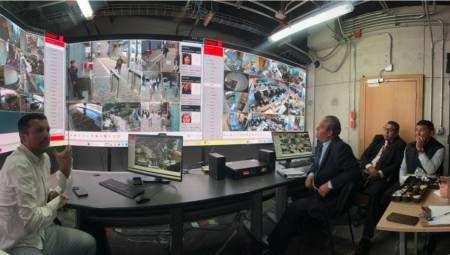
On the other hand, it is a fact that supplying a larger fleet would mean serving people more comfortably. But what if companies had the ability to know for which lines and at what times more vehicles are needed? Or, if they could see this data in real time and send additional vehicles for the busy stretches? The reality is that video surveillance cameras are beginning to be installed inside public transport around the world. Thanks to the use of digital equipment, which provides images through the network, administrators now have a new tool to improve the service, capable of counting the number of users in real time, reducing fraud and generating tests with high image quality.
The technology already allows cameras to be installed on buses near doors to count how many people get on and off the bus. In case the number is approximate to the limit, it is possible that the company automatically sends an empty vehicle for that line, avoiding overcrowding. In parallel, at the end of each month, this data is useful for the relocation of vehicles and redefine the regular supply of buses.
On the other hand, one of the most important elements for the promotion of the use of public transport in large cities focuses on the feeling of security of citizens. In this aspect, video surveillance technology helps prevent incidents of all kinds. When a dangerous situation occurs in the transit system, it is important to detect it in time and respond quickly. The main goals of incident management are to minimize impacts and not scale them unless necessary in order to utilize appropriate response resources. Thus , many thefts, robberies and assaults that occur inside the buses could be reduced thanks to the inhibitory power of these devices, which already have anti-vandalism protection. In these cases, the images of the crimes and crimes that occur before the cameras can be used to identify those responsible and provide video evidence with high image quality so that they can proceed in judicial decisions.
One of the most important video surveillance projects worldwide in buses is located in Madrid, Spain. The EMT company controls more than two thousand buses equipped with four or five Axis digital cameras each. The company accesses the images in real time, can communicate with the controllers, and all the images are sent to an alarm center. The cameras, resistant to vibrations and capable of operating at high temperatures, send two streams of video at the same time – they are used one, for live viewing and the other for high resolution that is only used in case of emergency. At this last point, the content will be downloaded via wi-fi when the bus arrives at the parking lot.