 Latin America. Large cities are constantly facing traffic problems due, among other factors, to the increasing use of private vehicles in front of public transport. This represents a great challenge for citizens to consider the latter as an economical, fast and safe option, and choose to move in short and medium distance buses.
Some newly developed technological innovations for trains and buses are presented as an opportunity for many cities to modernize their public transport systems. According to Resolution 374 of the Provincial Transport Agency of the province of Buenos Aires, which entered into force on January 1 of this year, all units must have at least one camera that allows monitoring what happens in it.
According to Juan Pablo Tavil, Sales Manager of Axis Communications for the Southern Cone, "large cities face the challenge of encouraging the use of public transport as a viable solution to growing traffic. For that, trains and buses have to offer security to avoid still common problems such as robberies or other types of crimes. That adoption depends on the maturity of society and the economy, but it also goes hand in hand with technology."
In this sense, technological development has allowed the creation of specific cameras for the transport sector, such as axis F Series, which are miniature cameras resistant to tremors, vibrations and shocks. In addition, they have Full HD resolution, electronic image stabilization and Wide Dynamic Range with Forensic Capture, which allows automatic compensation of abrupt variation in lighting, which is critical for means of transport.
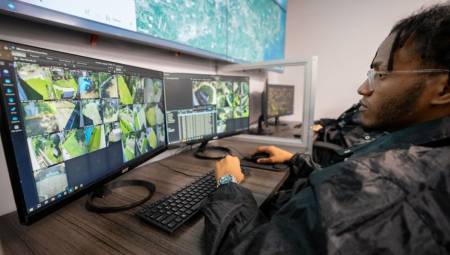
Recently, a group of companies including Axis Communications, Radwin and Innercalc introduced a smart bus that allows police to perform real-time monitoring, increasing oversight in the city. One of the cameras installed inside is equipped with a facial recognition system. When a passenger climbs up, the image of their face crosses over with a database, which can be a list of suspects used by the police. In case the faces match, a warning message appears on the cell phone with a photo, name and document number of the requested person, which allows the police to take immediate action.
These systems of live remote surveillance of moving spaces have shown in many cities around the world that it is possible to significantly reduce incidents and robberies, both at bus stops and inside them. And with the use of cameras that allow the counting of people, other aspects can also be defined, such as which are the points of greatest flow of users to be able to speed up the route and improve the service, record stops and unauthorized detours.